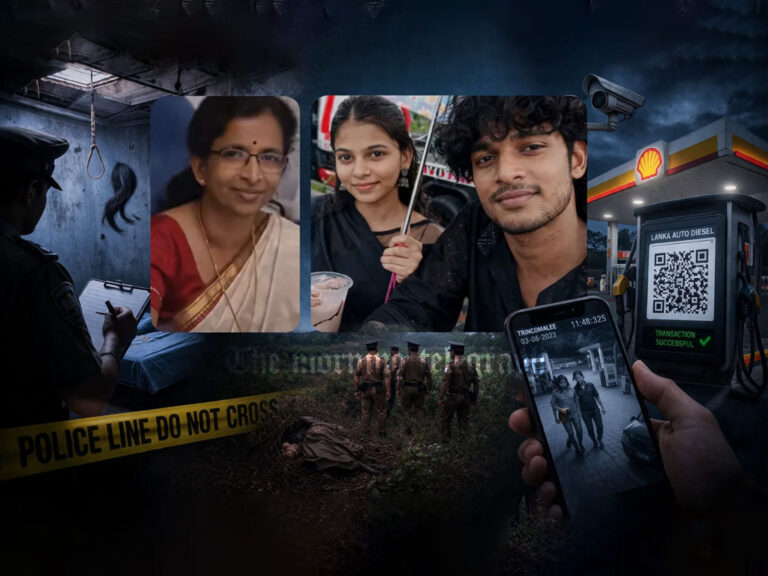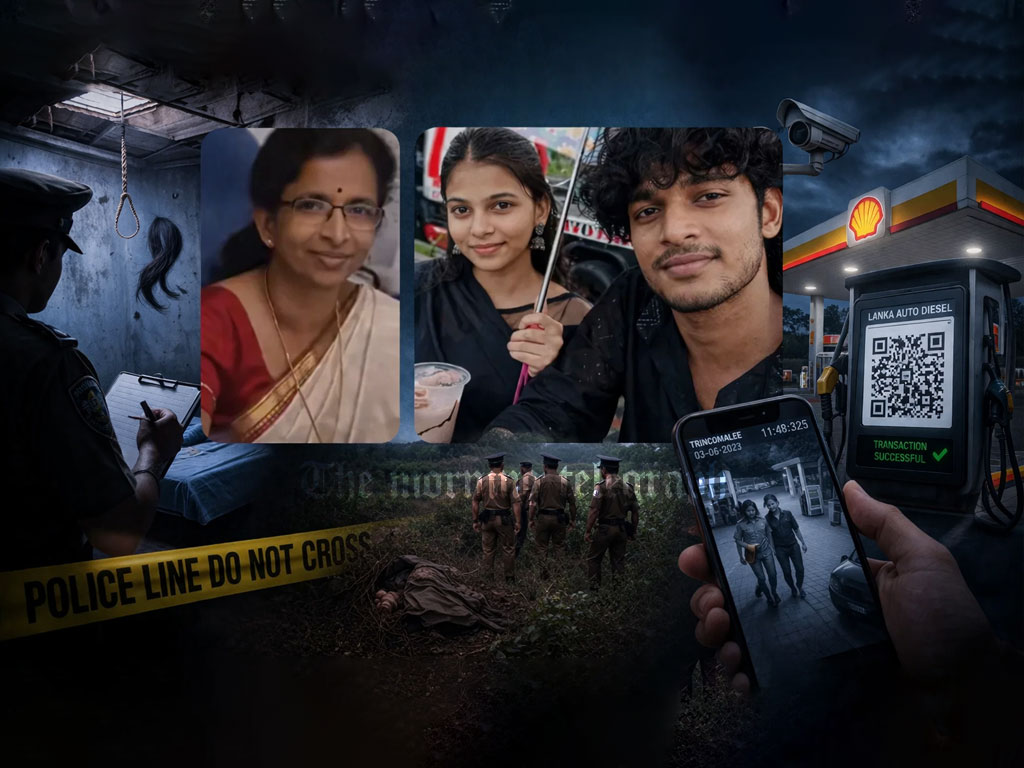
In a shocking Jaffna murder case, police used the QR code fuel tracking system and CCTV footage to trace a fugitive couple who killed a university lecturer, revealing how modern technology cracked a brutal family crime.
A brutal murder has sent shockwaves through Jaffna, where a 54 year old university lecturer was strangled to death by her own son-in-law while her daughter remained present at the crime scene. The victim, Thayarani Theepan, a lecturer at the University of Jaffna’s Faculty of Indigenous Medicine, lived with her daughter in Pandiyanthalvu after separating from her husband. Her son worked in Colombo.

The murder stemmed from a family dispute. The 19 year old daughter had entered into a registered marriage with a 21 year old young man, but the mother strongly disapproved of her son-in-law’s behavior. Acting on her mother’s advice, the daughter had filed for divorce, with the case pending in court. Previously, the magistrate had even issued an order prohibiting the suspect from entering the family home after he had caused disturbances.
The investigation began when the lecturer’s son reported both his mother and sister missing to Jaffna police. Officers inspecting the home discovered roof tiles removed with a rope suggesting entry, along with several cut locks of hair. The son then actively assisted the investigation by tracking his sister’s mobile phone locations and ATM withdrawals, providing crucial information to police.
Using this data, investigators confirmed that a vehicle had been refueled at a filling station in Trincomalee using the QR code fuel permit system. Jaffna District Crime Prevention police obtained CCTV footage from the station, which clearly identified the suspect son-in-law and his wife. The couple was apprehended in Trincomalee and brought back to Jaffna for questioning.
Initially, they revealed nothing about the mother’s whereabouts. However, after sustained interrogation in Jaffna, the daughter confessed that her husband had strangled her mother immediately after abducting her. Further investigation revealed that two gold ornaments belonging to the victim had been pawned in Trincomalee.
Following the daughter’s confession, police learned the body had been dumped in bushes near Navatkuli and Arakkukuli. Though initial searches proved difficult due to darkness, continued efforts eventually led to the discovery of the lecturer’s remains in a severely decomposed state.
Crime scene investigators, Jaffna Crime Prevention officers, and Judicial Medical Officer Dr. Pranavan Chelliah conducted on site examinations before the body was sent to Jaffna Teaching Hospital for postmortem. Without the son’s relentless efforts in providing mobile tracking data and ATM transaction information, the murder and body recovery might have been significantly delayed.
The Jaffna community, already living in fear due to a wave of drug related crimes, has been deeply traumatized by the brutal fate suffered by this respected academic. The case stands as a stark reminder of how modern technology, including the QR code fuel tracking system, can serve as a powerful tool in criminal investigations.