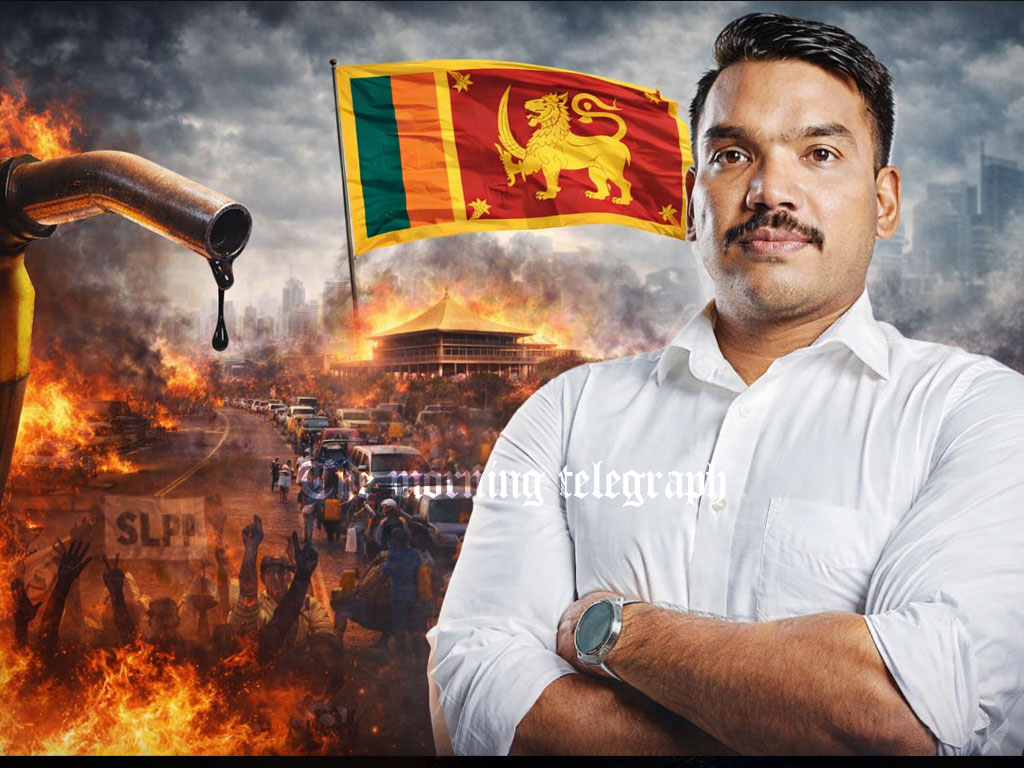
SLPP National Organizer Namal Rajapaksa launches a blistering attack on the government, accusing it of paying $45 above global market prices for diesel, undermining independent institutions, and failing to secure promised fuel deals from friendly nations while the nation faces an unprecedented energy crisis.
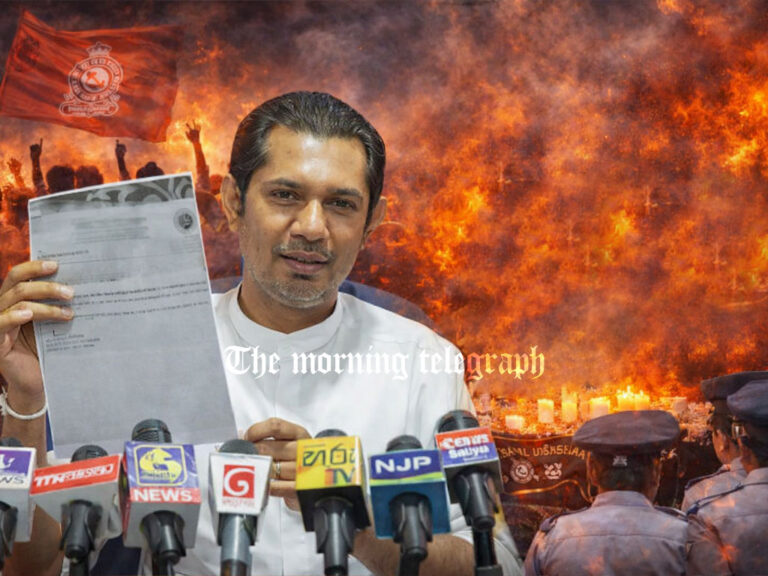
SLPP National Organizer and Member of Parliament Namal Rajapaksa has launched a scathing attack on the government over its handling of the escalating fuel crisis, questioning why Sri Lanka is unable to secure oil supplies from friendly nations that had previously pledged their support. Speaking to the media, Rajapaksa accused the government of paying $45 above global market prices for diesel while consistently failing to deliver on its promises to the people.

“The government is now buying diesel at $45 more than the international market price,” Rajapaksa stated. “Earlier they claimed they could negotiate with friendly countries and had the ability to obtain fuel at lower prices. Yet no effort has been made to do so. Instead, they deceive the public with one story while doing something else entirely. The people’s problems will not be solved by blaming us and throwing mud at us.”
Rajapaksa drew a sharp contrast between the government’s past rhetoric about recovering $18 billion allegedly stolen by the Rajapaksa family and its current economic management. “If you think you can manage by collecting twenty million rupees here and twenty million there, you will never recover that $18 billion, not in five years, not even in your next lifetime. The government talked about $18 billion. Now their path to recover that $18 billion is by collecting twenty million here and twenty million there.”
He accused the government of trying to cover up its incompetence by manufacturing false cases through supposedly independent institutions. “The government is clearly trying to hide its own inability. They are trying to prove their old lies through the courts or through institutions that claim to be independent in this country. That is why they intimidate people and force them to write statements. This is what this government learned from the previous Yahapalana regime, because the people who were in the anti-corruption committees during that time are now in this government.”
Rajapaksa expressed deep concern over the erosion of public trust in independent institutions. “My sadness is that the respect and trust people have for institutions that should protect the law and deliver justice to the people is being destroyed. The Inspector General of Police must decide whether he will continue to work as the police chief of the Malimawa government or whether he will work honestly as the police chief of Sri Lanka and deliver justice. If you go on collecting twenty million here and there, you will never recover that $18 billion.”
He questioned the government’s priorities, pointing to missed opportunities in renewable energy development. “In the past, when they tried to develop the Trincomalee oil tank farm, they opposed it. When they tried to bring the LNG power plant, they opposed it. When they tried to bring the wind power plant, they not only opposed it but cancelled the investment and sent the investor away. If they had at least built the 500 megawatt wind power plant by now, they wouldn’t need to raise electricity tariffs. It doesn’t matter which country the investor came from. Investment is investment. But they rejected the investor and sent them away.”
Rajapaksa also criticized the government’s handling of the coal procurement controversy. “Now the President spoke in Parliament about the coal scam, but didn’t say a single word about coal. The whole country and the world knows that substandard coal was imported. Ultimately, to cover the losses from that, they raise fuel prices and pass the burden onto the people. They raised electricity tariffs and made the people pay for that as well.”
He accused the government of creating a culture of intimidation within state institutions. “Where do we go now? If they are threatening responsible officers and forcing them to write statements, and if the Inspector General of Police is supporting this, and if the President and the government are backing it, where do we go? What institution is left for us to seek justice? That is why I am clearly saying that what they are doing is destroying the trust in these institutions.”
Rajapaksa raised concerns about a recent suicide case, alleging that the individual had been subjected to pressure until they took their own life. “There is also a case of someone who hanged themselves. They have been pressured to the point of suicide. They pushed him to the point of hanging himself. If they are now pressuring people within government institutions to fabricate false evidence, just like in 1988 and 1989, and trying to intimidate others, then who do we tell about the transparency of state institutions and independent institutions in this country? We will take legal action and inform every institution we need to inform. But ultimately, it is their own fabricated evidence that will be heard in the courts.”
Rajapaksa defended the legacy of former President Mahinda Rajapaksa, stating that he made decisions knowing the challenges they would bring and never regretted or backed down. “When the war ended, Mahinda Rajapaksa said in Parliament that not only for me, not only for my family, but even for my children’s children, the decisions we took would bring challenges. We took those decisions knowing that. Therefore, we have no regrets and we will not back down.”
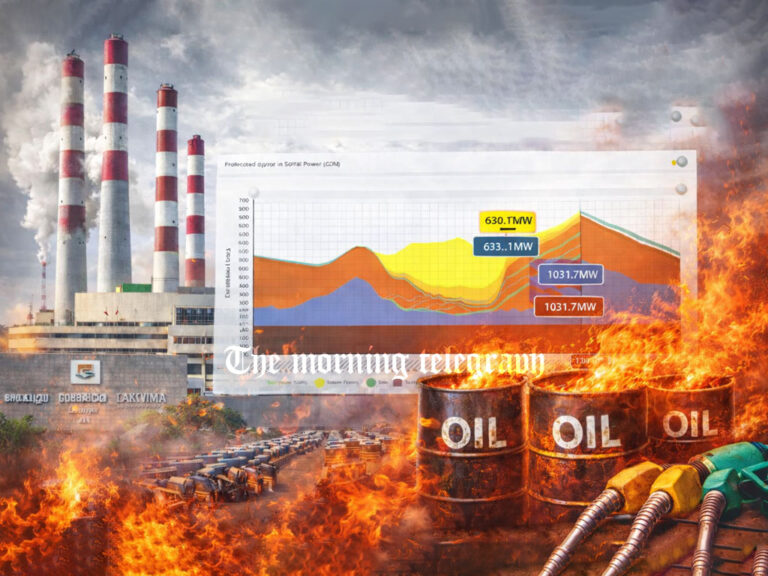
He questioned the government’s preparedness for the current crisis, noting that the administration had ample time to prepare but treated the situation as a joke. “The government had plenty of time to prepare for this. Every other country in the world prepared for this situation. When we raised this in Parliament, the government said they had 45 days of fuel reserves and there was no need to panic. But every other country prepared. Now the government is buying diesel at $45 above global market prices. That tells you everything about their preparedness.”
Rajapaksa also questioned the government’s handling of a recent submarine attack incident. “Regarding the submarine attack, the Navy spokesman first came and said this was not a submarine attack. A little while later, the US said it was a submarine attack. They also had discussions with one embassy regarding foreign employment. I won’t name the embassy. But a little later, they said they did not have such discussions. More recently, they had discussions with another embassy regarding fuel, and that embassy also said no such thing happened. I don’t know whether the President made this statement in good faith or whether he made it thinking that since no one understands Sinhala, no one would understand him. If the President genuinely made such a decision, that is good. But we will have to wait a few days to know the validity of that statement.”
He also addressed the issue of the US Agency for International Development and regime change. “It is clear that President Donald Trump himself made a statement that the USAID agency spent money to bring about regime change in the region. That is not Namal Rajapaksa’s statement. Scholars in this country have conducted research and published articles, written books, and produced documentary programs about such activities happening in this region. It is an open secret in the political landscape. President Donald Trump himself has said it publicly. If anyone says this will harm foreign relations because Namal Rajapaksa said it, they should take it up with President Trump. I am expressing my opinion.”
Turning to the government’s fuel price hike, Rajapaksa argued that reducing consumption is not the solution. “The government raises prices to reduce consumption. They don’t reduce queues by supplying fuel, they reduce queues by reducing consumption. But there is another side to this. The tourism industry will be severely hit, small and medium businesses will suffer, and farmers harvesting their crops will face a huge crisis. What is the government’s policy on fertilizer now? What is the alternative for fertilizer? Will they buy fertilizer by paying several dollars more like they paid $45 more for diesel, or have they negotiated with a friendly country? What is the price the government will pay for paddy? What is the system to buy paddy fairly from farmers, or will they continue to allow only a few businessmen to purchase it as was done in the previous season? These are matters the government needs to find solutions for and prepare for.”
Rajapaksa concluded by taking a swipe at the government’s past rhetoric about setting Parliament on fire. “Those who used to say Parliament should be set on fire, who invited the people of this country to set Parliament on fire, now sit in Parliament. When you come to the place you wanted to burn, how can you have respect? Parliament is the supreme institution of this country. For those who came to set it on fire, that is what Parliament means to them. What can you do?”
He called on the government to make maximum use of the Port City and Mattala International Airport, noting that Dubai and Middle Eastern investors are currently looking for new banking hubs. “The Colombo Port City was built to become a banking hub. Now is the time to use it. Give tax concessions to investors. At least exempt foreign income from taxes. Make use of the geographic advantage Sri Lanka has. Mattala Airport is also attracting global attention. Negotiate with those airlines. In another year or a few months, they will find alternatives. Before they find alternatives, we must make maximum use of the advantage we have with our Port City, Mattala International Airport, and Sri Lanka’s geographic location. So it would be good if the government starts working now.”