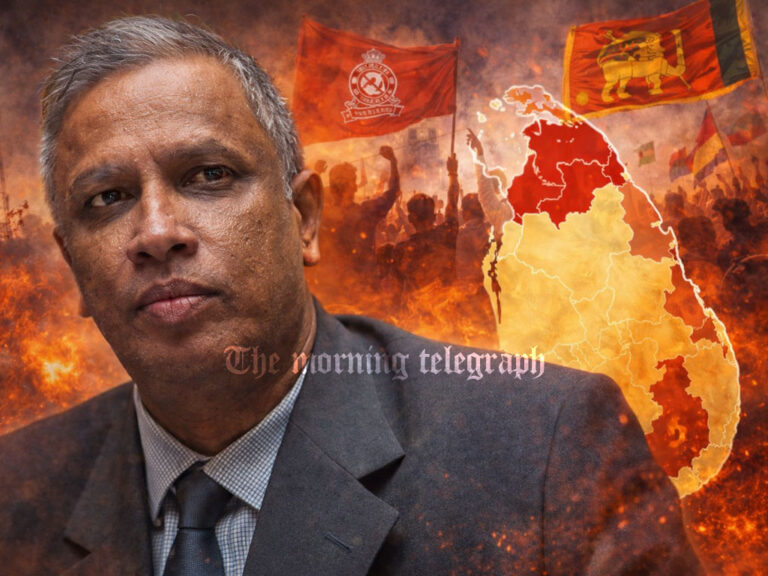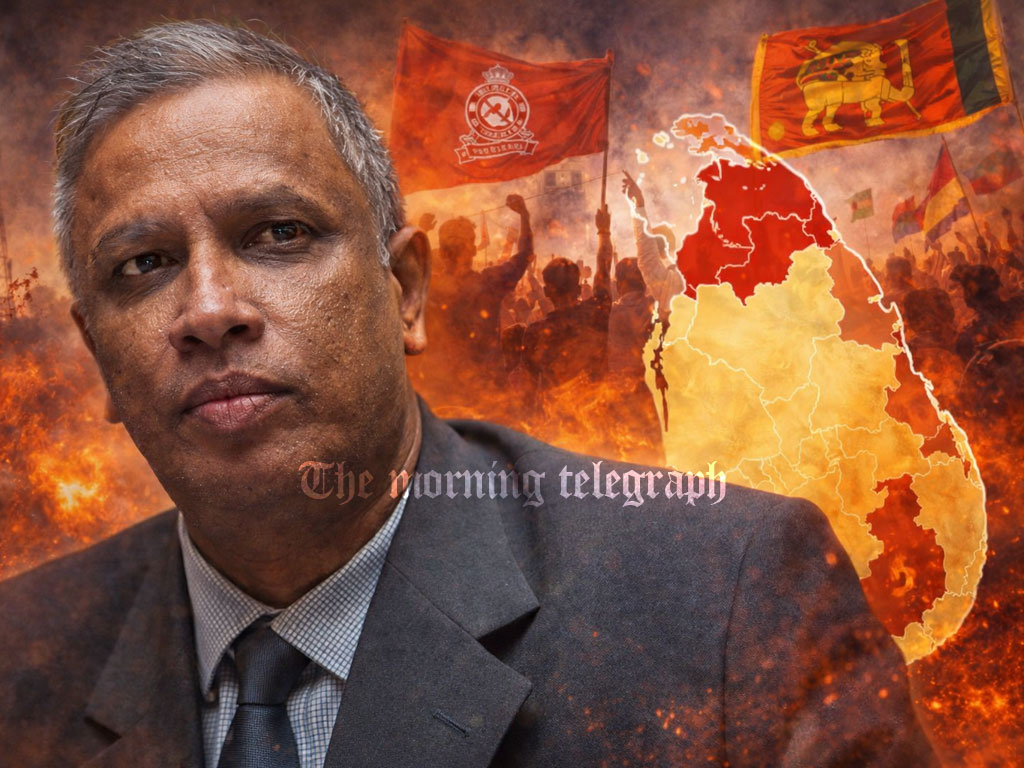
Senior Tamil leader M.A. Sumanthiran warns that Sri Lanka risks drifting into a one-party state under the JVP-led government, alleging parallel power structures in the North, rising political centralization, and growing resistance to democratic co-existence.
Sri Lanka is facing a growing risk of evolving into a one-party state under the dominance of a Marxist-led administration, according to M. A. Sumanthiran, Acting General Secretary of the Ilankai Tamil Arasu Kachchi. He cautioned that the current political direction could reshape governance structures across the country, particularly in the Tamil-majority Northern Province where new mechanisms of authority are already taking root.

Speaking during a visit to New Delhi, Sumanthiran stated that the concern extends beyond ethnic or regional politics and reflects a broader national challenge. He described the situation as serious and warned that the Janatha Vimukthi Peramuna is gradually moving toward consolidating power in a manner that could weaken democratic pluralism and institutional balance within Sri Lanka’s political system.
He observed that while President Anura Dissanayake appears pragmatic and open to dialogue, he is increasingly influenced by individuals within his political circle who hold rigid ideological positions. According to Sumanthiran, these hardline elements are resistant to political cohabitation and engagement with opposing parties, particularly after the government secured a two-thirds parliamentary majority.
Sumanthiran pointed to the implementation of the Praja Shakthi anti-poverty programme as an example of how governance is being reshaped at the grassroots level. He claimed that the programme is being administered through selected representatives rather than established local institutions, effectively bypassing elected bodies and altering the traditional framework of public administration in Sri Lanka.
Concerns raised by civil society groups, legal professionals, and community leaders in the Northern Province further support this view. These stakeholders have alleged that political forces aligned with the ruling party are limiting independent civic initiatives that operate outside their influence, raising questions about transparency, accountability, and participatory governance.
He also highlighted the appointment of five Members of Parliament to function in roles similar to shadow ministers within the region. According to Sumanthiran, this move undermines the authority of the Northern Provincial Council, which has not held elections for several years, and reflects a broader attempt to centralize power within the national political framework.
Recent remarks by a senior figure within the ruling party have intensified these concerns. The statement suggesting a shift from holding government power to seeking full state power has been interpreted by critics as an indication of ambitions to dominate all aspects of governance, potentially reducing political competition and diversity.
Drawing on historical context, Sumanthiran recalled a warning issued in 1971 by S. J. V. Chelvanayakam, who emphasized support for socialist principles while rejecting the concept of one-party rule. This perspective, he suggested, remains relevant today as Sri Lanka navigates complex political and economic challenges.
Despite the current situation, Sumanthiran expressed confidence in the future of the Ilankai Tamil Arasu Kachchi. He noted that while the JVP gained ground in the Tamil-majority North during parliamentary elections, local government election outcomes indicate a renewed shift toward traditional Tamil political parties.
He stated that the ITAK now controls a significant majority of local bodies in the North and East, positioning the party to regain influence in upcoming provincial council elections. He also indicated his own interest in contesting for a chief ministerial role, while acknowledging that governance in the Eastern Province would require collaboration with Muslim political parties.
Reflecting on his long-standing relationship with President Dissanayake, Sumanthiran revealed that their engagement spans nearly 15 years. However, he admitted that this relationship has weakened in recent times due to diverging political priorities and ideological differences.
He clarified that although the President remains open to revisiting established policies, internal resistance within the ruling party limits opportunities for meaningful collaboration. This tension has become more pronounced following the government’s strong electoral mandate, which has reinforced its confidence in pursuing its own political agenda.
Addressing speculation regarding an offer to serve as Justice Minister, Sumanthiran explained that the proposal was made prior to the presidential election. He declined the offer in line with his party’s decision not to support Dissanayake, a move that reportedly strained their relationship at the time.
Sumanthiran emphasized that he continues to engage constructively with the President and remains willing to contribute to national initiatives such as constitutional reform if invited. However, he acknowledged that both sides are gradually moving apart due to fundamental disagreements on key national issues.
He identified the Tamil question as a central point of divergence between the JVP and Tamil political parties. According to him, these differences make it difficult for Tamil leaders to align publicly with the government, particularly when they are also competing for political influence in the North and East.
Sumanthiran reiterated his long-standing opposition to violence, stating that while past armed struggles may have emerged under specific historical conditions, the path forward must be rooted in political dialogue and democratic engagement involving all communities in Sri Lanka.
He also expressed concern over certain narratives within Tamil political discourse, arguing that rhetoric surrounding separatism and self-determination is no longer constructive in the current context. Such language, he said, risks alienating broader segments of the population and undermining efforts toward reconciliation.
He stressed that meaningful progress on national issues can only be achieved with the consent and participation of the Sinhalese majority. Building trust and avoiding divisive messaging, he noted, are essential steps toward achieving lasting political solutions and national unity.
According to Sumanthiran, continued emphasis on concepts that are viewed unfavorably by both Sinhalese and Tamil-speaking Muslim communities has contributed to shifting political dynamics. This has, in part, enabled the JVP to expand its influence in traditionally Tamil regions, including Jaffna.
During his visit to India, Sumanthiran participated in engagements organized by the Bar Association of India alongside a delegation from the Bar Association of Sri Lanka. The group was received at the Supreme Court of India, where discussions were held with senior members of the Indian judiciary.
Following the conclusion of official meetings, Sumanthiran shared his views in an interview, reflecting on both domestic political developments and the broader direction of governance in Sri Lanka. His remarks highlight growing concerns about democratic institutions, political balance, and the evolving nature of power in the country.