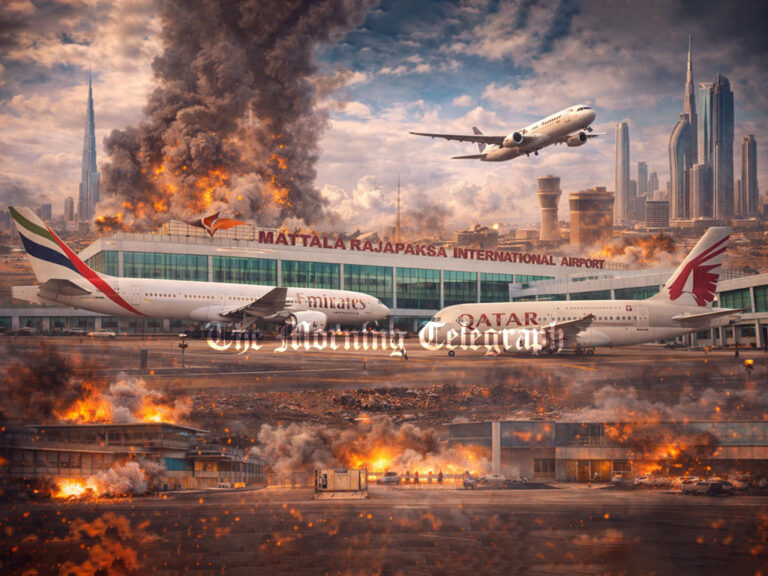
Sri Lanka moves to transform Mattala Airport into a strategic global transit hub as Gulf carriers explore emergency alternatives amid Middle East airspace shutdowns and aviation chaos.
With a high level field visit scheduled for next week, the Sri Lankan government is accelerating talks with leading Gulf carriers to position Mattala Rajapaksa International Airport as an alternative transit hub, as global aviation routes face disruption due to escalating Middle East tensions.
Following a key meeting earlier this week, Aviation Minister Bimal Rathnayake formally invited major airlines to inspect the Mattala facility, aiming to leverage the sudden shift in global aviation logistics and reposition Sri Lanka within international air travel networks.

Tourism and aviation authorities confirmed that Emirates, Qatar Airways, and other Middle Eastern airlines have already shown strong interest in relocating part of their transit operations, reflecting growing demand for stable and secure aviation hubs.
Deputy Minister of Ports and Aviation Ruwan Kodithuwakku revealed that a major condition has emerged during early discussions, with airlines requesting permission to operate through Mattala without paying landing fees, highlighting the competitive pressures within the aviation sector.
This development comes as global air travel systems experience severe strain, driven by a sharp increase in demand for alternative routes and emergency repatriation flights. The surge is directly linked to the conflict that erupted in late February 2026, which has triggered one of the most significant disruptions in modern aviation history.
The crisis has led to the closure or restriction of civilian airspace across Iran, Iraq, Israel, Qatar, and parts of the United Arab Emirates. As a result, major global aviation hubs such as Dubai, Doha, and Abu Dhabi have been forced to either suspend or drastically reduce operations, creating a massive gap in east west transit connectivity.
Aviation analyst Ben Schlappig commented on the proposal, describing the concept of using Mattala as an alternative hub as a practical and innovative approach. Writing on One Mile at a Time, he noted that a large and underutilised airport with a strategic geographic location offers a viable solution for airlines navigating operational uncertainty.
However, he also highlighted several challenges that must be addressed, including the rapid expansion of ground handling services, the availability of aviation fuel, and the development of supporting infrastructure to handle increased traffic.
Industry experts point out that Mattala holds a unique geographical advantage in the current environment. Located in southeastern Sri Lanka, the airport sits directly along major Indian Ocean aviation corridors connecting Europe, Southeast Asia, and Australia, making it an ideal transit point.
Crucially, Mattala is positioned well outside the conflict affected airspace of the Persian Gulf and Arabian Peninsula, providing airlines with a safer and more stable route option. Its 3500 metre runway is capable of handling the largest wide body aircraft, including fleets operated by Emirates and Qatar Airways.
The airport has also demonstrated improving operational readiness, recording its highest passenger traffic in 2025 with over 140614 passengers and 703 international flights, indicating its potential to scale up operations if required.
Meanwhile, SriLankan Airlines is facing mounting pressure as it struggles to compensate for the reduced capacity of Middle Eastern carriers. The national airline has already maximised the use of its wide body Airbus A330 fleet to maintain essential routes to Europe and Australia.
Flights to major destinations such as London, Paris, and Frankfurt are operating at full capacity, leaving no room for additional transit passengers. The airline’s smaller A320 aircraft are not suitable for long haul operations, limiting its ability to bridge the gap created by the disruption.
In the wider regional landscape, Turkish Airlines has emerged as the only fully operational transit hub connecting Europe and Asia, as Istanbul remains unaffected by the airspace closures. This has positioned Turkey as a critical player in global aviation during the crisis.