The disorder we see in the world is not created only by those in power, but also sustained through the fears, silences, habits, and contradictions woven into ordinary human life.
By Roshan Jayasinghe
When I look at the world as it stands today, I cannot honestly place all of its disorder in the hands of politicians, governments, corporations, billionaires, and institutions of power and then quietly excuse the rest of us as though we are merely helpless observers. That would make the matter too simple, and the condition of human life is never that simple. There are indeed those with enormous power, and with that power comes a scale of responsibility far greater than what the ordinary person carries in daily life. A government can direct the movement of a nation. A corporation can shape appetite, dependency, and attention in millions. Powerful interests can influence the rhythm of ordinary life without ever meeting the human beings whose lives are affected by their decisions. All of this is true and should be seen clearly. But even with that truth standing where it does, I do not feel the rest of us can say the state of the world has nothing to do with us.

The discomfort begins there, because most of us are inside it. We move through it every day. We depend on it, make use of it, resist parts of it, complain about parts of it, benefit from it at times, suffer from it at others, and in ways we rarely like to admit, continue helping it remain exactly as it is. We speak against greed while still being drawn toward comfort, convenience, and consumption. We criticize systems of exploitation while depending on the ease they provide. We say we want peace, dignity, justice, and truth, yet many of us continue living in habits of imitation, silence, fear, compromise, and self-protection that keep feeding the very roots of what we claim to oppose. This is not written to condemn the ordinary person. Human life is more burdened and more entangled than easy moral language allows. Many are exhausted. Many are struggling. Many are simply trying to survive. Many have inherited ways of living without ever being invited to look deeply into what those ways are creating. But even so, participation remains participation.
What holds my attention is not the drama of accusation. It is the quieter and more serious matter of how the world keeps becoming what it is. The condition of the world did not arrive here by itself. It is being shaped and reshaped through human beings every day through our fears, ambitions, loyalties, appetites, silences, conveniences, denials, and what we quietly agree to treat as normal. Society is not separate from us. It is made of us. Politics is not floating above human life. Economics is not detached from human desire. Institutions are not creatures of nature. They are organized expressions of the human condition, and whatever is active in the human being will eventually show itself in the structures human beings create.
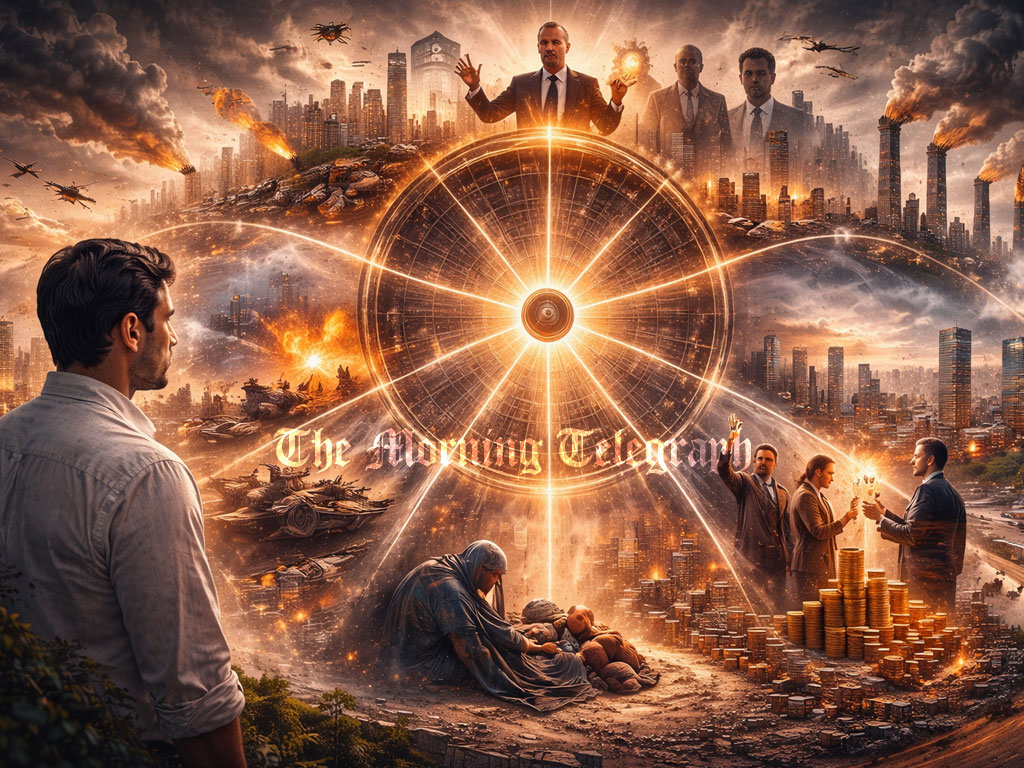
This is why I often return to simple images from life itself, because sometimes an ordinary image reveals more than a complicated explanation. When I think of the world, I think of a wheel. The first thing we usually notice is the tire, because it is what meets the road. It takes the friction, absorbs the shocks, and allows the movement to continue over rough ground. But the tire is not the whole wheel. There is the rim holding the shape. There are the spokes carrying and distributing the tension. And at the center there is the hub, the quiet point through which the whole structure turns. If the tire alone is damaged, we see it quickly. But if the rim is bent, if the spokes weaken, or if the hub is compromised, then the whole wheel is already unstable even if it still appears to be moving.
I feel that much of our way of looking at the world stops at the tire. We react to the visible event, the war, the scandal, the politician, the policy, the corporation, the public failure, the latest crisis. All of these matter, but they are not the whole wheel. Beneath what is visible there are deeper tensions holding the structure together. There are the spokes of fear, comparison, insecurity, greed, ambition, tribal loyalty, resentment, image, and the endless human effort to become more in order not to feel less. And there is the hub, the inner condition from which all this movement turns. If the center of human life is disturbed, then what is built from that center will carry the same disturbance outward. If fear sits at the hub, then fear will find its way into politics. If greed sits at the hub, then taking more than is needed will become an economic virtue. If insecurity sits at the hub, then power, domination, image, and control will be mistaken for strength.
That is why I do not feel the state of the world can be understood only through public events. It has to be understood through the human being. The disorder outside is not separate from the disorder inside. The violence that becomes visible in the world does not come from nowhere. The corruption we condemn in institutions is not born in some different universe from the self-interest, fear, and quiet dishonesty that human beings live with every day. What appears in public life often has private roots. What becomes global disorder usually begins in smaller fields of confusion, division, hurt, imitation, and appetite carried within human lives and then magnified through systems.
This is also why responsibility has to be looked at intelligently. It would be false to say that every person carries the same weight of responsibility for the state of the world. That is clearly not true. A child born into hardship, a laborer struggling to live, and a head of state deciding the fate of millions do not stand in the same place. Power increases consequence, and consequence increases responsibility. Those with greater reach carry heavier weight. That must be seen without hesitation. But even after saying that, I do not feel the ordinary human being can honestly claim no responsibility at all. The collective is made of individuals. The world does not only happen to us. It also happens through us.
That changes the inquiry completely, because it no longer allows a comfortable distance from which to judge. It asks something much closer and much harder. In what way am I participating in the making of the world I say I do not want to live in. In what way am I feeding what I condemn. Where am I silent because silence protects my comfort. Where do I excuse what I know is harmful because it suits my convenience. Where have I handed my conscience over to custom, habit, fear, or the crowd. These are not easy questions, but they are living questions. They move the matter out of performance and into reality.
I do not think true responsibility begins in guilt. Guilt can quickly become another image of the self, another drama, another way of appearing morally troubled without allowing anything deeper to change. Real responsibility begins in observation. It begins when a human being can see clearly that contradiction is present. We are entangled in much of what we criticize. But to see the entanglement without turning away is already a movement of intelligence. To deny it is to remain trapped inside it while pretending otherwise. The one who can see his own participation honestly is in a very different place from the one who points endlessly outward while refusing to look inward.
Silence too has to be seen more carefully. Silence is often mistaken for neutrality, but silence is not always innocent. Silence can become shelter. When exploitation becomes normal and people say nothing because they do not want discomfort, the roots deepen. When dishonesty settles into ordinary life and people quietly adapt, the dishonesty gains ground. When cruelty continues unchallenged because speaking carries risk, silence itself begins helping to hold the structure in place. To speak may bring criticism, anger, ridicule, or misunderstanding. But silence also has consequences. Silence shapes the world as surely as speech does.
I do not believe the answer is for each person to try to stand outside all contradiction and present himself as pure. That too can become another illusion, another image, another form of self-protection. Human life is too interwoven for that kind of innocence. The deeper work is to become conscious within the life one is already living. To see what one is part of. To reduce harm where one can. To stop blindly strengthening what degrades life. To question what has long been accepted simply because it is familiar. To understand that home, school, work, religion, politics, market, media, and the wider world are not separate compartments. The same human being moves through all of them. The same fear, the same tenderness, the same confusion, the same love, the same greed, the same possibility for awareness moves through these different spaces and gives them their character.
This is why I cannot separate the state of the world from the state of the human being. The world is not only out there in institutions and public events. It is also here in the way we speak to one another, in how we use the little power available to us, in how we raise children, in what we excuse, in what we normalize, in the loyalties we cling to, in the truths we avoid, and in the gap between what we say matters and how we actually live. What becomes visible as disorder on a large scale usually began much closer to home.
So when I ask whether we are all responsible for the state of the world, I do not ask it as a slogan. I ask it because I do not see how a different world can emerge unless we understand how this one is continuously sustained. Yes, some carry much heavier responsibility because they hold greater power. Yes, systems matter. Yes, institutions matter. Yes, leadership matters. But none of us can honestly say we are completely outside the field from which this world keeps arising. Each of us contributes something to it through action, silence, fear, courage, blindness, awareness, care, indifference, and the quality of consciousness we bring into daily life.
That, to me, is where a different kind of responsibility begins. Not in blame. Not in self-punishment. Not in moral theatre. It begins in the difficult simplicity of seeing that the roots of the world are not somewhere far away. They run through human life itself. Through you, through me, through all of us. And if the roots remain untouched, then the branches we complain about will continue to grow in the same direction no matter how often we cut at the surface.
The clarity I come upon through observation, I try to place into words, so that those who read may not merely agree or disagree, but look for themselves. And if that looking brings clearer thought, deeper reflection, and a more natural human alignment, then the writing has served its purpose in some small but meaningful way.
Author’s Note:
I do not write to persuade as much as I write to place what has become clear before the reader. What each person sees in it is their own. If these words open even a small space for reflection, honesty, and a more careful way of living, that is enough.
About the Author
Roshan Jayasinghe is a writer and observer of human systems. His work explores the gap between man made constructs and lived humanity, with a focus on how economics, trade and everyday choices intersect with questions of fairness, responsibility and inner alignment. Through essays for publications in The Morning Telegraph, he aims to remind readers that they are not passengers in a fixed machine, but active custodians of a shared world.