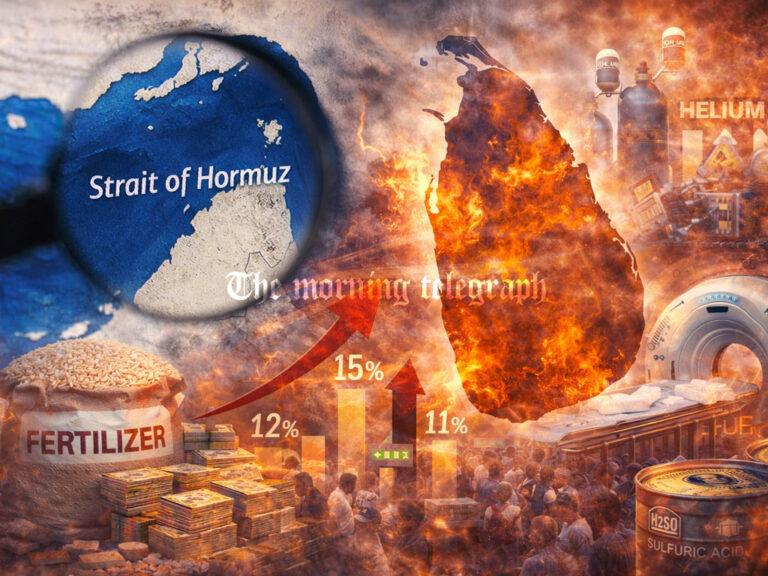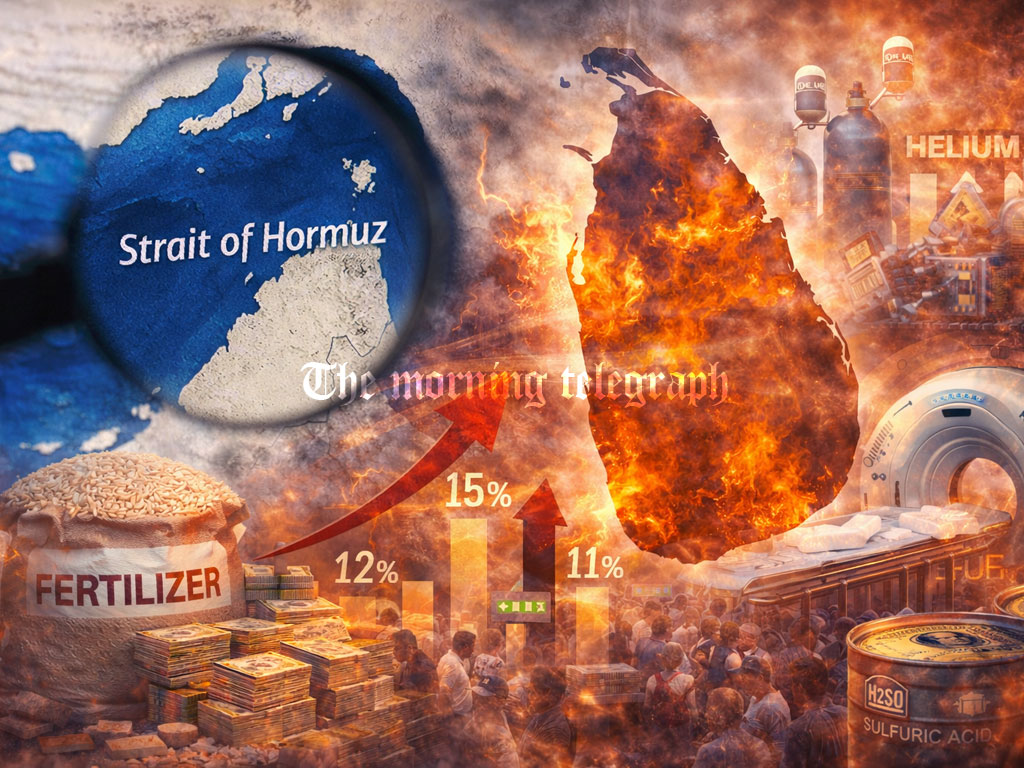
Research reveals that Sri Lanka would be the second worst affected country globally if the Strait of Hormuz is fully closed, with potential food price hikes of 15 percent, as the Iran conflict disrupts shipments of fertilizer, helium, petrochemicals, and sulfur essential for agriculture, medicine, and technology.
The disruption to fuel and gas shipments through the Strait of Hormuz due to the US-Israel war against Iran has caused global energy prices to spike sharply. Consequently, fuel prices have soared in many countries, including Sri Lanka.
However, the impact of the conflict extends far beyond fuel. The Strait of Hormuz serves as a critical artery for international supply chains, carrying a vast array of essential chemicals and goods. Daily shipping traffic through the strait has plummeted from over 100 vessels to just a handful. This has the potential to drive up prices for goods ranging from food and smartphones to medicine.

According to research by the Kiel Institute, if the Strait of Hormuz were to be fully closed, Sri Lanka would be the second most vulnerable country in the world to commodity price hikes.
Fertilizer and Food Security
Fertilizer is a key agricultural input produced from petrochemicals, and Gulf states are major exporters. According to the United Nations, roughly one third of global fertilizer needs, including urea, potash, ammonia, and phosphate, typically pass through the Strait of Hormuz. Data from the World Trade Organization indicates that fertilizer-related exports through the strait have been severely disrupted since the conflict began.
As March and April are the main planting seasons in the northern hemisphere, analysts warn that a fertilizer shortage could severely damage agriculture. Reduced fertilizer use could lead to lower crop yields later in the year. Researchers at the Kiel Institute note that even a relatively short closure could disrupt an entire growing season, with impacts on food security lasting long after the strait is reopened. Their research suggests that a full closure could raise global wheat prices by 4.2 percent and fruit and vegetable prices by 5.2 percent.
Estimates indicate that the countries worst affected by overall food price increases would be Zambia at 31 percent, Sri Lanka at 15 percent, Taiwan at 12 percent, and Pakistan at 11 percent. While Russia typically supplies about one fifth of global fertilizer exports, analysts say it could increase production to fill the gap. Russian special envoy Kirill Dmitriev noted that his country is well positioned as a major fertilizer producer.
Helium and Microchips
About one third of global helium shipments typically come from Qatar and pass through the Strait of Hormuz. Helium, a byproduct of natural gas production, is used to cool magnets in MRI scanners in hospitals and is essential for manufacturing semiconductor wafers used in computers, cars, and home appliances.
Following Iranian missile and drone attacks, Qatar’s Ras Laffan industrial complex has halted production. Qatari authorities warn that repairs could take three to five years, raising supply concerns. In 2023, the US Semiconductor Industry Association warned that a global helium supply disruption could drive up prices. Analysts warn that a Hormuz blockade could raise costs for a wide range of advanced technology products, from smartphones to data centers.
Prashant Yadav, a senior fellow on global health at the Council on Foreign Relations, warned of the impact on medical research. “MRI machines require 1,500 to 2,000 liters of helium to cool their magnets. With every scan, a small amount is lost or evaporates,” he told the BBC. “People like to think helium is mainly used for cooling data centers, semiconductors, AI, and the data industry. But we cannot forget that helium is critically important for MRI and other medical applications.”
Petrochemicals and Pharmaceuticals
Petrochemical derivatives such as methanol and ethylene are key raw materials for painkillers, antibiotics, and vaccines worldwide. Gulf Cooperation Council countries, including Saudi Arabia, Qatar, Oman, the UAE, Kuwait, and Bahrain, account for about 6 percent of global petrochemical production capacity. They export large quantities of these chemicals, primarily through the Strait of Hormuz, with about half destined for Asia.
India produces about one fifth of the world’s generic drug exports, most of which go to the US and Europe. Many of these pharmaceutical products typically reach global markets via Gulf hub airports, especially through Dubai. Flights through these hubs have been severely disrupted by the conflict, raising the possibility of higher drug prices.
Sulfur and Battery Production
Sulfur, another byproduct of oil and gas processing, is produced in large quantities by Gulf states. About half of global seaborne sulfur trade typically passes through the Strait of Hormuz. While its primary use is in fertilizer production, sulfur is also essential for metal processing. It is used to produce sulfuric acid, which is needed to process copper, cobalt, and nickel, and for lithium extraction. These metals are essential for battery production used in everything from household appliances to electric vehicles and drones. Analysts warn that a prolonged sulfur supply disruption could lead to higher prices for battery-powered products.