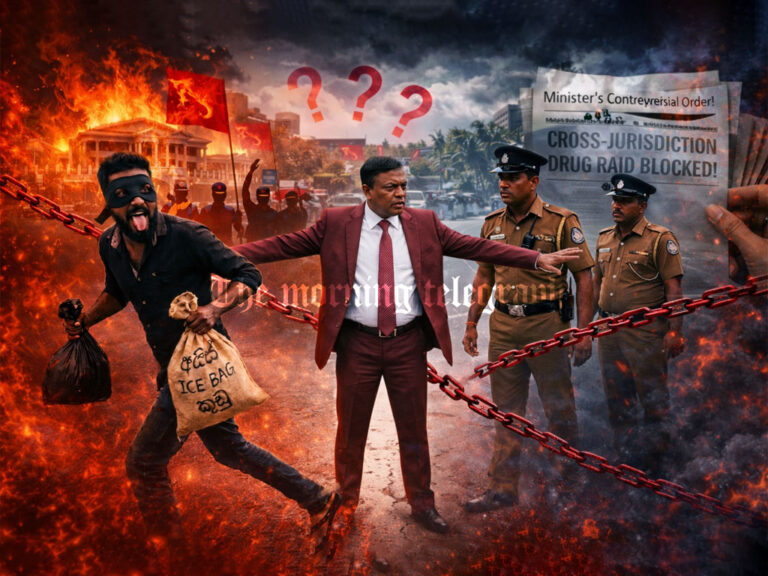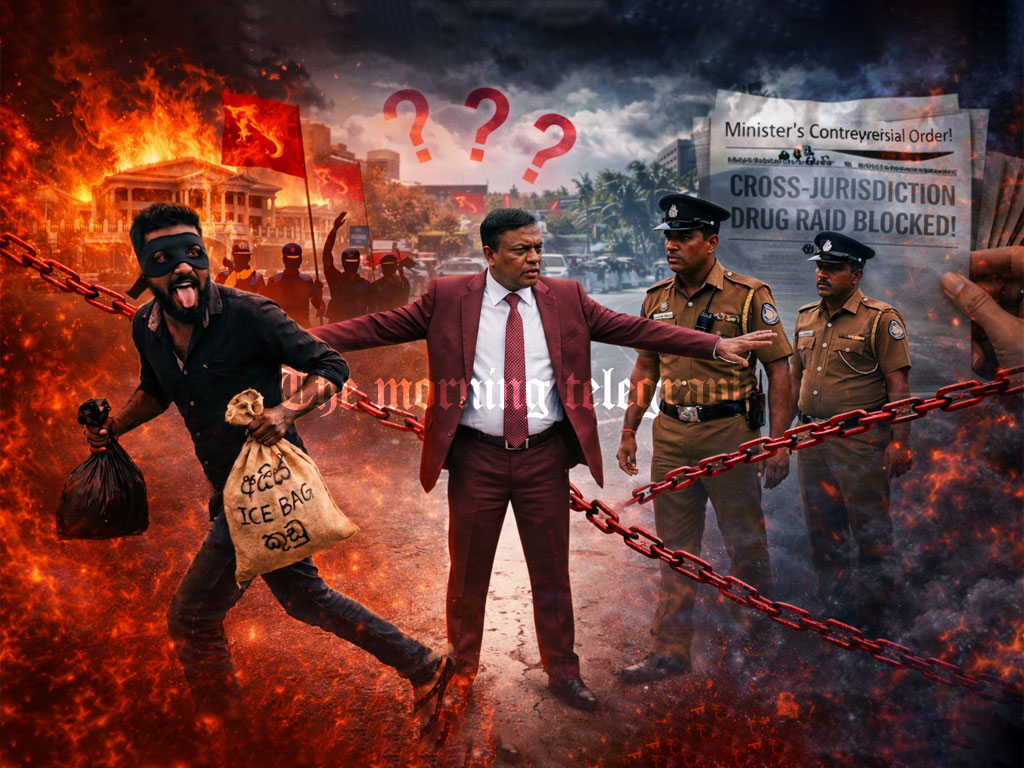
A controversial directive by Deputy Minister Sunil Watagala restricting cross-division drug raids ignites nationwide concern over political interference, police authority, and the growing influence of grassroots power structures.
The public recently witnessed, through televised coverage, Deputy Minister of Public Security Sunil Watagala issuing a directive to the Sri Lanka Police, instructing officers not to carry out drug raids outside their officially assigned divisions. This order followed a complaint submitted to a Public Security Committee regarding a successful drug raid conducted by officers from a different police division.

This development presents a deeply troubling situation. At a time when the country is grappling with war pressures, rising fuel costs, and increasing food insecurity, such critical governance issues risk being overlooked. The Deputy Minister’s tone and manner did not reflect a simple administrative concern, but rather conveyed a sense of authority that bordered on intimidation. Notably, this came from the very individual entrusted with oversight of the national police force.
The incident that triggered this controversy involved two police officers from an external division who apprehended a suspect in the Maharagama Pannipitiya area while in possession of illegal narcotics. Importantly, the Deputy Minister himself acknowledged that drugs were indeed found on the suspect at the time of arrest.
This situation gives rise to a series of serious and pressing questions. Who exactly constitutes these Public Security Committees? Reports circulating on social media suggest that grassroots members affiliated with the Janatha Vimukthi Peramuna have assumed significant influence within these bodies. Observers have also pointed out that the structure of these committees bears resemblance to local organizational frameworks seen during the late 1980s, a period historically associated with unrest and violence. It is alleged that these committees are largely composed of local JVP cadres.
The original intention behind establishing Public Security Committees was to assist and support the Sri Lanka Police at the community level, not to exercise control over their operational decisions. In practice, however, the relationship between local politicians, law enforcement, and criminal elements can become complex and, at times, counterproductive to effective crime prevention. This is precisely why specialized units such as the Panadura Walana Anti Corruption Strike Force were created, with the authority to operate across jurisdictions and tackle serious criminal activity without local interference.
While coordination with local police stations may serve administrative purposes, it becomes problematic if such coordination ends up shielding offenders from justice. If criminals benefit from jurisdictional restrictions, then the effectiveness of law enforcement is fundamentally compromised.
The directive issued by Deputy Minister Watagala raises several critical concerns:
Are Public Security Committees, reportedly influenced by local JVP cadres, being elevated above the constitutional authority of the Sri Lanka Police?
Should operational decisions of the police be dictated by politically influenced committees at the grassroots level?
If the suspect was indeed found in possession of narcotics, what prompted such a strong reaction from Deputy Minister Sunil Watagala?
Is there any underlying connection between the suspect, the Deputy Minister, and members of the Public Security Committee?
What explains the visible agitation displayed by the Deputy Minister during the incident?
Should not the officers who successfully carried out a drug arrest outside their division be recognized for their initiative and commitment to law enforcement?
Does this signal an early attempt to decentralize judicial influence to village level structures, as previously suggested in political discourse?
These questions demand clear and transparent answers. Deputy Minister Sunil Watagala owes an explanation to the public, particularly at a time when trust in institutions is of utmost importance. One cannot ignore the concerns of police officers who stood in line to cast their postal votes in the hope of building a better and more just society. It remains to be seen whether their faith in the system will be upheld or further tested.