India ramps up pressure on Sri Lanka to accelerate the Trincomalee oil tank farm project while stepping in with emergency fuel supplies, highlighting growing regional energy cooperation, supply chain vulnerabilities, and strategic stakes in fuel security.
Indian Prime Minister Narendra Modi urged President Anura Kumara Dissanayake during a recent phone call to fast-track key energy sector projects agreed between the two nations, placing strong emphasis on the Trincomalee oil tank farm joint venture.
The discussion followed a direct request from President Dissanayake for urgent fuel assistance from India through IOCL, as Sri Lanka grappled with supply disruptions affecting its fuel procurement pipeline.

The Sri Lankan government had appealed for the release of 38,000 metric tonnes of fuel that had been delayed due to supply chain disruptions linked to the closure of the Strait of Hormuz, a critical global energy route.
Prime Minister Modi highlighted that the Trincomalee oil tank development project holds mutual strategic value, strengthening Sri Lanka’s energy security while significantly expanding national fuel storage capacity.
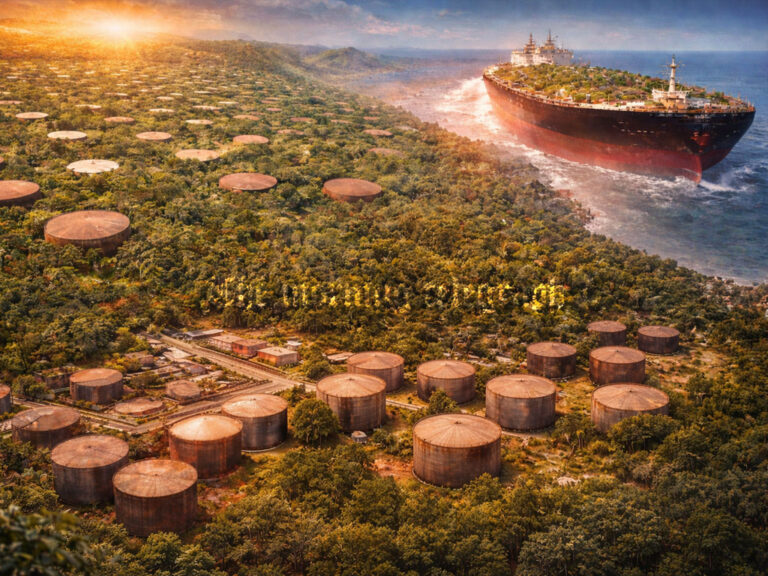
Under the 2023 joint venture agreement, Trinco Petroleum Terminal Private Limited, a collaboration between the Ceylon Petroleum Corporation and India’s Indian Oil Corporation, is tasked with developing 61 oil tanks, with nine tanks planned in the initial phase, although progress has remained stalled for years.
Foreign Affairs Minister Vijitha Herath stated that the renovation cost per tank is estimated at USD 1.2 million, with the full project projected to cost between USD 75 million and USD 100 million, reflecting its scale and long-term economic significance.
He further noted that discussions on the project were held with India’s External Affairs Minister S Jaishankar, signaling continued diplomatic engagement on strengthening bilateral energy cooperation.
According to Minister Herath, a special cabinet paper is expected to be presented soon to accelerate implementation, including calling for tenders to begin renovation work on the long-delayed oil tanks.
He emphasized that the Trincomalee energy project will help stabilize Sri Lanka’s domestic fuel supply while also enabling India to utilize the facility for bunkering operations and regional fuel exports.
A joint India-Sri Lanka statement issued after President Dissanayake’s visit to India in December 2024 reaffirmed both countries’ commitment to developing the Trincomalee tank farm and positioning the area as a regional energy and industrial hub.
Meanwhile, a shipment of 38,000 metric tonnes of petroleum products from India, including 20,000 metric tonnes of diesel and 18,000 metric tonnes of petrol, arrived in Colombo, providing immediate relief to Sri Lanka’s fuel supply challenges.
The Indian High Commission explained that Lanka IOC had earlier arranged fuel shipments for March from the Middle East and Singapore, but suppliers failed to deliver due to force majeure triggered by geopolitical tensions and vessel shortages.
As a result, emergency fuel supplies were requested from India, with the latest shipment forming part of that assistance, ensuring continuity of fuel distribution across Sri Lanka during a period of heightened global energy uncertainty.