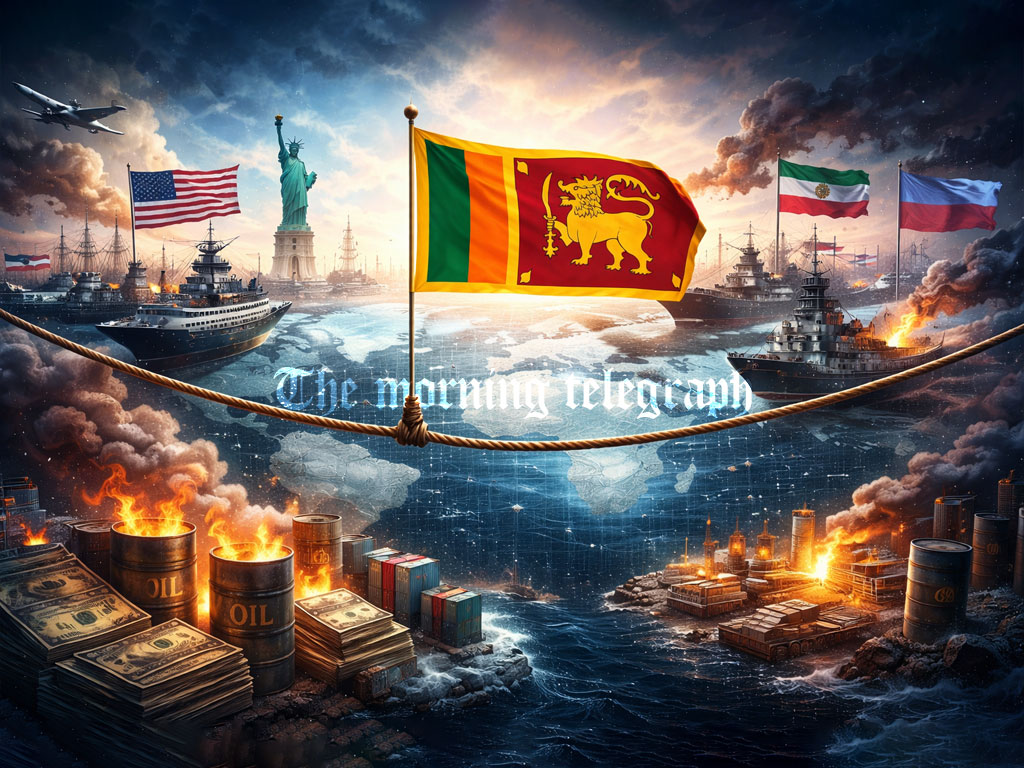
As Sri Lanka struggles to balance relations with Washington, Tehran, Moscow, and New Delhi, mounting diplomatic missteps, energy insecurity, and political uncertainty are exposing how fragile the country’s foreign policy and crisis management have become at the worst possible moment.
Sri Lanka has, over the decades, managed to protect itself from some of the harshest shocks of global instability largely because successive leaders understood the importance of foreign policy, strategic neutrality, and carefully cultivated international relationships.
That ability did not emerge by accident. It was built through a long tradition of diplomatic positioning that allowed the country to draw benefits from competing global powers without becoming trapped by any one of them.
During the 1970 to 1977 United Front administration, then Prime Minister Sirimavo Bandaranaike won wide international respect by firmly pursuing a non-aligned foreign policy. By keeping Sri Lanka outside the direct orbit of the major power blocs of the time, she built an image of balance, independence, and credibility on the world stage.

After 1977, J. R. Jayewardene moved the country in a different direction by nurturing close ties with the United States and Japan. That alignment helped Sri Lanka attract major development projects and significant foreign support at a critical stage of its economic transformation.
President Ranasinghe Premadasa later broadened Sri Lanka’s external engagement even further, strengthening ties not only with China but also with the United States and Japan. Through those relationships, he secured multiple development initiatives that contributed directly to the country’s growth.
President Chandrika Bandaranaike Kumaratunga continued with a broadly non-aligned foreign policy while also deepening relations with India, demonstrating again that Sri Lanka’s strength often lay in avoiding rigid dependency on one side.
Mahinda Rajapaksa then took relations with China to a much higher level, bringing in a wave of major infrastructure projects and large-scale investments that reshaped parts of the national economy.
This long record shows one consistent lesson. When a country is guided by a clear and disciplined foreign policy, and when its leaders build strong personal relationships abroad, it can unlock investment, influence, and strategic breathing space. But when foreign policy becomes weak, confused, or reactive, the consequences can quickly become serious, especially for a small state like Sri Lanka.
Diplomatic Predicament
It is against that historical background that Sri Lanka’s present difficulties must be understood. The country now appears to be facing a dangerous diplomatic and economic moment, driven in large part by uncertainty in its response to the intensifying conflict in the Middle East.
Whenever major powers become involved in open military confrontation, the reactions of smaller countries tend to reveal the real direction of their foreign policy. In the present conflict, some Middle Eastern states have openly leaned toward the United States and Israel. A number of European countries appear to be attempting a more independent line. Russia and China, meanwhile, are widely seen as operating in a manner favorable to Iran.
That wider geopolitical environment makes Sri Lanka’s current posture especially important. It is therefore necessary to closely examine the foreign policy being pursued by President Anura Kumara Dissanayake’s government in relation to the Middle East crisis and its direct consequences for Sri Lanka’s energy security, diplomacy, and national stability.
Tilting Towards the United States?
The present Malima administration came to power with the image of a left-leaning political force. Many expected strong leftist policies, both in economic governance and in foreign affairs. Yet the direction of the government now appears increasingly difficult to define.
Judging by both its domestic policy signals and its actions on the international stage, it is no longer clear whether the government is genuinely leftist, broadly centrist, pro-market, or drifting toward a highly pragmatic model shaped more by survival than ideology.
When the conflict first escalated and the United States and Israel launched attacks on Iran, the government publicly maintained that Sri Lanka would remain neutral and would not align with either camp.
However, developments that took place in the weeks that followed have cast doubt on that claim of neutrality. A particularly sensitive incident involved an Iranian vessel inside Sri Lanka’s exclusive economic zone. Immediately after the event, the Sri Lanka Navy held a special media briefing and maintained that the vessel had not sunk due to an attack. Yet within 24 hours, the U.S. Defense Secretary publicly stated that an American submarine had carried out a torpedo strike and sunk the Iranian ship.
That development did not remain confined to military or diplomatic circles. It soon collided with the economy. As U.S. attacks intensified, Iran moved to close the Strait of Hormuz, sending shockwaves through the global energy market. Sri Lanka quickly felt the pressure. Fuel queues returned. Restrictions were imposed. Prices were increased. Public anxiety rose again.
But beyond the immediate impact on fuel and electricity, a larger issue emerged. Because of the foreign policy line Sri Lanka is seen to have followed during the conflict, the country now appears unable to secure even an emergency fuel shipment at short notice.
Events over the past week have reinforced the growing perception that Sri Lanka has, in practical terms, leaned toward a pro-U.S. position, even while speaking the language of neutrality. The deeper question is whether such a tilt, if it exists, has been handled with enough care, discipline, and strategic foresight.
Diplomatic misstep
That question became sharper after a special statement made by President Anura Kumara Dissanayake in Parliament regarding the Middle East conflict. Critics argue that the President revealed matters that should never have been openly discussed in that setting, creating what many now view as a serious diplomatic error.
As a result, Sri Lanka appears to have placed itself in an uncomfortable position where pressure may now come from both Washington and Tehran.
At one stage, while seemingly trying to address his domestic support base, the President said that two U.S. military aircraft had requested permission to land at Mattala Airport and that the government had refused approval. In another statement, he claimed that the government had no prior knowledge of Iranian vessels entering Sri Lankan waters.
Those two remarks appear to have triggered significant repercussions. The first, concerning the U.S. aircraft, has reportedly been taken seriously by Washington. Information reaching Inside Politics suggests that some U.S. officials have interpreted the statement as dismissive and potentially offensive.
So far, there has been no formal public response from the U.S. State Department. Even so, it is understood that the issue is under close review and that an official expression of dissatisfaction may yet follow. If that happens, it could settle the question of whether the President’s parliamentary claims were accurate, exaggerated, or diplomatically damaging.
Requests Made
Through last week’s Inside Politics column, another important development involving the United States was disclosed. It was reported that two special envoys connected to Donald Trump arrived in Sri Lanka on the same day.
One was Sergio Gore, the Deputy Secretary responsible for Central and Asian Affairs, who also serves as the U.S. Ambassador to India and is known to have close ties with Donald Trump. While Gore arrived from India, another envoy, Michael Jeremiah, is said to have come quietly from Washington with little publicity.
According to the information gathered, Gore’s meeting with the President focused significantly on the question of security arrangements at Sri Lanka’s ports, including Colombo Port, and on how the United States could play a role in those matters.
Discreet arrival of Michael Jeremiah
American interest in Sri Lanka’s ports is far from new. For years, Washington has shown sensitivity toward strategically important facilities in the island’s maritime infrastructure. Proposals concerning access and influence within those locations have surfaced repeatedly in the past, and it appears those concerns arose again in the recent discussions.
Inside Politics has learned that Gore also raised the possibility of the United States being allowed to develop the Trincomalee oil tank farm, a project that is currently tied to India. It is understood, however, that the President did not give any clear response to that proposal.
The discussions reportedly went beyond ports and oil infrastructure. They also touched on the possibility of supplying SriLankan Airlines with modern Boeing aircraft and carrying out a full restructuring of the national carrier. The overall tone of the conversation appears to have reflected a strong U.S. effort to secure concrete strategic and commercial advantages.
That, in turn, raises a difficult question. Even if such requests were made, does the President realistically have the capacity to satisfy them without creating new tensions with India, China, or other regional actors?
The United States also possesses tools of pressure. A clear example is the tariff issue linked to Trump. The government was able to reduce an initial 40 percent tariff to 20 percent in roughly two months, largely by agreeing to a series of conditions set by the United States. Yet, according to available information, those conditions have still not been fully met.
This creates a serious risk. Washington could decide to use that leverage in response to the President’s comments in Parliament. If that happens, the tariff could be raised again to 40 percent, worsening Sri Lanka’s already fragile economic outlook. From Colombo’s perspective, the most prudent path would be to urgently engage the United States through direct dialogue and move quickly to honor whatever commitments were already made.
The Iran Issue
If the President’s remarks on the United States created one layer of difficulty, his comments concerning Iran appear to have created an even more serious and immediate diplomatic problem.
In Parliament, the President stated that the government was unaware that an Iranian naval vessel had entered Sri Lankan waters and insisted that no invitation had been extended for such a visit. But within 24 hours, that claim came under direct challenge, first from the opposition and then from Iran itself.
Opposition figures argued that the Sri Lankan Navy Commander had in fact invited the vessels. Soon after, the Iranian Ambassador to Sri Lanka held a special media briefing and forcefully backed that claim. The ambassador made it clear, more than once, that the ships had arrived on the basis of an invitation from Sri Lanka.
That was no minor diplomatic correction. It amounted to a public contradiction of the President by a foreign envoy on a highly sensitive matter. It also placed the Sri Lankan government in an even more vulnerable position by exposing a visible gap between its public narrative and what another state was willing to state on record.
Invitation from SL
The Iranian Ambassador’s briefing became even more significant because he did not stop with the issue of the invitation. He also stated that Iran was willing to supply oil to Sri Lanka at concessionary prices, presenting it as a possible answer to the country’s worsening fuel crisis.
That offer landed at a moment of acute vulnerability. Sri Lanka is under severe strain in securing sufficient fuel supplies. Earlier reporting by Inside Politics indicated that when the crisis first escalated, Colombo sought help from India but was told that India too was facing shortages. U.S. sanctions on Russia also made it difficult for Sri Lanka to pursue Russian oil as an immediate solution.
Procure oil from Russia
The pressure is made worse by technical limitations. The Sapugaskanda refinery, which was built with Iranian assistance, is designed to process Iranian crude. That means crude oil from many other sources is not easily compatible with the refinery’s system. Because of U.S. sanctions on Iran, Sri Lanka has for years been compelled to obtain Iranian crude indirectly through intermediaries in places like Singapore or Dubai instead of purchasing it openly and directly.
Given those realities, many expected that the government would seize on the Iranian Ambassador’s public offer and move swiftly to secure oil from Tehran.
There was also a wider regional context that strengthened that expectation. Iran had reportedly opened the Strait of Hormuz specifically for Indian-bound oil shipments, allowing India and some other countries to continue importing Iranian oil under those arrangements.
Yet in a move that surprised many observers, Cabinet Spokesman Nalinda Jayatissa stated at a media briefing that Sri Lanka would not pursue oil imports from Iran at present. His explanation was that Sri Lanka did not have the necessary vessels to transport the oil.
That response has been widely interpreted as diplomatically clumsy. Many now believe Tehran could view it as a dismissive rejection of a public offer made in good faith at a moment when Sri Lanka badly needs energy support.
Conditions from Russia
At the same time, another line of thinking has emerged. Some observers question whether Iran’s offer was entirely straightforward or whether it may also have been intended to draw Sri Lanka more deeply into a longer strategic dependency.
Their argument is that if Sri Lanka closes the door on Iranian oil, the remaining realistic option becomes Russia. But Russia is closely aligned with Iran in the current Middle East conflict, and China is also seen as broadly supportive of Tehran. That raises an obvious concern. If Sri Lanka appears to have offended Iran, will Russia and China remain fully willing to support Colombo diplomatically or economically?
At the beginning of the fuel crisis, the government said it was exploring supplies from the United States or Algeria. But since then, there has been little meaningful public update on the status of those talks. A U.S.-linked company operating in Sri Lanka, Park Company, has reportedly imported limited quantities of oil through intermediary channels, but it remains doubtful whether those supplies can meet the scale of the present demand.
Meanwhile, discussions with Algeria remain at an early stage. Compounding the problem, the Norochcholai power plant has not been able to function at its expected capacity because of low-quality coal imports. As a result, Sri Lanka has had to burn more oil than usual to sustain daily electricity generation, rapidly eating into already limited fuel reserves.
With the Sinhala New Year approaching, many now believe that unless emergency oil supplies are secured without delay, Sri Lanka could face a renewed and potentially severe fuel crisis.
Turning Towards Russia
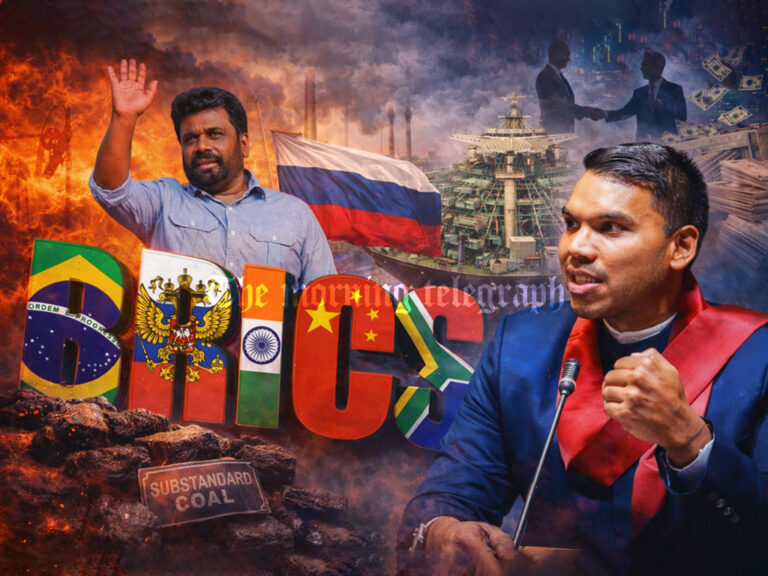
Under these conditions, the government appears to be moving toward Russia as its only remaining practical option for large-scale oil supplies.
Initially, U.S. sanctions on Russian oil created a serious obstacle for any country seeking to buy from Moscow. But those sanctions have now reportedly been relaxed temporarily for a period of one month, creating a narrow window for negotiation.
Foreign Minister Vijitha Herath had earlier raised the matter of oil procurement with the Russian Ambassador, who in turn conveyed Sri Lanka’s request to Moscow. At that time, however, no positive response was forthcoming.
Now, with the crisis deepening, the government has once again turned to Russia. Several individuals with strong Russian connections have reportedly been drawn into the effort to present Sri Lanka’s case more effectively. In response, Russia has decided to send its Deputy Energy Minister to Sri Lanka.
According to the information available, the Russian side has come with strict conditions. Moscow is reportedly willing to provide two fuel shipments in the initial stage. But if Sri Lanka wants supplies to continue, it must enter into a new agreement committing itself to purchase Russian oil for five years after those first two shipments are delivered.
It is also understood that only if Sri Lanka accepts these terms will Russia dispatch its Deputy Foreign Minister to conclude and sign the arrangement.
Rising Concerns
That offer may appear helpful on the surface, but it comes with serious strategic and diplomatic risks.
Even at the start, Russia indicated that only two shipments could be provided immediately. In the present context, much of that fuel would likely have to be diverted to electricity generation because of the pressure on the power sector.
Sri Lanka had expected 25 fuel shipments since the outbreak of the conflict, yet only around 13 have actually arrived. That shortfall is already severe. Under such circumstances, the government may feel compelled to sign a long-term oil agreement with Russia simply to survive the short-term crisis.
But this creates several troubling questions.
The first is the issue of sanctions. The U.S. suspension of sanctions on Russian oil is reportedly limited to 30 days. If those sanctions are reimposed after that period, it becomes highly uncertain whether Sri Lanka would be able to continue importing Russian oil under a five-year agreement without triggering another round of international trouble. In other words, a deal signed in desperation today could become the source of a new foreign policy crisis tomorrow.
India Factor
There is also the matter of India. A special telephone conversation reportedly took place last week between President Anura Kumara Dissanayake and Indian Prime Minister Narendra Modi. That call has led to speculation that the President may have sought India’s help in securing oil from Russia.
Sri Lanka had already asked India for fuel assistance at the start of the crisis, but those efforts did not yield the desired result. Since Modi has a close working relationship with Russia, some believe Colombo may now be hoping New Delhi can act as a bridge to Moscow.
Yet many analysts remain skeptical. If the President did indeed approach Modi with such expectations, it may reveal more about Colombo’s lack of diplomatic leverage than about any realistic strategy for resolving the crisis. International relations at this level cannot be navigated on wishful thinking alone.
Anura Meets YouTubers
Immediately after the Middle East war began, this column carried a special report based on information from several sources saying that the government had drawn up its forward plans on the assumption that the conflict would end within eight weeks.
At the time, many considered that assumption unrealistic and questioned whether the government had the capacity to make such an assessment. Events since then have only strengthened those doubts. The administration is now confronting the serious economic and energy fallout of the conflict, and many believe the situation is likely to worsen in the weeks ahead.
Crisis management questioned
Concerns have also grown regarding the way the government is managing the public narrative around the crisis. In earlier national emergencies, presidents and governments typically summoned newspaper editors, electronic media chiefs, or media owners to the Presidential Secretariat for formal consultations on national communication and public responsibility.
This time, however, the government is said to have chosen a very different path. It is learned that government leaders held a lengthy meeting with selected YouTubers to discuss management of the ongoing crisis.
What stands out is that the President did not treat the meeting as an official state engagement. It was not held at the Presidential Secretariat. Instead, selected YouTubers were invited to the JVP headquarters in Pelawatte. The meeting began last Monday at 3:00 p.m., with the President and Media Minister Nalinda Jayatissa already seated in the conference hall when the invitees arrived.
No official protocol
The atmosphere, by all accounts, was informal and relaxed, operating outside normal state protocol. A range of issues was discussed. Yet, in the middle of the conversation, another episode reportedly occurred that echoed the President’s earlier misstep in Parliament.
While answering questions on the fuel crisis, the President is said to have disclosed details from conversations with the Emir of Qatar and the Emir of the United Arab Emirates. Although it was not clear which leader had said what, the President stated that he had received information suggesting that Iran would soon run out of weapons and would not be able to continue the war for much longer. He added that Iran’s remaining military assets could soon come under attack.
By the time this article is written, many believe such remarks would almost certainly have been relayed to foreign embassies in Colombo. If so, they may have further offended Iran and deepened the diplomatic strain already created by the President’s previous statements.
Whether he is speaking in Parliament, before media figures, or in a private political setting, the President’s words on international affairs carry consequences. In moments like this, restraint and discipline are not optional. They are essential.
Other Key Exchanges
The President is also said to have made several other notable remarks during the YouTubers’ meeting. One of the most important concerned the Sapugaskanda refinery.
He reportedly said that the oil shipments for which tenders had been called were expected only by June, meaning Sri Lanka would have to depend on spot tenders in the meantime. Even then, he said, finding a vessel remained difficult. He added that attempts were being made to secure oil from ships already at sea but that those efforts too had not succeeded. If the situation continued, he warned, the Sapugaskanda refinery might have to be shut down by April 4 unless a solution was found quickly.
That statement alone highlights the seriousness of the energy crisis. It also suggests that the government’s room for error has become dangerously narrow.
During the same discussion, YouTubers supportive of the administration reportedly complained that government ministers were avoiding appearing on their channels.
They argued that while ministers continued to appear on television, the public increasingly consumed content through digital platforms. Yet those same ministers were not willing to engage with YouTube-based media. They also claimed that many of the government’s 159 MPs were saying they needed approval from Pelawatte before speaking publicly and asked that this matter be resolved.
In response, the President reportedly made another revealing comment. He said the government had already decided to reduce the public exposure of its key ministers and instead intended to communicate its responses through other parties.
That reply appeared to suggest a deliberate strategy in which unofficial voices, third parties, or friendly communicators would increasingly be used to deliver the government’s narrative rather than ministers speaking directly.
At one stage, a YouTuber asked why government representatives were appearing on Derana TV but not on their channels. Neither the President nor Nalinda Jayatissa is said to have answered that question.
Mattala Airport & Other Issues
The YouTubers also raised the issue of Mattala Airport. In response, the President referred to Western Province Governor Yusuf Hanifa and said discussions were already underway with two major countries.
According to the President, talks had already been initiated with Qatar and the Emirates and Governor Hanifa was handling related activities.
Awkward Moment on Human Rights
One of the most uncomfortable exchanges of the meeting reportedly came when a YouTuber questioned the President on human rights issues.
The questioner argued that there was serious injustice surrounding human rights complaints and that violations were not being properly investigated, then asked why the President remained silent on the matter.
The President appeared visibly uneasy. He initially tried to brush off the issue by saying it was not their matter. But when the questioner persisted, he reportedly attempted to evade the issue, replying that it was difficult to talk about and suggesting it be left for later.
For many observers, that moment may have been as politically revealing as any of the foreign policy remarks. It suggested that when pressed directly on sensitive governance questions, the President appeared uncomfortable, hesitant, and unwilling to engage in a clear public answer.
After the Meeting
The meeting, which started at 3:00 p.m., reportedly ended only after 5:45 p.m., lasting nearly two hours and 45 minutes. During that period, the President’s side served the YouTubers tea and several packets of Kist biscuits.
Once the YouTubers had left, JVP General Secretary Tilvin Silva entered the room, accompanied by another notable figure. MP Bimal Rathnayake soon joined them. The President, Nalinda Jayatissa, Bimal Rathnayake, and Tilvin Silva then held a separate discussion on the government’s future political direction.
A Special Visitor Meets Sajith
During the last phase of the economic collapse under former President Gotabaya Rajapaksa, there was an early plan to invite Opposition Leader Sajith Premadasa to take over the government. Yet while Gotabaya was making that move, others in the Rajapaksa camp were pursuing a different path that would eventually bring Ranil Wickremesinghe to power through Parliament and safeguard their own interests.
At that time, Sajith called together his economic advisers, including Dr. Harsha de Silva, Kabir Hashim, and Eran Wickramaratne, for a serious discussion about the possibility of assuming power.
According to repeated reporting in the Inside Politics column, the group led by Harsha strongly advised Sajith not to take over the government under those conditions. Rajitha Senaratne later publicly confirmed that this advice had indeed been given.
Ranil Wickremesinghe ultimately became the eighth Executive President with the backing of the SLPP in Parliament. In the period that followed, some of those who had advised Sajith not to take power appeared to build closer working ties with Ranil and benefit from that relationship.
Learning from the Past
It appears Sajith may have learned an important lesson from that episode. Now, as fresh signs of another possible economic crisis emerge, he has begun consulting experts much earlier about what should be done next.
He has moved to establish committees tasked with offering both short-term and long-term solutions. His immediate concern has centered on the fast-growing energy crisis, especially the interconnected problems of fuel, gas, and electricity.
Against that backdrop, a special representative is said to have visited Sajith’s residence last week and held a one and a half hour private discussion with him. It was after this meeting that Sajith reportedly became much more active in seeking possible responses to the crisis.
During the conversation, the visitor is said to have identified two specific windows during which a major crisis could erupt and advised Sajith to begin preparing immediately.
Within 24 hours, Sajith convened another meeting at the Opposition Leader’s Office, bringing together respected experts from Sri Lanka’s energy sector, including individuals with strong reputations in the private sector.
The discussion focused on possible responses to the energy crisis, which countries might be able to help, which contacts could be approached directly, and what short-term and long-term policy paths should be prepared. Following that, Sajith instructed that a formal report and policy framework be produced and appointed an expert committee to begin work at once.
Advice from a Diplomat
Sajith also met several senior ambassadors last week in a series of informal discussions. During one of those meetings, a diplomat reportedly offered him a deeply personal warning.
The diplomat urged Sajith to build a new and trustworthy team around him to handle economic matters. He also reminded him how, during the previous crisis under Gotabaya, certain individuals had undermined him while helping elevate Ranil Wickremesinghe.
The diplomat reportedly explained, drawing on personal experience, that many who approached embassies did so with their own agendas. Some wanted influence inside political parties. Others wanted personal advantage. According to the diplomat, they were not sincerely committed to helping create an SJB government. Instead, some of them had met foreign diplomats while quietly damaging Sajith’s standing.
The diplomat’s advice was simple but sharp. Sajith, he said, should build a fresh and reliable team that was genuinely capable of managing crises rather than relying on figures who used him for their own advancement.
Building a New Team
Sajith appears to have taken that advice seriously. He has begun appointing a new set of economic advisers, including Professor Prasanna Perera from the Department of Economics at the University of Peradeniya and legal professional and economic analyst Charana Kanankegama.
Professor Perera is regarded as someone who can explain complicated economic issues in language ordinary people can understand. That practical style has helped distinguish him from economists who are often seen as overly abstract or disconnected from day-to-day realities.
Last week, Sajith also met internationally recognized economist Elena Panaritis, with both Perera and Kanankegama present for the discussion.
Diplomatic Strategy
In addition to the economic dimension, Sajith has also started strengthening his diplomatic strategy.
He has brought several important individuals closer to assist him in navigating international affairs, including a foreign policy expert who had previously been pushed aside because of internal resistance.
Sajith has reportedly instructed this expert to immediately begin work on a foreign policy strategy and to prepare a report identifying the countries and world leaders who could be approached quickly for assistance if the crisis deepens.
The two are also said to have held detailed discussions on three potential diplomatic crises that may arise in the near future, suggesting that Sajith is trying to prepare more systematically than before.
Unity Becomes Certain
Two weeks ago, this column reported that a meeting between the leaders of the SJB and UNP was expected during the commemoration of the late Gamini Dissanayake. However, Ranil Wickremesinghe was unable to attend because of emergency surgery in Singapore, and the planned encounter did not take place.
Even so, the event drew considerable attention because several senior UNP figures attended alongside leading SJB personalities. Supporters of both parties saw the gathering as politically meaningful. Among those present were Navin, Ruwan, Akila, and Talatha.
At the beginning of the event, Navin and Mayantha Dissanayake were seated on either side of Sajith Premadasa. But when UNP Deputy Leader Ruwan Wijewardene arrived, Mayantha gave up his seat, leaving Sajith seated between Ruwan and Navin.
During the event, Ruwan quietly asked Sajith an important question about when the process of uniting the two parties would be completed.
According to the report, Sajith answered by saying it was already done and that the rest would be completed gradually, without rushing.
Soon after, Navin also leaned in and asked whether a positive signal could be given to supporters that very day.
Sajith reportedly smiled and told him to wait and listen to the speech.
Key Statements from Sajith
As expected, attention then turned fully to Sajith’s address. In that speech, he made two politically important points.
Political entry
The first was a personal revelation. Many had long believed that it was Ranil Wickremesinghe who brought Sajith into politics. But Sajith said it was actually the late Gamini Dissanayake who invited him into political life and handed him the Hambantota seat.
The second statement carried even greater significance. Sajith declared that the SJB and UNP would definitely come together in the near future.
He also argued that the old division between right and left in Sri Lankan politics had effectively reached its limit. According to him, the country must move beyond crony capitalism and extreme liberal economics while also rejecting extreme communism and rigid socialism. In their place, he said, Sri Lanka should embrace a model of humane capitalism.
That phrase was not accidental. It appears to be Sajith’s attempt to reposition himself as a leader seeking a middle path, one that rejects both ideological extremes and presents itself as practical, compassionate, and electorally broad.
In the current climate, where the government is under pressure over foreign policy confusion, fuel shortages, energy insecurity, and questions about crisis management, Sajith seems to be moving quickly to project preparedness, moderation, and strategic flexibility.
Whether that effort will succeed remains to be seen. But one thing is becoming increasingly clear. At a time when Sri Lanka is struggling to manage pressure from the United States, Iran, Russia, India, and the wider global economic crisis, the battle for the country’s next political and diplomatic direction is already well underway.