By Roshan Jayasinghe
What if one weekday were consciously set aside for voluntary civic participation, so that the care of our cities becomes a shared social responsibility rather than a burden left only to institutions?
The thought came to me while observing the contrast between two cities. One seemed less burdened by human concentration, less pressed upon by the weight of movement, waste, noise, and strain, while the other carried all the visible signs of dense population, constant demand, and the quiet neglect that can settle into shared places when too many people live close together without enough collective care. It was not a political theory that came to me in that moment, nor some abstract civic idea. It was something simpler and more human. If we are going to live in cities, especially densely populated cities, then we must also build into the structure of life a way for people to directly participate in the care of the place they inhabit. Not only through taxes, not only through complaint, and not only by expecting local authorities to carry the full burden, but through our own presence, our own hands, and our own time.

A Sri Lankan word came into my thoughts in that moment: Shramadana, the willing offering of one’s time and labor for the well-being of the community. It points to people coming together in shared effort for a common purpose. It is not merely about labor. It carries dignity, willingness, contribution, and the recognition that the place we live in should not be somebody else’s concern alone. As I reflected on this in the context of modern urban life, I found myself wondering why such a spirit could not be extended through our social structure in a more deliberate way. Why should people spend nearly the whole of life moving between work, traffic, bills, routines, and private concerns, while the neighborhoods they return to each evening are left increasingly to municipal systems already stretched, delayed, or disconnected from the lived feeling of a place.
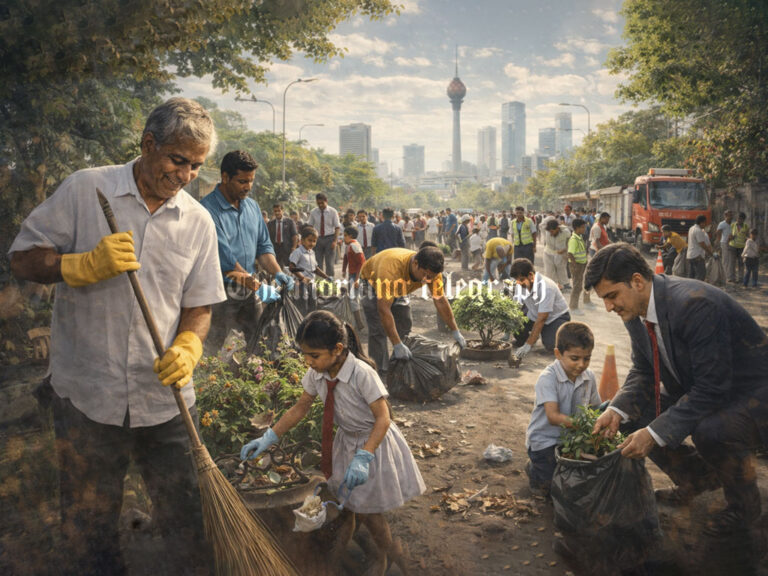
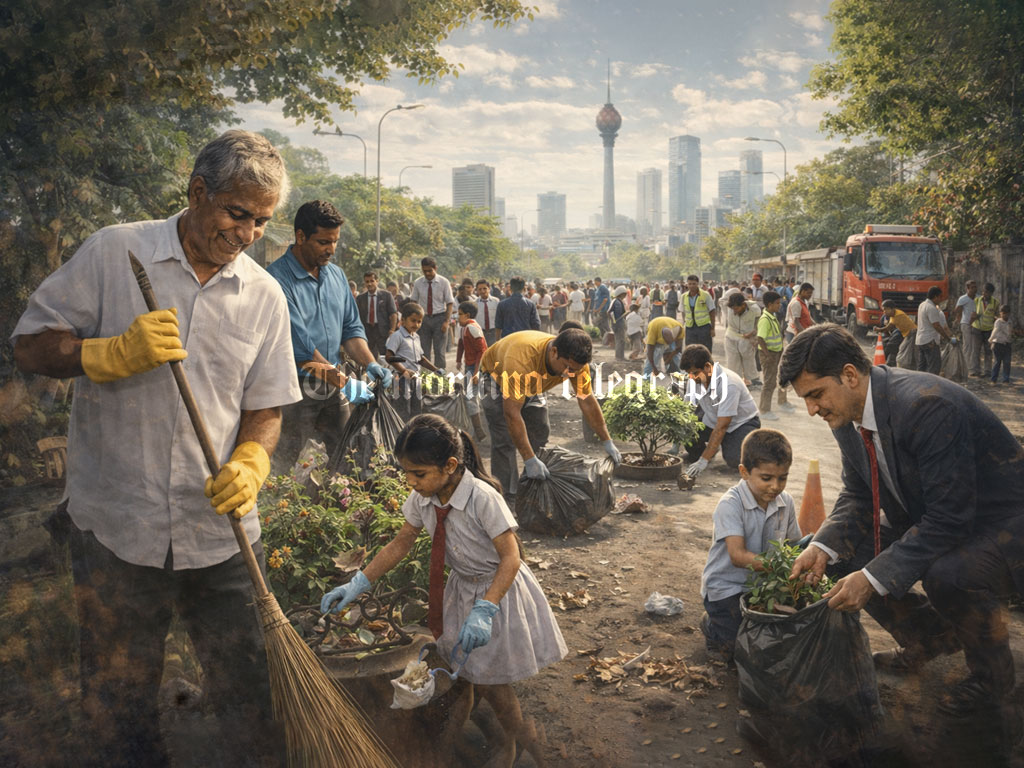
I began to think that this is something people can and should demand from their local representatives. Not as an unreasonable burden, but as a meaningful redesign of civic participation. Why should there not be an allocated weekday, even one day each week, in which schools, businesses, and non-essential sectors of government make room for voluntary participation in community service and neighborhood upkeep. I am not speaking here of those already employed in sanitation, public works, emergency response, or social services, whose duties are already tied to public maintenance and care. I am speaking of the wider body of ordinary citizens, people whose lives are otherwise fully absorbed into their own work and obligations, being given a recognized opportunity to step out of the ordinary rhythm and participate directly in the care, restoration, and upkeep of the place they live in.
This need not be looked at as lost economic time. It may in fact be time recovered. Recovered for the neighborhood, for human connection, for civic dignity, and for the reminder that a city is not merely a machine of productivity, but a living shared environment. A street does not become clean only because a budget exists. A public space does not become respected only because a department has jurisdiction over it. Something else is required. A sense that people belong to the place, and because they belong to it, they are willing to care for it.
I have also seen individuals, and at times smaller groups, already doing such things on their own. I have seen people clean an area, tend to a neglected space, remove what has been left behind by others, or quietly take responsibility for a part of the environment around them without waiting for instruction. So the spirit is already there. The willingness has not disappeared from human beings. What is missing is not the impulse itself, but the recognition and structure that could extend what now appears in fragments into a wider culture of participation. That is where local government could play a thoughtful role, not to control the spirit, but to create room for it and help organize it so that what a few already do voluntarily can become a civic rhythm available to many.
If such a day were consciously built into the week, there could be practical benefits as well. If schools, businesses, and non-essential sectors eased their normal weekday rhythm on that assigned day, there may naturally be less traffic on the roads and less congestion in certain public areas. That alone could create better conditions for the departments already responsible for highway cleaning, public maintenance, and civic upkeep. Roads may be more accessible. Cleaning may be more efficient. Public space maintenance may be easier to carry out with less obstruction and less strain. So the value of such a day would not lie only in what ordinary people contribute directly, but also in the more effective functioning of the public systems already charged with caring for the common environment.
If this idea is to hold real moral weight, then it must not become something expected only of ordinary citizens while those of higher standing remain outside it. Business owners, heads of government offices, district leaders, administrators, and all who hold position or status should also participate in the same light. The city does not belong only to those below them. The public environment holds all of us equally, and therefore the responsibility for its care should also fall across the whole of society. The deeper beauty of such a system would be seen when those regarded as important do not stand apart from the shared task, but enter it willingly alongside everyone else. That would restore something badly needed in modern life, the moral understanding that leadership is not exemption, but example.
The more I think about it, the more I feel this is not just a matter of cleaning streets or tending parks. It is about what sort of society we wish to build. We have become too conditioned to believe that a human being’s worth is exhausted by employment, by productivity, by how much can be extracted from one’s time for the movement of an economy. But that is too small a definition of human contribution. A person who helps restore a public space has created value. A group of students who participate in the care of their neighborhood has created value. A business that releases its workers, even for a few hours, to engage in community upkeep has contributed to value beyond commerce. A child who grows up seeing adults work together to improve the place they share receives a lesson more important than many things taught in formal instruction. That child learns that citizenship is not passive, that community is not an abstraction, and that the world around them is not separate from them.
This is also why I feel such a notion has the power to restore relationship among people. So many now live side by side without truly knowing one another. Streets are shared, but not lives. Walls are near, but hearts remain distant. Yet when people come together in practical, visible, shared effort, a different social condition can begin to emerge. People speak. They recognize one another. They begin to know who lives nearby. Small neighborhood committees, which in many places have become dormant or irrelevant, could begin to come alive again, not as hollow administrative structures, but as living points of relationship and responsibility. That matters, because the health of a society is not only in its infrastructure. It is also in whether people feel related to the place and to each other within it.
There is also something deeply balancing about this idea in a time when so much of life is built around movement for the sake of private survival or private gain. We travel here and there, rush from one task to another, spend fuel, spend time, spend energy, often without pausing to ask whether the very place from which we live is itself being cared for with enough attention. A community service day built into the life of a city could reduce unnecessary movement on that day, redirect human attention inward toward the immediate locality, and give people a different relationship to time itself. Not time only as something sold, but time given. Not time only for earning, but time for tending. That is not a small shift. It is a moral shift.
I am not suggesting compulsion. The word voluntary matters here. The spirit must remain willing, otherwise the meaning drains out of it. But voluntary does not mean unsupported or unstructured. Society organizes many things it considers important. It organizes work, transport, school schedules, taxation, waste removal, zoning, and development. Why should it not also organize space for shared civic care. Why should the system not recognize that one of the wisest investments it can make is to help create citizens who do not merely occupy a place, but participate in its upkeep and dignity.
To me, this feels especially important in a world where many have begun to feel that life is arranged mostly for the benefit of the few who profit the most from the labor of the many. People work constantly, yet often feel little ownership of the larger social shape of the world they are helping to sustain. Something in that arrangement leaves the ordinary person inwardly disconnected. But when people are invited into visible acts of collective care, something returns to them. A sense of authorship. A sense of belonging. A sense that they are not merely surviving within a system, but helping to shape the quality of the place in which life is actually being lived.
This beautiful planet was not given to us merely to consume and pass through. It was given to us already carrying order, life, beauty, and a quiet intelligence greater than our own design. To make better what we stand upon is part of our responsibility. Not only in large speeches about the environment, not only in distant policies, but in the daily and local world immediately around us. The road, the sidewalk, the park, the wall, the public corner, the school boundary, the drainage line, the neglected patch of earth, these too are part of our moral field. To care for them is not beneath us. It is one of the clearest signs that we understand what it means to live responsibly upon the earth.
These forms of community service already exist across the world in different ways, cultures, and local traditions. Human beings have always shown that they are capable of coming together voluntarily for the care of a place, for the support of one another, and for the well-being of the wider community. So the essence of what I am speaking of is not new. What I am really suggesting is that this should be more thoughtfully embedded into the weekly structure of life in every nation where democracy, human rights, and human dignity are claimed as guiding values. A society that speaks of rights must also speak of responsibility. A society that values democracy should also make room for meaningful civic participation beyond voting alone. And a society that respects human dignity should recognize that one of the highest expressions of that dignity is the willing contribution of one’s time and effort toward the common good.
This is why Shramadana feels to me not merely like a Sri Lankan word, but a human principle. It points to something modern life may need to rediscover. That a society becomes healthier when people are not reduced only to private roles, but are also given pathways into shared civic contribution. That local governments should not only manage decline, but help cultivate participation. That representatives of the people should not only speak in the language of policy and administration, but also help create the conditions through which ordinary people can directly serve the dignity of where they live.
If such a day were thoughtfully imagined, it could bring together many strands at once. Cleaner public spaces. Better neighborhood upkeep. More effective highway and municipal cleaning due to reduced traffic and public pressure. Greater community interaction. Revived neighborhood committees. A more visible civic culture. A healthier relationship between citizens and local representatives. Children learning by example. Businesses and schools becoming part of social well-being rather than standing outside it. And above all, the quiet but powerful restoration of the understanding that the place we live in is not someone else’s burden alone.
A good society is not measured only by how much it produces, how much it consumes, or how rapidly it expands. It is also measured by what it cares for, what it preserves, what it repairs, and whether the people within it still know how to come together for something beyond themselves. That, to me, is what this thought was really about when it arose through observing the contrast between cities. Not only the difference between one place and another, but the question of what kind of shared life becomes possible when human beings are given not only duties to survive, but opportunities to contribute meaningfully to the common good.
The time has come to ask more of our local systems, and also more of ourselves. Not in the language of pressure alone, but in the language of possibility. To ask whether one weekday, one voluntary shared rhythm of care, one civic act woven into the structure of ordinary life, could begin to restore something we have gradually allowed to weaken. If so, then what begins as a simple neighborhood service day may in time reveal itself to be something deeper. A way of remembering that we do not merely live in a city. We are also responsible for the life of it.
Author’s Note:
This reflection arose from a simple observation of contrast between cities, and from asking what might become possible if civic life were shaped not only by administration, commerce, and routine, but also by shared care. The Sri Lankan idea of Shramadana offers more than a cultural memory. It points toward a human possibility that may still have relevance anywhere people live together and wish to make the place they inhabit more dignified, more connected, and more responsibly held.
About the Author
Roshan Jayasinghe is a writer and observer of human systems. His work explores the gap between man made constructs and lived humanity, with a focus on how economics, trade and everyday choices intersect with questions of fairness, responsibility and inner alignment. Through essays for publications in The Morning Telegraph, he aims to remind readers that they are not passengers in a fixed machine, but active custodians of a shared world.