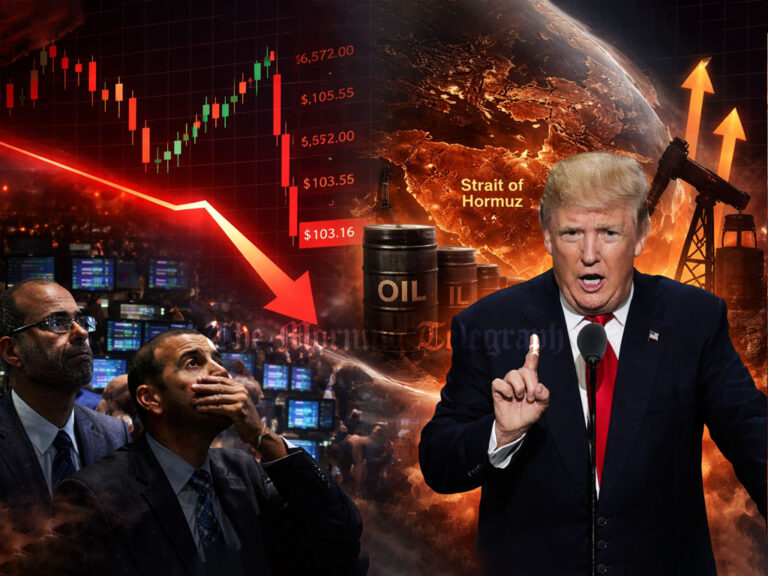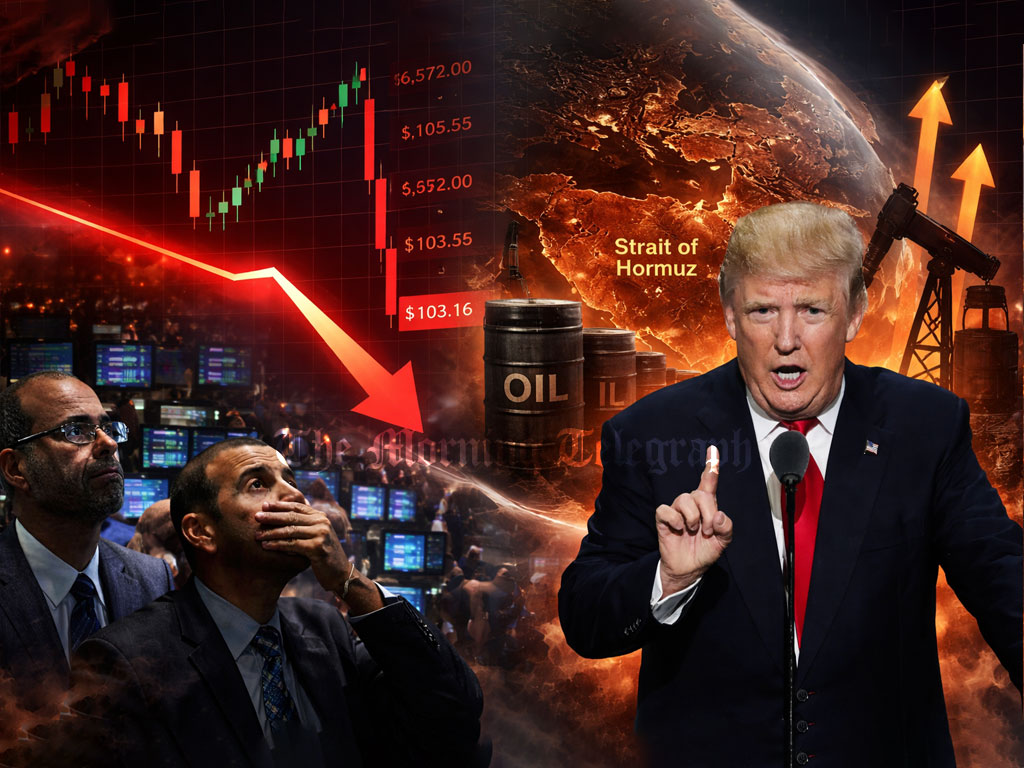
A single speech from Donald Trump rattled global markets, triggering a sharp stock sell-off and a surge in oil prices, as fears grow that the Iran conflict could drag on and disrupt global energy supply chains.
Global financial markets tumbled while oil prices surged sharply on Thursday after Donald Trump’s latest speech shattered investor optimism about a quick resolution to the escalating Iran conflict.
Investor sentiment turned negative almost instantly as hopes of a near-term peace faded, with renewed fears that geopolitical tensions in the Middle East could further disrupt global oil supply and economic stability.
In a televised address delivered on Wednesday night US time, Trump told Americans that his war objectives were nearing completion and suggested the conflict could end within two to three weeks, offering a brief moment of reassurance to markets.

However, he also reinforced his warning that Iran’s energy infrastructure could face widespread and coordinated strikes if negotiations fail, raising concerns of a prolonged and more destructive phase of the conflict.
Market reaction was swift, with S&P 500 futures dropping 0.8 percent, Nasdaq futures falling 1 percent and Dow Jones futures declining by 0.8 percent, while the Australian stock market also slipped 0.5 percent by early afternoon trading.
Oil markets reacted even more dramatically, with Brent crude jumping over 4 percent to reach 105.55 dollars per barrel, while West Texas Intermediate climbed 3 percent to 103.16 dollars, reversing earlier declines before the speech.
In recent days, equity markets had rallied strongly on expectations that the US-Israel-Iran conflict would be contained and resolved within weeks, fueling a short-lived sense of stability.
Analysts say that optimism has now been replaced with uncertainty, as Trump’s speech introduced new ambiguity into the outlook for global markets and geopolitical risk.
Nigel Green, CEO of deVere Group, said investors had begun pricing in a more predictable scenario, but the latest developments have shifted expectations significantly.
He noted that markets were anticipating a shorter and more contained conflict, but the absence of clarity has now increased volatility across multiple asset classes.
Stephen Innes of SPI Asset Management observed that the speech focused more on ongoing military objectives rather than a clear resolution, reinforcing the perception of continued instability.
He described the message as one of unfinished business, warning that such signals tend to fuel market volatility and uncertainty in both equities and commodities.
Oil prices reacted strongly because markets had prematurely assumed the conflict would wind down quickly, and the shift in narrative forced traders to reassess supply risks.
Asian markets mirrored the global downturn, with Seoul falling 3 percent after a sharp rally the previous day, while Tokyo, Hong Kong, Shanghai, Singapore and Taipei also recorded significant losses.
Jumpei Tanaka of Pictet Asset Management said the speech failed to provide the clear signals investors were hoping for regarding an end to hostilities.
Instead, the suggestion of potential escalation was viewed as a negative factor for global equities and risk assets.
Trump also reiterated his stance on the Strait of Hormuz, indicating that reopening the vital oil shipping route was not a priority for the United States and urging allies to take responsibility.
He called on countries such as France, Japan, South Korea and China to secure their own energy supply routes, questioning the US role in protecting global oil flows.
Trump emphasized that his primary objective remains preventing Iran from obtaining nuclear weapons, framing the conflict within broader security concerns.
Earlier, he had claimed on social media that Iran’s leadership had sought a ceasefire, but stated that any consideration would depend on the reopening of the Strait of Hormuz.
Iranian authorities later denied making such a request, adding further confusion to an already uncertain geopolitical situation.
Sebastien Page of T Rowe Price warned that markets must now focus on the longer-term economic damage caused by the conflict rather than expecting a quick return to stability.
He cautioned that inflation pressures could persist, as disruptions in energy markets continue to ripple through the global economy.
Page noted that while economic fundamentals remain relatively strong, the risk of a sudden growth shock is increasing due to sustained geopolitical uncertainty.
World Bank Managing Director Paschal Donohoe also expressed concern about the broader impact on inflation, employment and food security worldwide.
He highlighted the need for coordinated international action, as institutions like the IMF and International Energy Agency move to respond to the crisis.
Nigel Green reiterated that investors had initially positioned themselves for a short-duration conflict, but the evolving situation has made the outlook far more complex.
He said the lack of clarity around how and when the conflict will end is now a key driver of market risk and volatility.
Green warned that unresolved risks surrounding the Strait of Hormuz could quickly reintroduce a geopolitical risk premium into oil prices.
Such developments would have direct consequences for inflation expectations and broader financial market sentiment.
He added that traditional safe-haven assets like gold and the US dollar are likely to gain strength as uncertainty continues to rise.
Ultimately, the speech underscored the absence of a clearly defined end state for the conflict, raising questions about the long-term stability of global markets.
Green emphasized that a conflict declared complete without addressing underlying risks cannot be considered fully resolved.
He said markets will need to adjust rapidly to this shifting narrative, as changing expectations continue to drive sharp movements across asset classes.
According to Green, the central issue remains uncertainty, which is likely to keep markets highly sensitive to every new development.
Until there is a clearer picture of how the conflict concludes and what risks remain, volatility is expected to persist across equities, oil and currency markets.