By Roshan Jayasinghe
A reflection on religion, ritual, holidays, power, and the human tendency to preserve ceremony while neglecting the deeper truth those traditions were meant to awaken.
There comes a point in human life when inherited things must be looked at again. Not rejected in anger, not defended in fear, but examined in the clear light of what we now know. We live in an age where history, archaeology, science, philosophy, comparative study, and human observation have given us more than enough to question the stories, rituals, and structures that have governed societies for centuries. Yet still, across nations and across cultures, human beings continue to move through calendars built long ago, following sacred dates, ceremonial customs, and belief systems as though repetition itself confirms truth. What is carried forward by a civilization is not always what has been honestly understood. Very often it is simply what has been preserved.

For far too long, humanity has lived beneath the weight of inherited narratives formed in ages when questioning was dangerous, obedience was rewarded, and myth often stood where evidence now stands. Today, with all the knowledge available to us, one would think the human being would be more willing to separate symbol from truth, history from embellishment, ceremony from understanding. Yet many still cling to inherited forms as though they themselves are sacred, without asking whether the thing being preserved still carries life, clarity, or honest meaning. The issue is not that human beings seek meaning. The issue is that they so often inherit outer form without examining inner substance, preserve ritual without living insight, and defend custom without asking whether it still serves truth.
When one looks honestly across the mainstream religions of the world, a clear pattern begins to appear. Each tradition contains teachings that, at their best, point human beings toward discipline, moral conduct, self-restraint, humility, compassion, responsibility, and a wiser relationship with life. Yet around those teachings, societies have built festivals, sacred dates, rituals, processions, commemorations, fasts, feasts, observances, and public identities that often become more visible than the truth they were meant to serve. Christianity has Christmas, Easter, Good Friday, Advent, and Lent. Judaism has Sabbath, Passover, Yom Kippur, Rosh Hashanah, Sukkot, and its broader religious year. Islam has Ramadan, Eid al-Fitr, Eid al-Adha, and its sacred calendar governed by lunar cycles. Hindu traditions carry a vast world of festivals, temple observances, puja, pilgrimage, and sacred dates. Buddhist societies too observe Vesak, full moon days, New Year rites, pilgrimages, and ceremonial customs adapted through time and place. These are all real parts of living history and living culture. But the existence of ritual does not prove the depth of understanding behind it.
Christianity offers one of the clearest examples of how religion, once joined to institutional power, can shape not only belief but the very rhythm of public life. Christmas celebrates the birth of Jesus, Easter the resurrection, Good Friday the crucifixion, and the church year organizes collective memory through recurring sacred time. Yet history also shows that these observances were shaped through centuries of institutional development, theological emphasis, and social custom. December 25 was not established as the church’s formal celebration of Christmas until the fourth century in Rome, and later Christian observance accumulated further social and cultural meaning around it. What matters is not whether people may gather, reflect, mourn, rejoice, or remember. What matters is whether the calendar has become, for many, a substitute for the inward demands of the teaching itself: love, truthfulness, humility, conscience, forgiveness, and moral courage. One can keep the feast and still miss the teaching. One can honor the date and neglect the transformation.
Judaism presents another powerful example of how remembrance can be carried through sacred structure. Sabbath marks rest. Passover preserves liberation through story and ritual meal. Rosh Hashanah opens introspection, and Yom Kippur stands as a day of repentance, fasting, and reconciliation. These are not shallow inheritances. They carry seriousness and moral depth. Yet even here, the same human danger exists. A people may preserve remembrance and still lose the inward force of what is being remembered. One may keep the fast, the prayer, the meal, the annual cycle, and still remain inwardly unchanged. The outer form survives while self-knowledge fades. The purpose of remembrance is not remembrance alone. It is to call the human being back into sincerity, restraint, responsibility, gratitude, and truthfulness. If that call is no longer heard, then the ritual remains while the living essence quietly drains away.
Islam presents the same human tendency in another expression. Ramadan is not merely a month on a calendar. It is meant as a period of fasting, introspection, prayer, recitation, restraint, and disciplined awareness. Eid al-Fitr marks the completion of that fast with communal joy, prayer, and celebration. The calendar itself is tied to the moon, and with that comes a rhythm of sacred observance moving through time. Yet here too this must be faced honestly. Is the fasting bringing the human being into deeper truth, patience, mercy, and self-command, or has it become, for many, a social season simply passed through because the community expects it? Is the moon being watched while the mind remains unexamined? Is the body abstaining while the inward life remains governed by vanity, anger, division, and pride? These are not hostile questions. They are the very questions a serious spiritual tradition should invite.
Many assume Buddhism escapes this problem because its original emphasis rests so strongly on observation, suffering, awareness, discipline, impermanence, and the practical study of mind and conduct. Yet even in Buddhist societies the same human pattern can be seen. The full moon day is observed, Vesak is celebrated, anniversaries are remembered, rituals are performed, and local customs gather around what was once a teaching of direct seeing. The moon, however, is full because of the order of the universe, not because truth belongs to a date. If the Buddha pointed human beings toward the understanding of suffering, the disciplining of the mind, the correction of conduct, and the ending of delusion, then the real honoring of that teaching cannot lie in lunar observance alone. It must lie in living truthfully. Otherwise even a path rooted in observation becomes another tradition carried more by ceremony than by awakened attention.
The same honest light must also fall upon Hinduism. Hindu traditions contain some of the most profound reflections humanity has produced on self, reality, duty, bondage, liberation, consciousness, and ultimate truth. Yet alongside that philosophical depth, Hindu life has also developed an immense world of ritual and festival. Lamps are lit, offerings are made, deities are adorned, calendars are followed, processions are carried, and sacred dates shape the life of communities. Again, none of this is false as social reality. It is part of how societies remember, belong, and continue themselves through time. But the question still remains. Are people living the clarity, or mainly preserving the form? Is the lamp being lit while the mind remains dark? Is the offering made while the human being remains untouched by the deeper truths of conduct, attachment, awareness, and liberation? A tradition may contain enormous depth and still be lived superficially when inherited socially rather than entered consciously.
And this is where holidays themselves become especially revealing. Holidays do not fall from the sky as unquestionable truth. They are human constructions, institutional decisions, inherited observances, social agreements, and cultural arrangements. Some arose from theology, some from sacred calendars, some from political need, some from historical struggle, some from adaptation of older customs into newer systems. That does not make them meaningless, but it does mean they must not be mistaken for untouchable truth. They have been shaped by priests, rulers, institutions, communities, and repetition. Human beings have carried them, repeated them, adorned them, and bound themselves to them emotionally. In time, what was once symbolic becomes unquestioned, and what was once meant to point beyond itself becomes treated as if it were the destination.
Why should a modern human being need a miracle claim, a sacred date, a priestly sanction, or a centuries-old story in order to be granted time for reflection, family, rest, gratitude, silence, and renewal? Why should truth require theater to be remembered? Why should a society not be mature enough to create holidays for self-examination, for decency, for ethical reflection, for family presence, for care of parents and children, for community repair, for service, for inward honesty, for mental clarity, and for the dignity of labor itself? Human beings need pause. Human beings need renewal. Human beings need time away from production to examine the life they are living. That should be reason enough.
This is not an argument against rest, beauty, gathering, reflection, or remembrance. It is an argument against confusing those things with truth itself. It is an argument against allowing ritual to become a shelter under which self-ignorance continues untouched. Human beings often love observance because observance is easier than transformation. A festival is easier than self-mastery. A procession is easier than honesty. A fast is easier than compassion if compassion is not actually practiced. A lamp is easier to light than the inward fire of awareness. A holiday is easier to inherit than a truth is to live.
This is why unexamined ritual is never only a private matter of belief. It so easily becomes public material for manipulation.
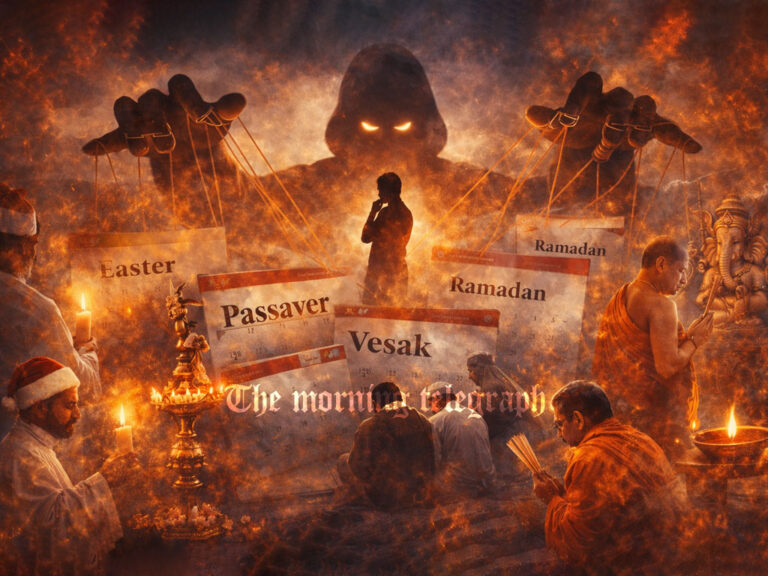
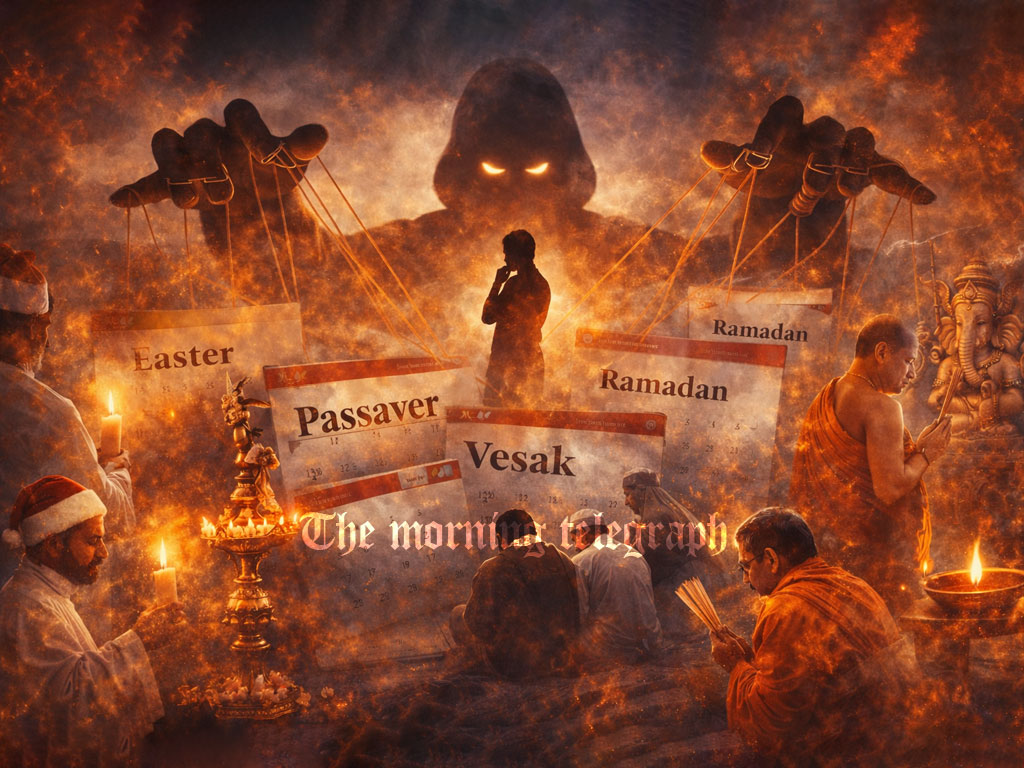
And with this comes the oldest partnership human beings have repeatedly failed to confront: the partnership between power and inherited untruth. It has so often been the rulers, the monarchies, the priesthoods, the religious institutions, and the political parties that stepped into this already crowded field of fear, ritual, grievance, and unquestioned belief and turned it to their own advantage. They understood that once a people are trained to accept without examining, to repeat without understanding, and to defend what they have never honestly investigated, they become easier to divide and easier to govern. Then religion is no longer only belief. It becomes political currency. It becomes a cloak for ambition, a language for authority, a machinery for obedience, and a weapon for shaping crowds. In this way the lie keeps haunting the truth, not only through old stories and ceremonies, but through the hands of those who know how to use the unchecked mind of humanity for power, control, and gain. The doctrine of divine right, the long alliance between throne and altar, and the enduring entanglement of religion with state power make this pattern unmistakable.
That is where the haunting really continues. Not merely in scripture, not merely in ritual, not merely in a holiday or observance, but in the way unexamined belief leaves the human mind vulnerable to those who know how to move crowds without enlightening them. The lie survives because the inward work is so often left undone. The lie survives because symbol still feels safer than truth. The lie survives because many would rather belong than see clearly. And where the mind remains unchecked, it is easily turned away from reality and toward performance, obedience, outrage, and division.
What matters is not whether a religion can preserve memory, beauty, structure, or moral aspiration. What matters is whether the human being within it is becoming more awake. If the ceremony continues, yet the person remains inwardly confused, fearful, dishonest, divided, and easily manipulated, then something essential has been lost. The moon may still be full, the lamp may still be lit, the fast may still be kept, the feast may still be prepared, the prayer may still be recited, but none of these, on their own, can guarantee truth. Truth enters only where life is honestly lived.
This may be the real human hypocrisy. We say we honor prophets, sages, teachers, liberators, scriptures, saints, enlightened beings, and divine truths, yet we repeatedly choose the ceremonial shell over the living message. We keep the dates. We repeat the names. We wear the clothes. We prepare the food. We light the lamps. We follow the moon. We recite the story. But have we become more truthful, more compassionate, less violent, less manipulative, less fearful, less greedy, less divided, less dishonest with ourselves? If not, then what exactly are we celebrating? Memory without transformation becomes performance. Ritual without inner work becomes culture without clarity. Religion without self-awareness becomes inherited identity dressed as wisdom.
The civilized human being of this age must therefore ask more of all traditions, not less. Not hatred toward religion, and not blind defense of it, but examination. Not mockery of observance, and not surrender to it, but clarity about what it is for. Every religion that survives into this century should be asked the same question: does it help a human being live more truthfully now? Does it deepen awareness, responsibility, ethical conduct, and humility? Or does it merely preserve belonging through ritual continuity while leaving the person inwardly unchanged? These are fair questions. More than fair, they are necessary. We know too much now to keep pretending that old forms must remain beyond inquiry simply because they have been carried for centuries.
The way forward is not to mock every observance or abolish every holiday. It is to free human beings from the idea that sacred time must always belong to inherited dogma. Let there be days for truth. Let there be days for conscience. Let there be days for self-correction, family presence, care of the earth, rest from labor, silence, learning, service, gratitude, and reflection on the life one is actually living. Let humanity become mature enough to celebrate not merely what it has been told, but what it has honestly seen. No religion is honored by empty ritual, and no teacher is honored by symbolic remembrance alone. Truth is honored only when it is lived.
And that may be where a more honest human future begins, not in hatred of what came before, not in rebellion for its own sake, but in the quiet courage to see clearly what still carries life, and what no longer does.
Author’s Note
This reflection is not written to insult sincere believers, nor to deny the beauty, comfort, or cultural depth that many find in religious traditions and observances. It is written to ask whether humanity is willing, in this age of knowledge, to distinguish between inherited form and living truth. If a belief, ritual, holiday, or tradition still helps a human being become more aware, more ethical, more compassionate, and more honest, then it still carries life. But if it survives only through repetition, fear, identity, and unexamined loyalty, then it deserves not blind defense, but careful observation.
About the Author
Roshan Jayasinghe is a writer and observer of human systems. His work explores the gap between man made constructs and lived humanity, with a focus on how economics, trade and everyday choices intersect with questions of fairness, responsibility and inner alignment. Through essays for publications in The Morning Telegraph, he aims to remind readers that they are not passengers in a fixed machine, but active custodians of a shared world.