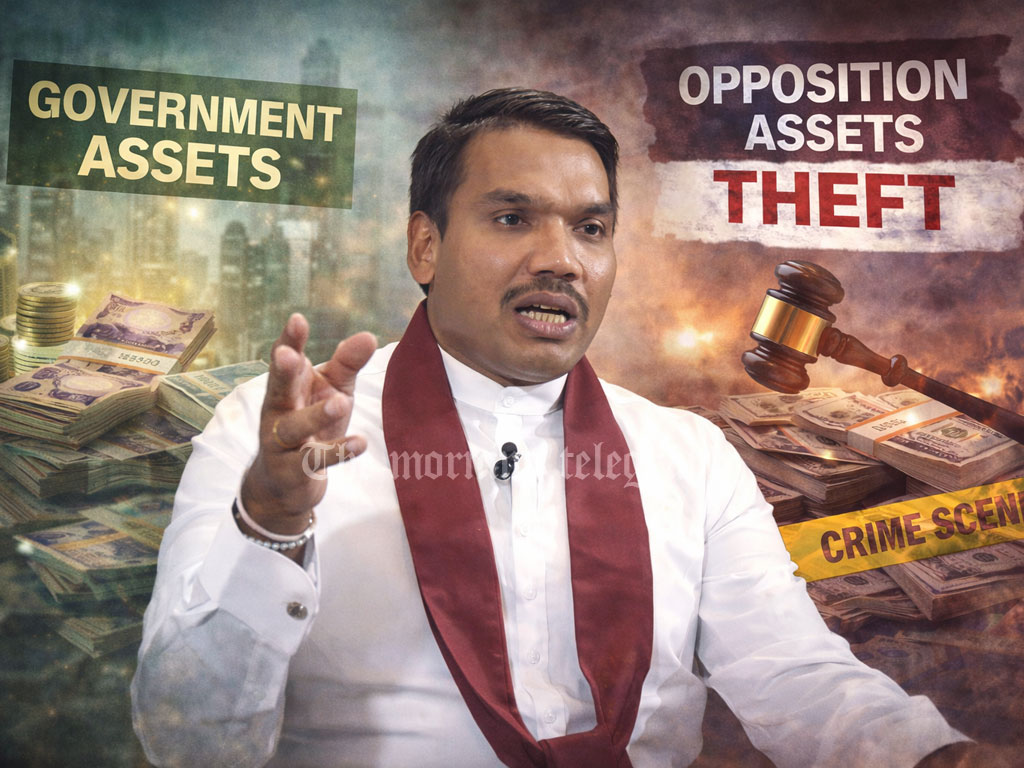
Namal Rajapaksa has accused the government of applying one rule for those in power and another for those in the opposition, arguing that wealth, corruption claims, and public morality are now being judged through political convenience rather than fairness or truth.
Sri Lanka Podujana Peramuna National Organizer and parliamentarian Namal Rajapaksa says the country is now witnessing a dangerous political double standard where the assets of government figures are described as social capital, while the assets of opposition politicians are instantly branded as theft. According to him, the language of accountability is being selectively twisted to shield those in power and target those outside the ruling camp. His remarks have added new fuel to the political confrontation over corruption, political hypocrisy, public trust, and the unequal standards now shaping Sri Lankan governance.

He made these remarks while speaking to the media after attending a religious event at the Kelaniya Raja Maha Viharaya.
Namal Rajapaksa went on to expand on his criticism.
He said that for his birthday, the Kelaniya electorate, including Prasanna Ranaweera and Sri Lanka Podujana Peramuna members from the Gampaha District, had organized a gathering with the blessings of the Nayaka Thero, and that he had come to attend it.
He then said he has recently been studying the idea of social capital. According to him, when members of the government acquire assets or receive benefits, those things are described as social capital. If a government-aligned official gains something, it is spoken of in the same way. But if an opposition politician or a civil servant linked to the opposition possesses assets, that is immediately called theft. He said that those in the ruling party and those aligned with the JVP now seem to enjoy this convenient protection of language, while others are condemned under a completely different standard. In his words, this is the political reality he is now carefully observing.
Namal also recalled how dramatic allegations had once been made from political stages against the opposition. He said there were claims about Lamborghinis, golden horses, and even accusations that 18 billion dollars had been taken to Uganda. He argued that those sensational stories were loudly used for political gain in the past, but that today the same energy is missing when allegations arise around the ruling side. He then claimed that the President is directly tied to the Bala coal scam. He further alleged that the President’s close associate had been elevated to a ministerial post. Referring to the past, he said that when the President had earlier been involved in politics alongside former President Chandrika Kumaratunga as Agriculture Minister, the biggest tender at that time had been the fertilizer tender. Now, after becoming President, Namal said the biggest tender in focus is the coal tender, and that the key political appointments around it reveal a troubling pattern. He suggested that those in power were protecting each other while the real burden was being pushed onto the public. In the end, he said, it is the ordinary people of Sri Lanka who suffer, as electricity bills rise, fuel prices increase, and the cost of living keeps climbing.
He also urged people to remember the assistance given during the Covid period, saying five thousand rupees was distributed four times during the pandemic. He said governing during such severe hardship was never easy and that the Covid crisis was one of the hardest periods the country had faced. According to him, many of the questions now being raised could not have been answered in simple terms at that time because the situation was extraordinary. There were oil tankers delayed, ships could not arrive properly, and the global emergency created intense pressure on the state. Yet even in such a situation, he said, their government stood with the people and worked to protect them. He argued that their political approach had always been to shield the country from deeper social disaster and wider national collapse.
From there, he widened the argument by referring to the war against the LTTE. He said they fought the LTTE because they wanted to prevent a larger social disaster and that they could easily have chosen a softer path by letting the division continue. He claimed that if Mahinda Rajapaksa had taken such a route, he might today have been praised internationally and even awarded the Nobel Peace Prize. Instead, Namal said, Mahinda Rajapaksa was later branded a murderer and a thief despite defeating the LTTE. He asked what the reason was for condemning him after the defeat of the LTTE. He then argued that the same logic applied during the Covid pandemic. When the country was facing another social disaster, he asked whether leaders should simply have stepped aside and focused only on economic formulas and the demands of the IMF or other outside institutions.
He maintained that their government acted to stop a social disaster, prevent hunger, and support agriculture. He said people should remember that before the chemical fertilizer crisis, fertilizer was given only for two seasons, and that this had been part of an effort to encourage the cultivation of every crop that could be grown in Sri Lanka. According to him, their politics had always been guided by the need to stop disaster before it spread further. He added that when the Aragalaya struggle emerged and young people came onto the streets, they did not respond by dragging the country into deeper collapse as had happened elsewhere. Instead, he said, they stepped back and prevented another social disaster. He argued that they have always tried to function within democratic politics and in line with the religious and social character of the country, adapting to the needs of the Sri Lankan people as they understood them.
He concluded by saying that they come when the people call them and leave when the people reject them. According to him, the decisions they made were always intended to protect citizens from greater suffering rather than drag them into more crises. In contrast, he said, the present government not only makes decisions without hesitation, but also forces the public to carry the losses created by its own fraud, corruption allegations, and failed governance.