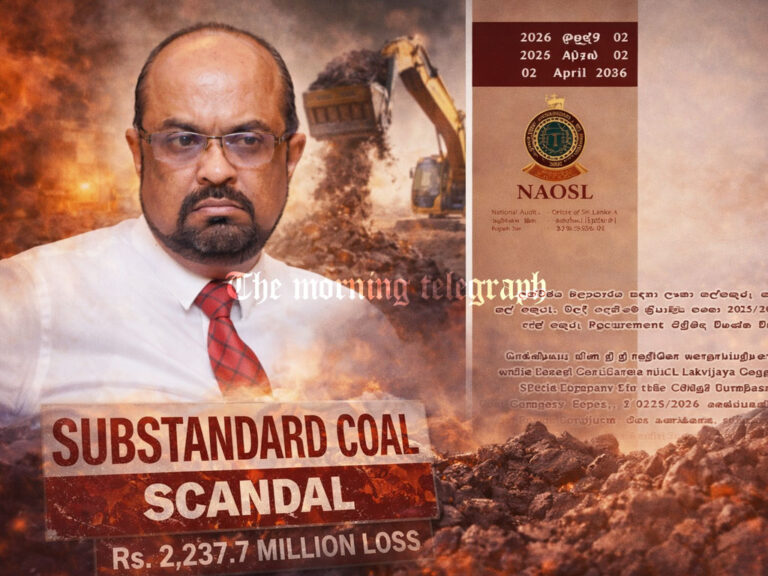
A damning audit report uncovers systemic failures, questionable procurement practices, and massive financial losses linked to Sri Lanka’s substandard coal imports, raising serious concerns over transparency and governance.
There has been intense public and political discussion surrounding irregularities linked to the importation of coal for the 2025 and 2026 period, particularly focusing on procurement transparency and energy sector governance.
The audit investigation report into the substandard coal imports has now been officially released, estimating that the financial loss caused by excessive coal consumption amounts to Rs. 2,237.7 million, placing significant strain on the national economy.
The report highlights a series of critical irregularities identified during the audit process, raising serious concerns about compliance, procurement integrity, and oversight within the Lanka Coal Company.

The observations outlined in the audit report are detailed as follows.
Irregularities in the submission of tender documents:
The audit revealed that Lanka Coal Company had sent tender documents via email on August 18, 2025, and by courier on August 19, 2025, to Trident Chemphar Limited, which had not completed its registration by paying the full fee by the required deadline, and to ANACAPE Trading DMC, which completed its registration only on August 19, 2025. This contradicts the tender notice that required documents to be issued only to registered suppliers as of August 18, 2025.
It was further noted that Trident Chemphar Limited received confirmation of full payment only on August 22, 2025, indicating that its registration was incomplete at the time of the tender call.
The audit concluded that the contract to supply 1.5 million metric tons of coal for the Lakvijaya Power Plant was awarded to a supplier that had not fulfilled mandatory registration requirements, violating procurement fairness and equal opportunity principles.
Testing of coal quality:
The audit found that despite 12 coal shipments arriving by March 11, 2026, the power plant failed to reach full operational capacity, raising questions about coal quality and energy efficiency.
Although concerns regarding substandard coal were raised in Parliament and public forums, Lanka Coal Company did not appoint an independent inspector acceptable to both parties to verify quality.
Opportunities to conduct random sampling inspections at the loading port and to utilize umpire sample testing were also not used, preventing corrective action on poor quality shipments.
The audit further revealed inconsistencies in laboratory testing, where an Indonesian company was assigned responsibility but reports were instead issued by a different entity that lacked proper accreditation for coal testing.
Additionally, the agreed testing agency’s accreditation had expired and was not renewed, further undermining the reliability of quality assessments.
Despite most parameters of the coal failing to meet required standards in 9 out of 12 shipments, inspectors certified them as acceptable, although plant data showed reduced power generation capacity.
Criteria for supplier registration:
The audit highlighted that the required gross calorific value for coal was 6,150 kcal per kilogram, but supplier qualification criteria were relaxed, allowing suppliers with significantly lower quality coal experience to qualify.
Trident Chemphar Limited had previously supplied coal with calorific values mostly between 4,900 and 6,000 kcal per kilogram, well below the required standard.
Audit findings confirmed that none of the shipments met the required calorific value standard for the Lakvijaya Power Plant, directly affecting energy production efficiency.
Other suppliers, including Taranjot Resource Pvt Ltd and PT Fawad Trading and Construction, were also registered despite failing to meet minimum quality thresholds.
The audit further observed that supplier registration criteria were significantly weakened from previous years without clear justification based on technical or legal analysis.
Additionally, long-term supplier registration without annual re-evaluation prevented proper verification of financial stability and operational capability.
Obtaining Attorney General approval:
Although approval from the Attorney General’s Department was granted on November 20, 2025, the contract with the selected supplier had already been signed on November 19, 2025, indicating procedural violations.
Impact of non-standard coal:
The audit estimated that losses from excessive coal consumption due to poor quality amounted to Rs. 2,237.7 million, reflecting a significant financial burden on the country.
Due to the inability to generate the expected 300 MW capacity, the estimated additional energy requirement is 114,531,131 kWh if operating at full capacity for 24 hours daily.
If operating at full capacity for 16 hours daily, the additional energy requirement is estimated at 76,354,087 kWh, highlighting the severe impact on Sri Lanka’s energy sector and electricity generation efficiency.