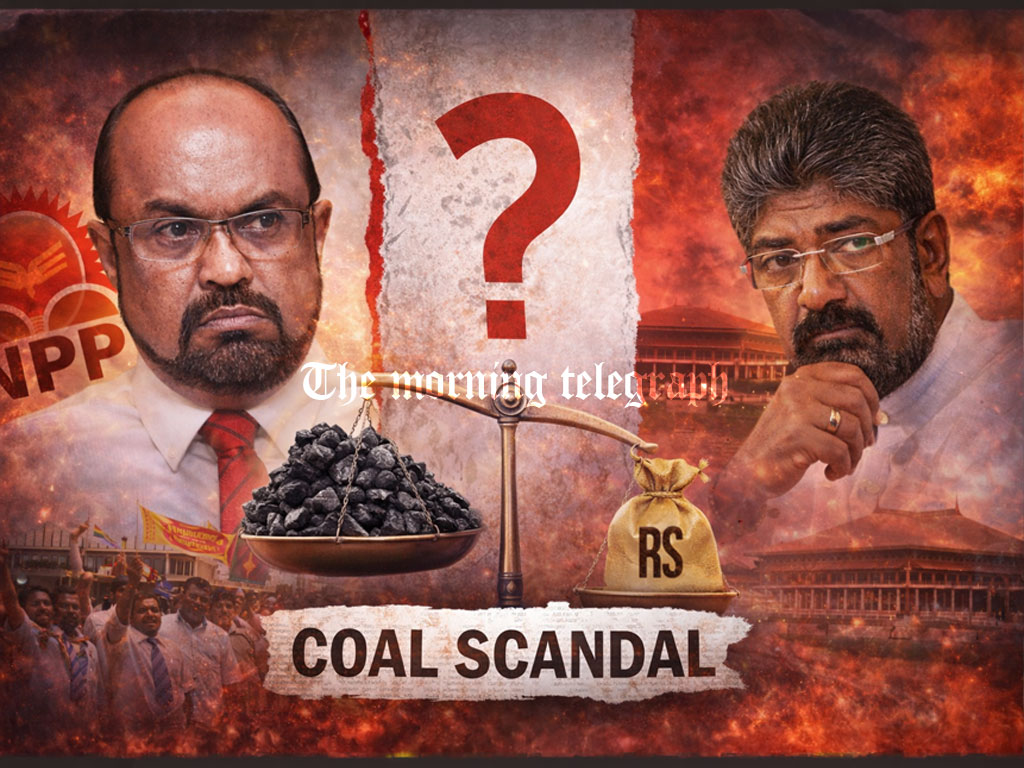
A mounting political storm raises tough questions about governance, accountability, and whether protecting one minister could cost the NPP its credibility and reform promise.
Consider this unfolding political dilemma. A sitting Cabinet minister is indicted after months of speculation, publicly declares his innocence, survives a no confidence motion, yet is ultimately forced to resign. This was the case of Keheliya Rambukwella two years ago. Importantly, Rambukwella did not wait for a guilty verdict before stepping down.

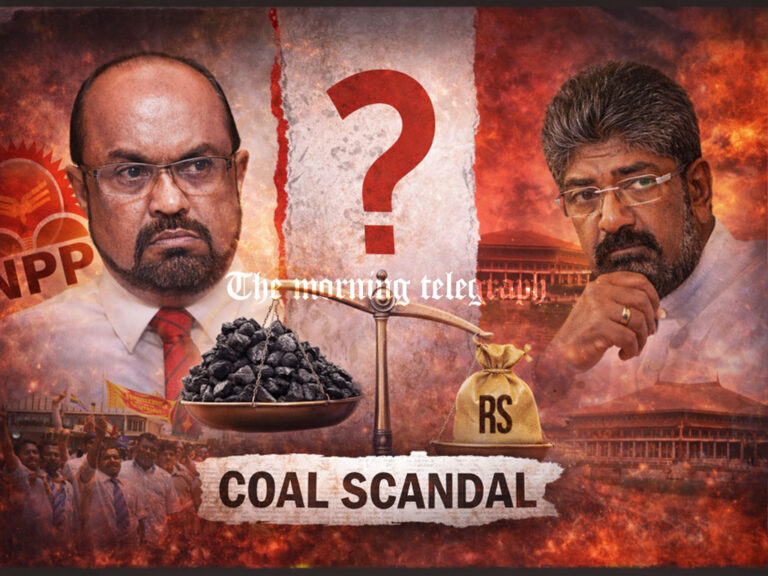
Now turn to the present political landscape. The National Peoples’ Power government’s Minister for Energy, Kumara Jayakody, finds himself in a strikingly similar position. He has already been indicted over a procurement decision made during his time as a government official many years ago. At the same time, allegations surrounding the controversial low quality coal procurement, a key issue under his current ministry, continue to swirl, although they remain unproven. Despite mounting pressure from the opposition demanding his resignation, Jayakody has remained unmoved, and President Anura Kumara Dissanayake has not removed him from office.
To be fair, the allegations against Jayakody are far less severe than those faced by Rambukwella. Furthermore, like any citizen, he is entitled to the presumption of innocence until proven guilty in a court of law.
Jayakody and the government have attempted to justify his continued position. They argue that the charges stem from actions taken many years ago in his capacity as an official, not as a minister. President Dissanayake has echoed this reasoning when questioned about retaining him in Cabinet. However, this raises an important question. Would the same logic apply if the charges involved a more serious offence? Where exactly is the line drawn between what is acceptable and what is not within a government that claims zero tolerance for corruption?
On the issue of the controversial coal tender, the government has maintained a more consistent stance. It insists that there were no irregularities in awarding the contract but acknowledges that the coal supplied was of inferior quality, resulting in significant financial losses to the state. Even if corruption is not proven, questions about competence and oversight arise. The failure to ensure proper checks and balances has reportedly cost the country far more than the alleged offence for which Jayakody has been indicted.
The opposition, as expected, has called for Jayakody’s resignation. When this did not materialise, it moved to initiate a no confidence motion. Given the NPP’s commanding two thirds majority in Parliament, there is little doubt that Jayakody will survive such a vote. However, survival does not necessarily translate into political victory. Rambukwella survived a similar motion, yet still had to step down.
The NPP rose to power in late 2024 on a platform built around anti corruption, transparency, and strong governance. It promised a system where no individual would be above the law and where even the slightest hint of wrongdoing would not be tolerated.
The first real test of that promise came with the controversy surrounding then Speaker Asoka Ranwala, who was unable to substantiate claims about his academic qualifications. After initial hesitation, decisive action was taken, and Ranwala was removed. His departure was seen as a signal that the government was willing to uphold its standards, although questions about his continued role in Parliament lingered.
The situation with Jayakody, however, is far more serious. The allegations he faces could potentially result in criminal penalties if proven. In such circumstances, the most prudent course of action would have been a voluntary resignation. This would have allowed the government to claim moral consistency while preserving its credibility. If exonerated, Jayakody could have returned with his reputation restored. If not, the government would have demonstrated its commitment to accountability.
Instead, this path has not been taken. Reports suggest that the NPP leadership believes in Jayakody’s innocence. Yet divisions within the party are evident. One faction is pushing for his removal, while another views resignation as surrendering to opposition pressure and therefore resists such a move. As a compromise, discussions are reportedly underway for a face saving exit, potentially after Jayakody survives a no confidence vote, mirroring the Rambukwella approach.
This strategy raises an important question about cost. For a government that campaigned on eradicating corruption and delivering system change, allowing this situation to drag on provides ammunition for the opposition. Weeks of political messaging and public criticism risk eroding the goodwill the NPP has built since coming to power. Jayakody remaining in Cabinet while investigations continue does not align with the image of clean governance, even if he is ultimately cleared of wrongdoing.
There is also the question of political perception. Has the NPP become overly confident due to its control of both the Executive Presidency and a strong parliamentary majority? Opposition parties are already alleging that there may be deeper connections behind the coal tender controversy. While such claims may be politically motivated, repetition can influence public opinion and shape narratives.
Kumara Jayakody is not among the most prominent figures within the NPP. If the decision to retain him is driven solely by a desire to avoid appearing weak, it may prove to be a serious miscalculation. While he may survive politically in the short term, the long term impact on the NPP’s credibility could be far more damaging.
Ultimately, the question remains whether protecting one minister is worth undermining the very principles on which the government was elected. Saving Kumara Jayakody may come at a cost the NPP cannot afford.