By Marlon Dale Ferreira
A dramatic fall from influence unfolds as an ethics ruling triggers a two-year ban, exposing deeper cracks in governance, power struggles, and accountability within Sri Lanka’s Olympic movement.
It began, as many such stories do, quietly.
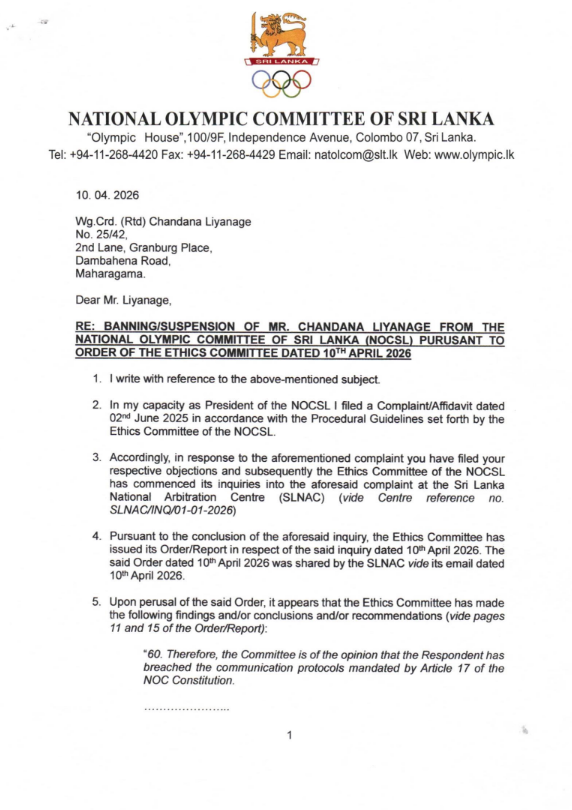
Inside the corridors of the National Olympic Committee of Sri Lanka, a formal complaint was filed. Dated June 2, 2025, it did not immediately capture public attention. There were no headlines, no outrage, no debate. But within that document lay the beginnings of a process that would eventually ripple across Sri Lanka’s sporting landscape.
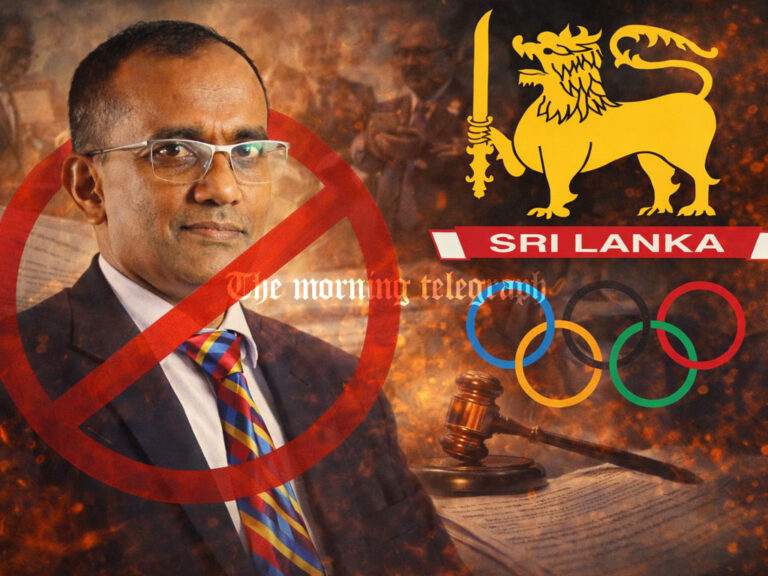
The complaint, lodged by NOCSL President Suresh Subramaniam, was not just procedural. It was strategic. It invoked the authority of the Ethics Committee and pointed to alleged breaches of communication protocols under Article 17 of the NOC Constitution. At its center stood a familiar name in Sri Lanka’s sports administration, Wing Commander Chandana Liyanage.

What followed was not swift justice, but a structured and deliberate process.
Liyanage responded. Objections were filed. The matter moved beyond internal discussions and into a formal inquiry at the Sri Lanka National Arbitration Centre. Behind closed doors, documents were examined, arguments presented, and positions defended. The case was no longer just an allegation. It had become a test of governance, procedure, and institutional credibility.
Months passed. Then came April 10, 2026.
On that day, the Ethics Committee delivered its findings.
The conclusion was clear. The committee determined that Liyanage had breached the mandated communication protocols. It was not framed as a minor oversight. It was presented as a violation significant enough to warrant disciplinary action at the highest level.
But the real impact lay in what followed.
The recommendation was decisive. A two-year suspension from all activities related to the NOCSL and affiliated Olympic sports federations. Not a warning. Not a temporary restriction. A complete ban.
Once the report was issued, the machinery of authority moved quickly.
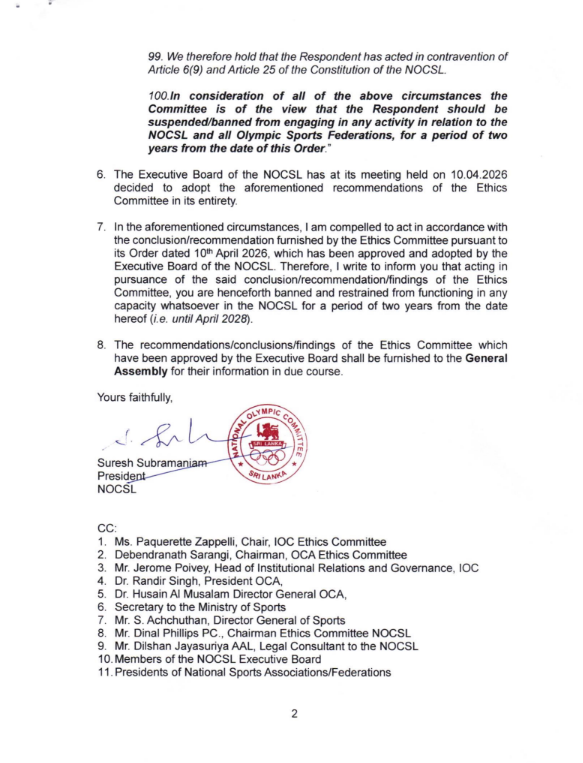
The Executive Board of the NOCSL reviewed the findings. There was no visible hesitation. The recommendation was approved and adopted. The decision was no longer confined to a committee report. It had become official policy.
Then came the letter.
Addressed directly to Chandana Liyanage, it carried the weight of finality. The language was formal, but the message was unmistakable. Effective immediately, he was banned from functioning in any capacity within the National Olympic Committee of Sri Lanka until April 2028.
For a figure once embedded within the system, it marked a sudden and absolute fall.
Yet the story does not end with the ban itself.
What makes this moment significant is not only the disciplinary action, but what it reveals about the evolving dynamics within Sri Lanka’s sports governance. The involvement of the Sri Lanka National Arbitration Centre, the structured inquiry, and the alignment of the Ethics Committee with the Executive Board all point to a system attempting to assert control, enforce rules, and demonstrate accountability.
At the same time, the extensive list of those copied in the communication tells its own story. From the International Olympic Committee to the Olympic Council of Asia, from national sports authorities to legal advisors, the decision was not kept internal. It was broadcast across institutional networks, ensuring visibility at both local and international levels.
This was not just a ruling. It was a statement.
A statement that governance breaches would be addressed. A signal that internal disputes could carry external consequences. And perhaps most importantly, a reminder that power within sports administration is never permanent.
For Chandana Liyanage, the next two years will be defined by absence. Removed from committees, excluded from federations, and cut off from the very system he once operated within.
For the NOCSL, however, the real challenge lies ahead.
A ban may resolve a case, but it also raises questions. Questions about consistency, transparency, and whether similar standards will be applied across the board. Questions about whether this marks a turning point or simply another chapter in a long history of internal struggles.
In Sri Lanka’s sporting world, where influence, politics, and administration often intersect, moments like this rarely fade quietly.
They linger.
They reshape alliances.
And sometimes, they redefine the rules of the game.