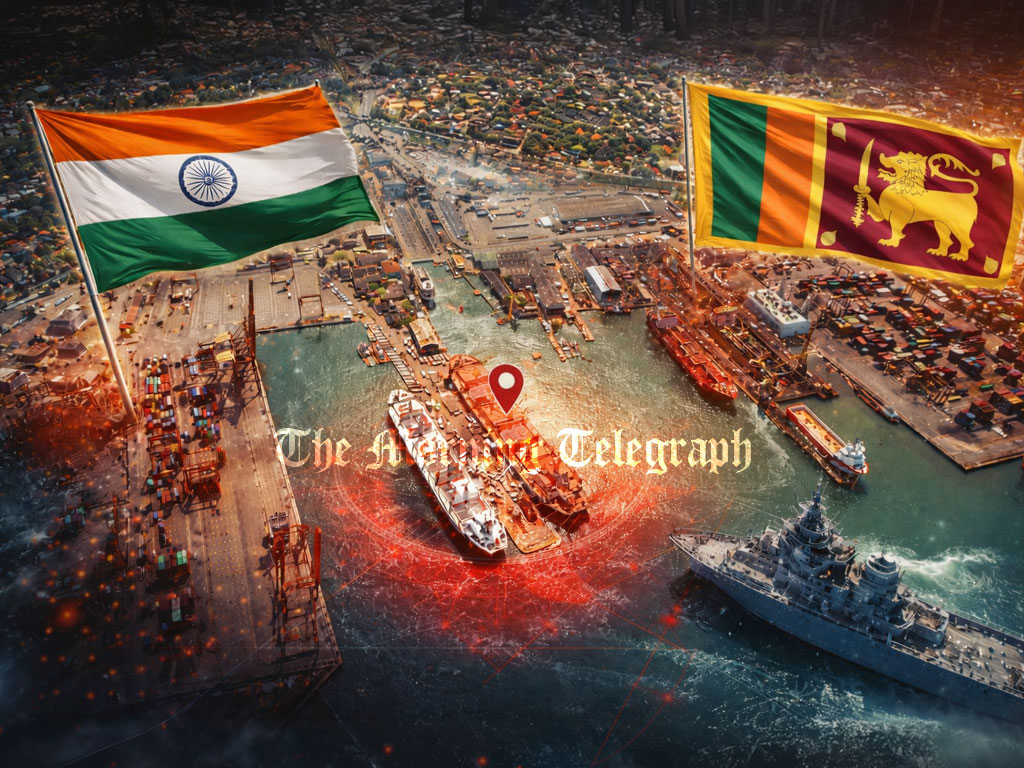
A high-stakes shipyard deal is reshaping Sri Lanka’s strategic future, raising urgent questions about sovereignty, influence, and power in the Indian Ocean.
In a move already sending ripples across the strategic landscape of the Indian Ocean, Mazagon Dock Shipbuilders Limited has secured a controlling 51 percent stake in Colombo Dockyard PLC, effectively transforming Sri Lanka’s largest shipyard into a subsidiary of India’s leading defence public sector enterprise. Valued at 26.8 million dollars, the acquisition marks MDL’s first major international expansion and signals a decisive shift in India’s maritime ambitions beyond its own shores.

Announced on April 9, 2026 in both Mumbai and Colombo, the deal is being positioned by Indian authorities as a commercial and strategic milestone aligned with long term maritime goals under Maritime Amrit Kaal Vision 2047. While framed as an investment driven by growth and cooperation, the development has triggered renewed debate about India’s expanding footprint in Sri Lanka’s critical infrastructure, particularly at a time when global powers are intensifying competition for influence in the region.
The transition of Colombo Dockyard into an MDL controlled entity has already brought immediate institutional changes. The board has been restructured under Indian leadership, with Captain Jagmohan appointed as Non Executive Chairman. Senior MDL officials including Biju George and Ruchir Agrawal have joined the board, while local leadership such as Thimira S. Godakumbura remains involved in operational roles. The inclusion of Vish Govindasamy from Sunshine Holdings reflects an effort to balance local participation within a framework that now consolidates Indian strategic oversight.
This restructuring is not merely administrative. Analysts suggest that control over a major shipyard in Colombo provides India with critical logistical and industrial advantages due to its proximity to major maritime routes. Colombo Port sits along one of the busiest shipping corridors globally, linking East Asia with Europe and the Middle East. Through this acquisition, India secures a foothold in a location long considered geopolitically sensitive and strategically valuable.
The timing of the agreement also carries significance. In November 2025, Colombo Dockyard secured its largest ever shipbuilding contract with Orange Marine of France, valued at approximately 150 million dollars. The project involves constructing two advanced cable laying and repair vessels equipped with hybrid electric propulsion and ABB Azipod systems. Delivery is scheduled for 2028 and 2029, with the keel of the first vessel already laid in April 2026.
Such high value contracts underline the commercial potential of Colombo Dockyard under its new ownership. The integration of Indian technical expertise and financial backing is expected to enhance competitiveness, enabling the yard to attract more international orders. MDL has already outlined plans to achieve a 20 percent increase in revenue and profits within the current financial year by leveraging operational efficiencies and new project inflows.
However, the implications extend far beyond commercial outcomes. A memorandum of understanding signed on April 7, 2026 between Colombo Dockyard and the Dredging Corporation of India positions the facility as a preferred partner for dredging, repair, and maintenance services. Witnessed by India’s High Commissioner to Sri Lanka, Santosh Jha, the agreement is widely seen as a step toward integrating Sri Lanka more deeply into India’s maritime services network.
Further engagements with the Shipping Corporation of India are expected to channel vessel repair and refit operations to Colombo, effectively turning the dockyard into a regional hub aligned with Indian maritime interests. This growing web of partnerships reflects a broader strategy to establish a cross border maritime corridor anchored in Indian influence across the Indian Ocean.
For Sri Lanka, the deal presents both opportunity and risk. On one side, the inflow of capital and access to Indian markets could revitalize the shipbuilding industry, generate employment, and elevate Colombo as a key regional maritime center. On the other side, concerns are emerging over national sovereignty, economic dependence, and the long term implications of foreign control over strategic infrastructure assets.
These concerns are part of a larger geopolitical context. Sri Lanka has increasingly become a focal point in the competition among major powers, especially in relation to infrastructure investments. The entry of Mazagon Dock Shipbuilders into Colombo Dockyard adds a new layer to this dynamic, particularly given MDL’s status as a defence linked entity under India’s Ministry of Defence.
While Indian officials maintain that the acquisition is purely commercial in nature, the dual use capability of shipyards means that strategic interpretations are inevitable. Facilities capable of servicing both civilian and military vessels raise questions about potential future naval utilization, an issue already being closely monitored by regional observers.
Captain Jagmohan has described the acquisition as a landmark moment for both organizations and for India Sri Lanka maritime cooperation. He highlighted the Dredging Corporation agreement and ongoing collaboration with the Shipping Corporation of India as early indicators of a partnership aimed at reshaping maritime connectivity in the region. His confidence in Colombo Dockyard’s growth reflects the broader optimism surrounding the deal within Indian policy circles.
Yet the broader narrative remains complex. As India expands its presence in the Indian Ocean, developments such as this acquisition will continue to draw scrutiny not only in Colombo and New Delhi, but also across Asia and beyond. What begins as a commercial investment has the potential to evolve into a matter of regional strategic significance, where commerce, geopolitics, and national interest intersect in increasingly consequential ways.