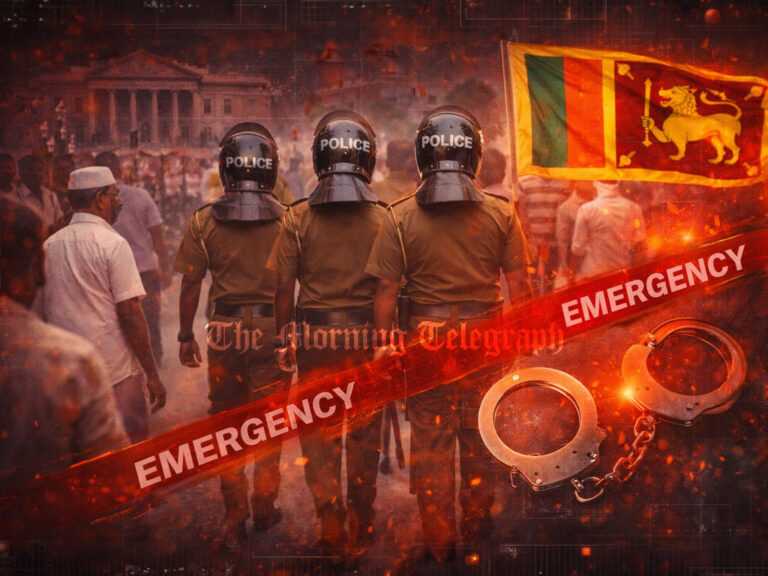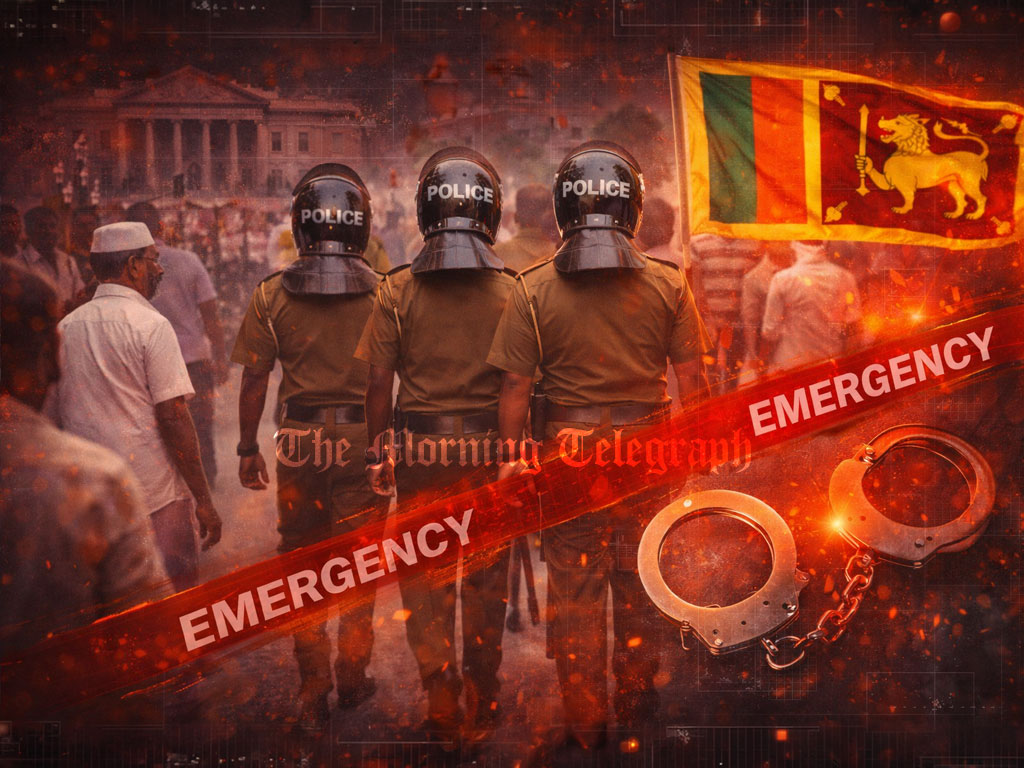
A deepening reliance on emergency powers is raising urgent concerns about democracy, civil liberties, and the long-term future of governance in Sri Lanka.
It is often said that when people fear the government, tyranny takes root, and when governments fear the people, liberty prevails. Yet in Sri Lanka today, the balance appears to be shifting in a troubling direction. In an effort to retain control, successive governments have increasingly turned to emergency regulations, often justified under shifting pretexts. These measures, while sometimes necessary, carry serious consequences for democratic governance and civil liberties. Sri Lanka has, in fact, spent a significant portion of its post-independence history under a state of Emergency.

The current JVP-NPP administration continues this pattern, extending emergency regulations even months after the immediate trigger, Cyclone Dithwa, has passed. The delay in declaring the initial state of Emergency drew widespread criticism, yet the continuation of these powers raises deeper questions about intent and governance. Having once positioned itself as a vocal critic of Emergency rule and the Prevention of Terrorism Act, the government had pledged reform and restraint. Today, that promise appears to have faded, replaced by a continuation of the very mechanisms it once opposed.
Parliament’s recent decision to extend the state of Emergency under the Public Security Ordinance reflects this shift. The vote, which saw 137 in favor and 27 against, was marked by a notable absence of lawmakers. Only 165 Members of Parliament were present in a House of 225. The absence of 60 MPs, including members from both government and opposition benches, raises serious concerns about accountability and legislative responsibility. Calls for division votes and public accountability ring hollow when participation itself is inconsistent. The criticism often directed at public servants for dereliction of duty seems equally applicable to elected representatives.
While a state of Emergency remains a legitimate constitutional instrument, its use must be measured, targeted, and grounded in genuine necessity. When extended for political convenience rather than national urgency, it risks eroding public trust and weakening democratic institutions. The continued reliance on such powers threatens not only civil liberties but also the broader credibility of governance in Sri Lanka.
The prolonged use of emergency regulations has far reaching consequences. It contributes to the erosion of democratic culture, fosters distrust in institutions, and weakens transparency. Civil society and media freedom face pressure, while economic uncertainty grows. Investors are wary of instability, particularly at a time when Sri Lanka is attempting to recover from its worst economic crisis and attract much needed foreign direct investment.
The issue is not confined to the present administration alone. Sri Lanka’s political history reveals a consistent pattern of Emergency rule across successive governments. From 1953 to 1958, from the 1971 insurrection to the long years of conflict ending in 2009, emergency regulations have been repeatedly invoked. Governments led by the UNP and SLFP alike have relied on these powers, whether to suppress unrest, manage crises, or consolidate authority. The legacy is one where Emergency has often been normalized rather than treated as an exception.
In more recent years, events such as the Easter Sunday attacks, economic collapse, mass protests, and natural disasters have further reinforced this trend. Each crisis has brought with it a renewed reliance on extraordinary powers, embedding them deeper into the fabric of governance. The current trajectory suggests that Emergency is no longer a temporary measure but an enduring feature of Sri Lanka’s political landscape.
Ultimately, the concern is not simply about the existence of Emergency regulations, but about their increasing misuse. The present government appears to be following the same path as its predecessors, adopting practices it once criticized while continuing to speak of reform and good governance. This contradiction underscores a deeper structural issue within Sri Lanka’s political system.
As the country navigates its recovery and seeks stability, the challenge lies in restoring balance between authority and accountability. Emergency powers, when overused, risk undermining the very democratic principles they are meant to protect. What Sri Lanka faces today is not just a policy debate, but a defining question about the future of its democracy.