By Roy Denish.
Questions are mounting over alleged delays and internal police disputes surrounding an investigation into two suspicious drug containers.
Over the past few days, social media platforms have been flooded with intense debate, rumours, and sweeping reports alleging a deep-seated institutional rift between the senior leadership of the Sri Lanka Police and the current Inspector General of Police, Priyantha Weerasooriya.
According to various political analysts and pro-government supporters, this narrative is not an organic expression of public concern, but rather a coordinated propaganda campaign allegedly orchestrated by defeated political factions, opposition elements, and members associated with the United National Party.
Furthermore, allegations have also been directed at certain external entities, including specific members of the National Police Commission — such as individuals linked to the former administration, including Dilishan Kapila Jayasuriya — and various media personnel, accusing them of actively manufacturing conflict within the law enforcement hierarchy.

The roots of the controversy trace back to an international intelligence tip-off reportedly received on June 27, 2026, amid growing global concerns over Sri Lanka’s position within transnational narcotics-trafficking networks.
Given these vulnerabilities, foreign anti-narcotics agencies and Interpol reportedly monitor suspicious shipments from the moment contraband is loaded onto vessels at foreign ports.
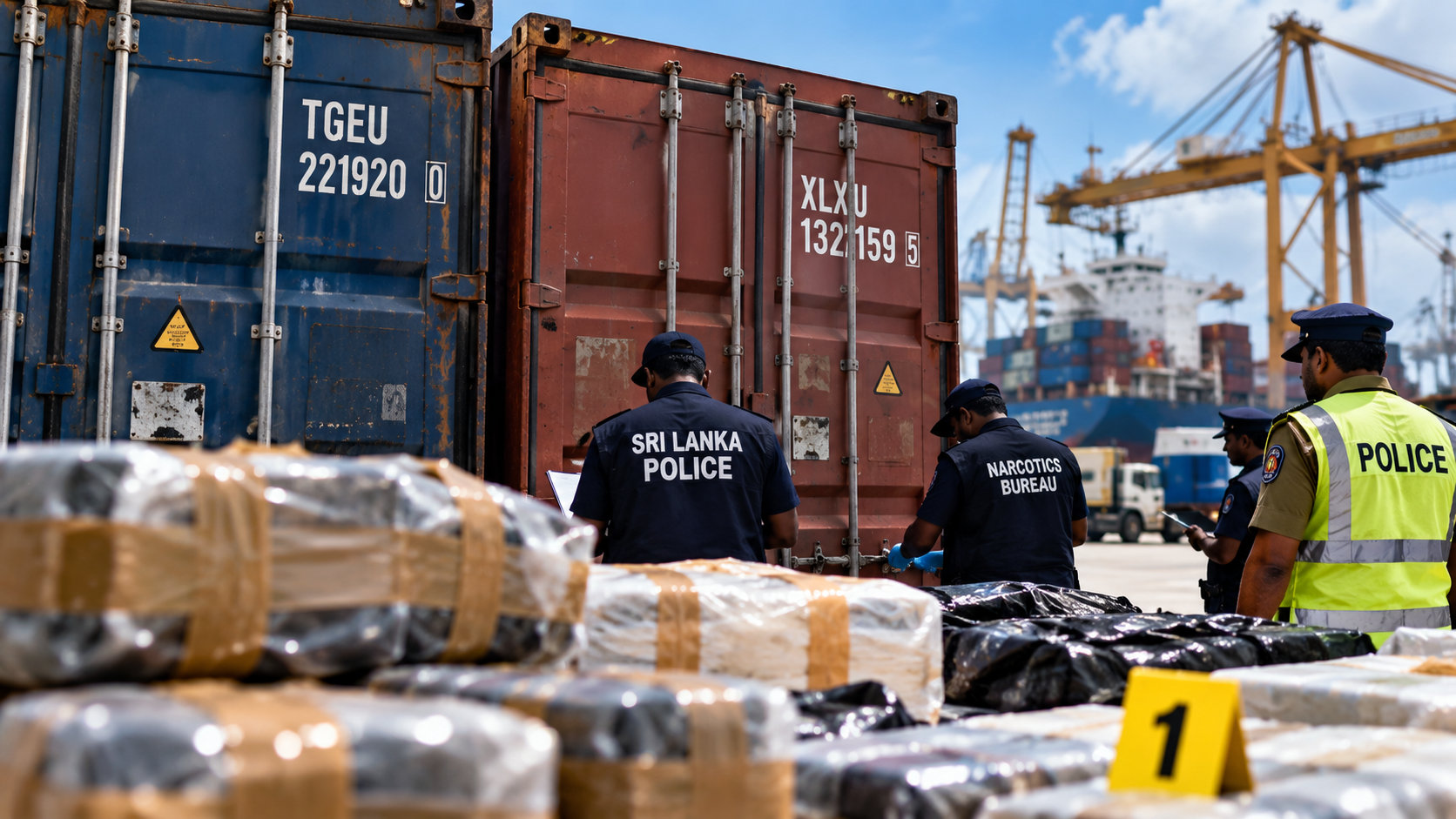
According to the intelligence received, two suspicious containers allegedly carrying narcotics from Pakistan were dispatched to a Sri Lankan port, bearing container numbers TGEU221920 and XLXU132159.
This sensitive information was reportedly received on June 27 by Senior DIG Ranmal Kodituwakku, who holds oversight responsibilities for the Police Narcotics Bureau, traffic divisions, and criminal divisions.
Despite receiving such critical, time-sensitive intelligence, reports allege that immediate action was not taken to notify the Inspector General of Police or direct the Police Narcotics Bureau to intercept the shipment at that stage.
Instead, a significant period allegedly elapsed without visible operational progress concerning the two containers.
Weeks later, on August 17, 2026 — roughly a month and a half after the initial intelligence tip was reportedly logged — Police Inspector Rajapaksa, attached to the Police Narcotics Bureau, filed a formal ‘B’ report before the Colombo Magistrate’s Court.
The primary purpose of the court filing was to seek judicial authorisation to open and inspect the two containers on suspicion that they contained illegal narcotics.
However, the application reportedly triggered judicial scrutiny when the presiding Magistrate rejected the request on August 18, pointing to a fundamental legal issue.
In rejecting the application, the Magistrate reportedly emphasised that under the provisions of the Poisons, Opium and Dangerous Drugs Ordinance, police already possess statutory powers to enter, search, and seize suspicious cargo or locations without first obtaining court permission.
This judicial dismissal raised questions across legal and law enforcement circles as to why experienced narcotics officers chose to seek a court order when the existing legal framework allegedly granted them direct enforcement authority.
While the Police Narcotics Bureau’s initial legal manoeuvring stalled in court, a separate piece of confidential intelligence reportedly reached SI Ekanayake, an officer operating under the supervision of Colombo Crime Division Senior Superintendent of Police Kamal Ariyawansa.
This fresh intelligence allegedly warned law enforcement that the two containers, which had remained at the port since June, were being prepared by unidentified parties to be moved illicitly from the port premises.
Operating independently of the PNB’s earlier actions, Colombo Crime Division officers moved to verify the information, briefing senior officials, including SSP Kamal Ariyawansa and DIG Chandana, given the seriousness of the transnational threat.
Acting on instructions attributed to IGP Priyantha Weerasooriya, CCD teams conducted a raid and apprehended a suspect named Arumugam Shidaran, a resident of Dematagoda, who was allegedly connected to the movement of the cargo.
Following the arrest, the Colombo Crime Division filed a comprehensive ‘B’ report on August 27, 2026, bearing number B87048/2026, outlining the alleged locations of the containers and their status.
The Colombo Magistrate’s Court accepted the submissions and issued the necessary legal directives to facilitate further investigations.
The potential involvement of more than 400 kilograms of high-value narcotics, together with allegations of delays in acting upon the original international intelligence, prompted serious internal concerns within the police department.
To determine whether institutional negligence, administrative lapses, or deliberate wrongdoing contributed to the delayed response, IGP Priyantha Weerasooriya ordered an internal inquiry.
Recognising the gravity of the allegations and the possibility of high-level involvement, the investigation was transferred to the Criminal Investigation Department under the supervision of Senior DIG Shani Abeysekara, with the involvement of the Ministry of Public Security.
The handover of the case to the CID triggered political reactions, with opposition figures and external commentators criticising the police administration.
Critics claimed that the inquiry was a politically motivated manoeuvre designed to sideline Senior DIG Ranmal Kodituwakku and weaken key divisions within the force.
Conversely, defenders of the administration and pro-government commentators have argued that these claims are baseless counter-narratives intended to protect vested interests and create discord within the police establishment.
Public commentary has increasingly drawn parallels with historical drug scandals from previous political eras, during which major narcotics investigations were allegedly suppressed or influenced by political pressure.
Supporters of the current police leadership argue that transparent investigations by the CID are essential to breaking any nexus between organised crime, drug cartels, and corrupt officials.
As suspects arrested in connection with the container incident remain remanded under court orders, ongoing judicial and investigative proceedings continue to examine the network allegedly behind the shipment, testing the resilience and independence of Sri Lanka’s law enforcement framework.