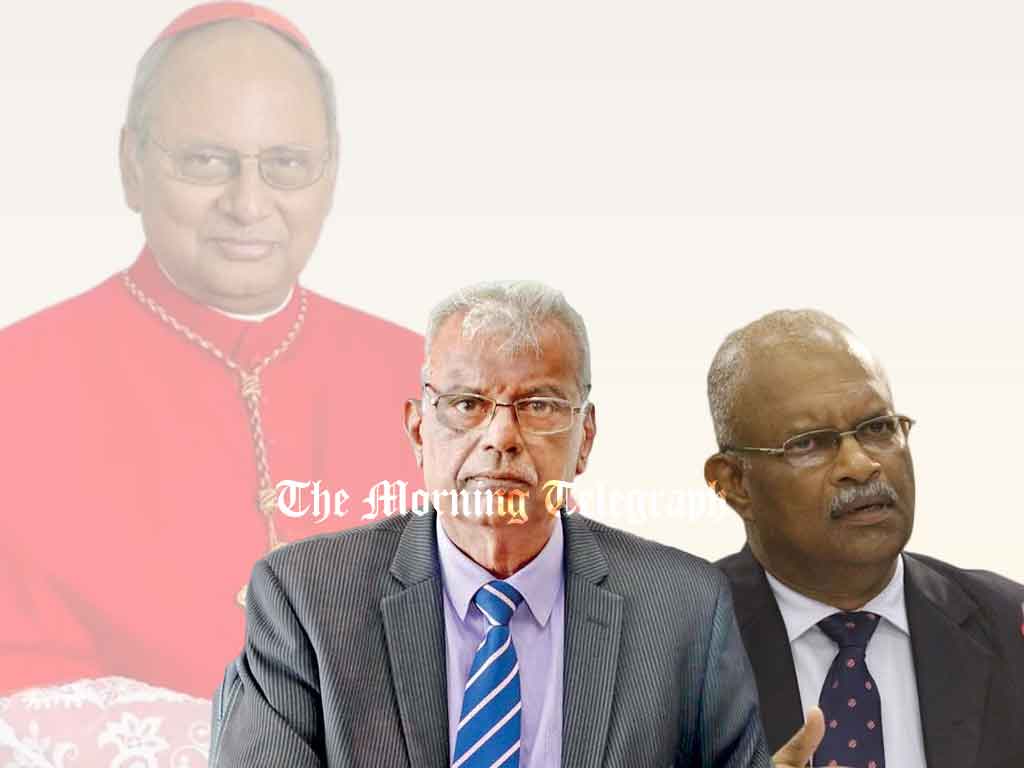
Minister Bimal Ratnayake’s revelation that key police officials were appointed at the Cardinal’s request has triggered intense scrutiny. A deep dive into Sri Lanka’s police history suggests a pattern of influence, raising concerns over politicized clergy and religious favoritism in state affairs.
Minister Bimal Ratnayake’s recent statement in Parliament has reignited a long-simmering debate about religious influence in Sri Lanka’s state appointments. According to the Minister, current Public Security Secretary Ravi Seneviratne and CID Director Shani Abeysekara were appointed at the explicit request of the Catholic Church’s highest representative in Sri Lanka, Cardinal Malcolm Ranjith.
The revelation doesn’t stop there. Social media platforms have exploded with claims that the Cardinal has also lobbied for a service extension for the current Army Commander, Lasantha Rodrigo. While the comments have triggered emotional reactions across the political spectrum, observers familiar with Sri Lanka’s law enforcement history aren’t surprised.
The Sri Lanka Police, established constitutionally on September 3, 1866, has been led by 36 Inspector Generals of Police (IGPs), including 11 foreigners and 25 Sri Lankans. Since Sir Richard Aluwihare became the first local IGP in 1947, the force began its transition from British to indigenous control. However, of the 36 IGPs, a surprising 26 are reportedly from the Cardinal’s hometown. Coincidence? Or institutional legacy?
The article outlines the IGP timeline:
From Sir Richard Aluwihare in 1946 to T.M.W.D. Tennakoon in 2024, Sri Lanka has seen varied leadership. Notably, Cardinal Ranjith has played an active role not just in religious affairs, but in shaping national security through lobbying and court interventions.
The Cardinal has taken legal action against former IGPs Pujith Jayasundara and Deshabandu Tennakoon, both Sinhala Buddhists. Critics question if this reflects a concerning pattern. If the Cardinal truly advocates justice, such interventions should be consistent across all demographics, yet his active role in removing Buddhist IGPs is causing discomfort.
Historical context adds fuel to the fire. In 1962, a failed anti-government coup attempt involving military and police officers was largely orchestrated by individuals from the Cardinal’s region. These events add weight to accusations that religious figures have played dual roles in Sri Lanka’s political and security landscape.
The Cardinal’s activism wasn’t limited to appointments. He was a visible figure during the public uprising that ousted President Gotabaya Rajapaksa, a Sinhala Buddhist leader. Many recall his call to action during the 30-year civil war, and his vocal advocacy post-Easter attacks has been seen by some as politically charged rather than spiritually driven.
Yet, the Cardinal continues to demand influence. His apparent efforts to control police appointments are viewed by critics as a continuation of a long-standing strategy to secure power through soft influence.
However, this isn’t a one-sided critique. It is a reflection of how deeply intertwined religion and politics have become in Sri Lanka. While some defend the Cardinal’s interventions as efforts to restore justice post-Easter attacks, others argue it signals a deeper problem: a politicized religious leadership wielding disproportionate power.
The article concludes with a poignant reflection: understanding history requires the ‘third eye.’ This isn’t about inciting religious hatred. It’s about recognizing patterns, influence, and the fine line between advocacy and overreach.