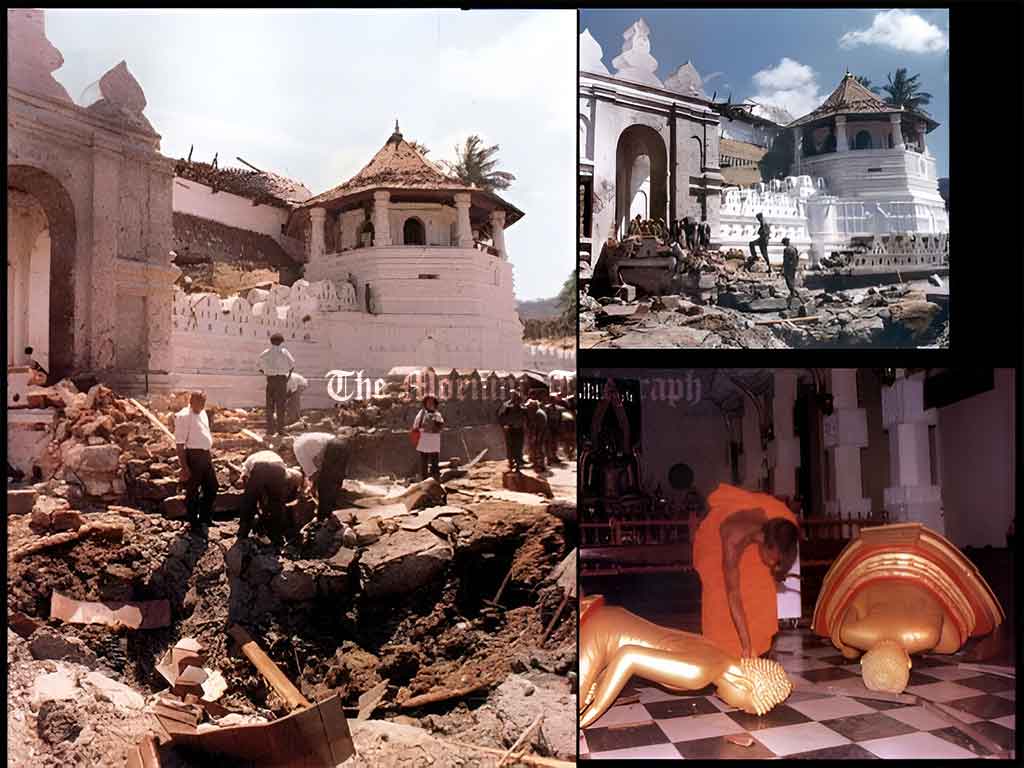
In a startling revelation, the Sri Lankan government admits it holds no official records of the 1989 JVP-led attack on the sacred Dalada Maligawa. The disclosure has sparked outrage in Parliament, with opposition MPs demanding transparency, accountability, and a public report on what many consider one of the darkest days in Sri Lanka’s religious and political history.
No Official Records of 1989 Dalada Maligawa Attack, Says Government
The Sri Lankan government has admitted it possesses no official records or investigative reports related to the 1988/89 attack on the sacred Sri Dalada Maligawa, Parliament was told today.
Public Security Minister Ananda Wijepala, representing the JVP-led National People’s Power (NPP) government, made the revelation while responding to a question posed by Samagi Jana Balawegaya (SJB) MP Rohini Kaviratne during a Parliamentary session.
Kaviratne highlighted the gravity of the incident, pointing to the widely acknowledged February 8, 1989 attack carried out during the second JVP insurrection. She also referenced a later attack by the LTTE on the same religious site and questioned whether the main road in front of the Maligawa, closed since the attacks, could now be reopened for civilian access.
In his response, Minister Wijepala confirmed that no documentation or detailed government records exist on the 1989 attack. He added that the only detail available is that six women were arrested in connection with the incident. He did not elaborate on the outcome of those arrests or mention any follow-up investigations.
The revelation drew sharp criticism from other MPs. MP Dayasiri Jayasekera contested the Minister’s claim, stating that details of the attack are indeed available. “The JVP launched attacks on five security points of the Maligawa. One attacker dressed in saffron robes even threatened the Diyawadana Nilame with a knife. We know that six women were arrested afterward. We demand that a formal report be submitted to the House on this attack,” he insisted.
The disclosure has reignited controversy over JVP’s violent history, especially as the party now leads the current coalition government. Critics argue that failure to maintain or reveal records of attacks on sacred sites like Dalada Maligawa raises serious questions about transparency, accountability, and national memory.
The incident continues to resonate deeply in Sri Lanka’s collective consciousness, and many citizens and lawmakers alike are demanding answers and justice more than three decades later.