A groundbreaking Virginia Tech study warns of a catastrophic mega-tsunami up to 1,000 feet high that could devastate the US Pacific Coast if a massive earthquake strikes the Cascadia Subduction Zone. Experts say urgent action is needed to protect millions from one of North America’s deadliest seismic threats.
Scientists are sounding the alarm over a potential mega-tsunami that could strike the US Pacific Coast, triggered by a massive earthquake along the Cascadia Subduction Zone (CSZ). Stretching roughly 600 miles from Northern California to Vancouver Island, the CSZ is a highly hazardous fault where the oceanic Juan de Fuca Plate slowly pushes beneath the North American Plate, building extreme tectonic stress over centuries.
A Virginia Tech research team, led by geoscientist Tina Dura, estimates a 15% chance of a magnitude 8.0 or greater earthquake occurring in the CSZ within the next 50 years. Their study, published in the Proceedings of the National Academy of Sciences, reveals that such a quake could cause the coastline to drop by as much as 6.5 feet almost instantly, expanding floodplains and generating tsunami waves that dwarf anything in recorded history.

The last major quake in the CSZ occurred in 1700, triggering a tsunami that reached Japan. A similar event today, researchers warn, would be far deadlier due to heavily populated cities, complex transportation networks, and critical infrastructure along the coast. Coastal communities could face submersion within minutes, leaving little time for evacuation.
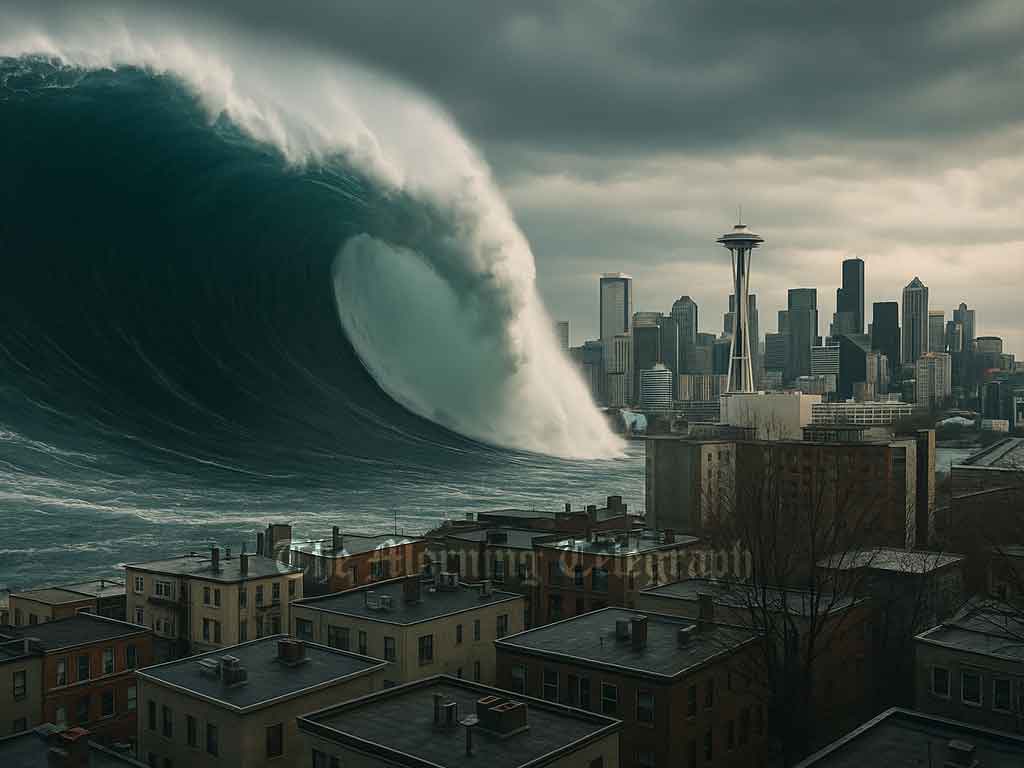
Simulations by Dura’s team show that a major CSZ earthquake could unleash a tsunami reaching heights up to 1,000 feet—far exceeding the few feet typical of most tsunamis. Seattle, Portland, and multiple towns in northern California could be rapidly inundated. Tens of thousands of modeling scenarios revealed that current hazard maps underestimate the number of people, buildings, and roads that would be flooded.
The study stresses that the combination of sudden ground subsidence and extreme wave heights would create conditions unlike any past tsunami in the Pacific Northwest. Southern Washington, northern Oregon, and northern California are identified as the most vulnerable regions, with Alaska and Hawaii facing lesser, delayed impacts. Rising sea levels due to climate change would only worsen the risk, potentially causing permanent inundation in low-lying areas.
Researchers urge immediate investment in early-warning systems, evacuation route planning, and reinforcement of critical facilities such as hospitals, shelters, and transportation links. The study warns that without preparation, a CSZ mega-tsunami could kill over 30,000 people, damage more than 170,000 structures, and cause economic losses exceeding $81 billion.
Tina Dura emphasizes that this is not a slow-onset environmental problem but a sudden, catastrophic event. Local governments, policymakers, and residents are urged to strengthen building codes, conduct preparedness drills, and plan for long-term displacement. The combination of earthquake and tsunami hazards with projected sea level rise is described as a “compound disaster” that requires immediate and coordinated action.
The Virginia Tech study is a critical wake-up call for coastal communities, underscoring that proactive disaster planning could mean the difference between survival and large-scale devastation.