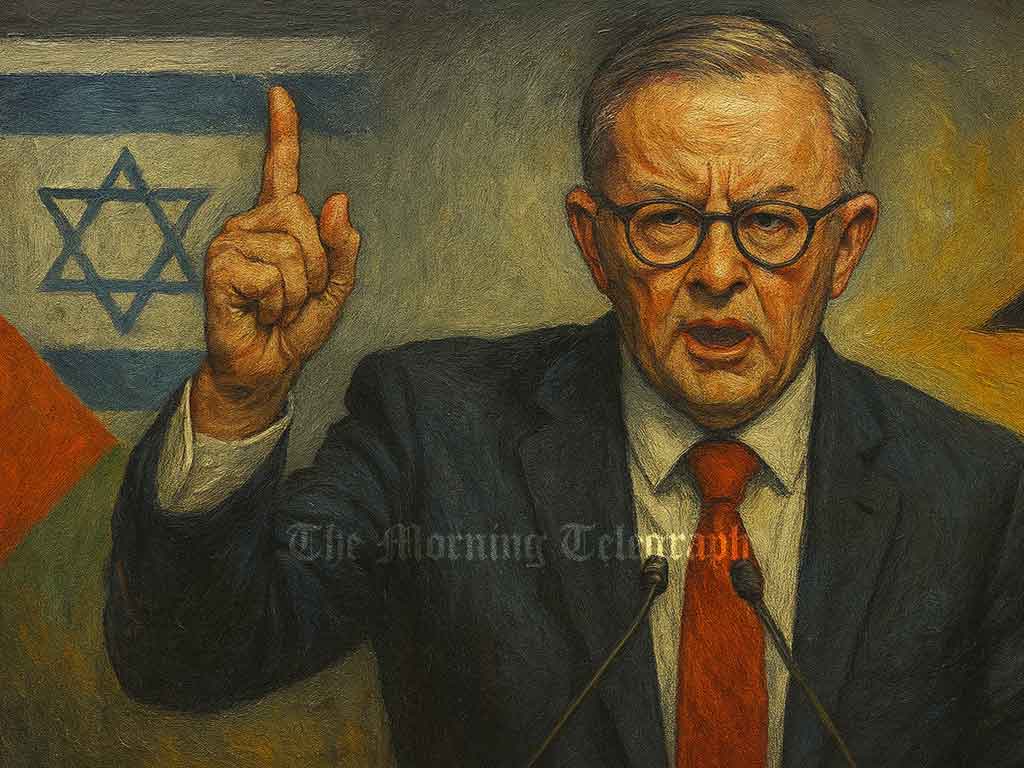
Prime Minister Anthony Albanese has announced that Australia will formally recognise Palestine as a state at the UN General Assembly in September, aligning with major Western allies. The decision comes with assurances from the Palestinian Authority excluding Hamas from any future government, amid strong opposition from Israel.
Australia will formally recognise Palestine as a state at the upcoming UN General Assembly in September, joining Britain, France and Canada in a coordinated diplomatic move. Prime Minister Anthony Albanese confirmed the decision, stating it was part of a broader international effort to push forward a two-state solution as the most viable path to peace in the Middle East.
Albanese revealed that Australia had secured endorsements for key proposals, including the withdrawal of troops from the Palestinian Authority, holding democratic elections and continuing to uphold Israel’s right to exist. He said the aim was to break the cycle of violence, conflict and hunger in the Gaza Strip, where humanitarian conditions have reached critical levels.

The Prime Minister stressed that his government had received direct assurances from Palestinian Authority President Mahmoud Abbas that Hamas would not play any role in a future Palestinian state. This assurance, Albanese noted, was crucial in gaining domestic and international support for the recognition plan.
He said the announcement followed two weeks of talks with his counterparts in the UK, France, New Zealand and Japan, all of whom have been exploring coordinated diplomatic measures to advance peace.
“There is still an opportunity for a two-state solution,” Albanese told reporters. “Australia will work with the international community to seize that opportunity before it slips away.”
However, the decision has drawn immediate criticism from Israel, which remains under mounting global pressure to end the war in Gaza. Israeli officials argue that recognising Palestinian statehood at this stage risks emboldening extremist groups and paving the way for terrorism.
Despite this pushback, Albanese said the move was a moral and strategic necessity. “We cannot stand by while conflict destroys lives. The time for a political solution is now,” he said.
The recognition is expected to spark heated debate at the UN General Assembly, where global divisions over the Israeli-Palestinian conflict remain stark.