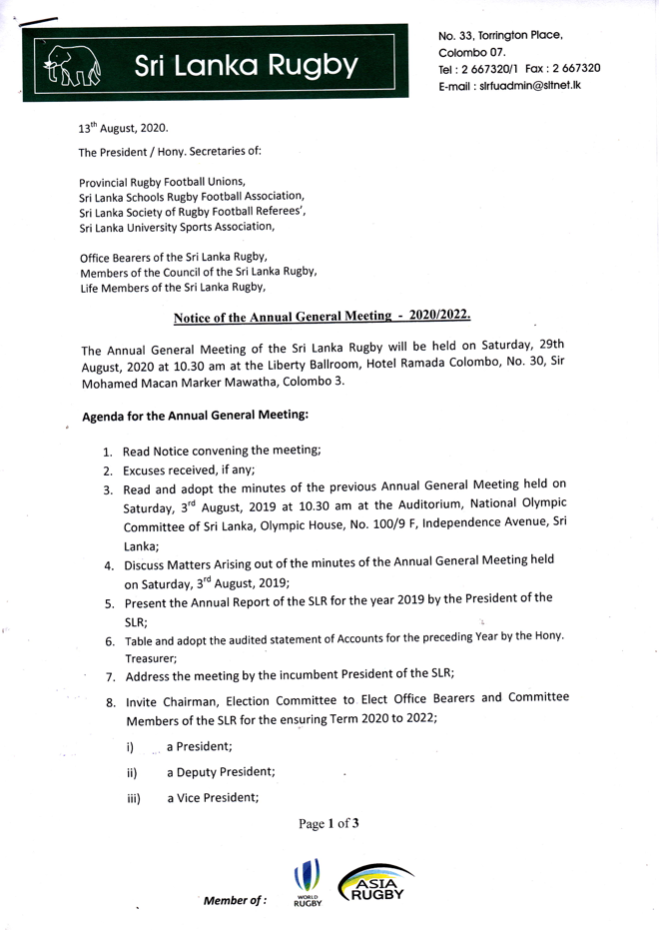
It isn’t just Pavi Fernando who finds himself barred from the race. The entire Sri Lanka Rugby Executive Committee elected in 2020 is also disqualified from contesting the upcoming elections on September 9, 2025. Their ineligibility stems directly from the suspension gazette issued by then Sports Minister Namal Rajapaksa on April 1, 2022, a decisive legal measure that strips the committee of its mandate.
The Morning Telegraph’s earlier report, “Breaking News: CR & FC’s Pavi Fernando Ineligible to Contest SL Rugby Presidency”, has triggered an even bigger debate in rugby circles. What began as a simple matter of constitutional ineligibility has now widened into a saga involving ministerial gazettes, suspended executive committees, and the grim reality that not just Pavi Fernando, but every member of the 2020–2022 Executive Committee remains disqualified from contesting at the 9th of September 2025 Annual General Meeting and Elections.
Wrong Start, Wrong Way
Pavi Fernando’s energetic campaign has been described as a case of “trying to do the right thing the wrong way.” Under Sri Lanka Rugby’s constitution, he has not served a full two-year term in the executive, falling short by six months before resigning on the 2nd of March 2022.

Deep down, Pavi Fernando cannot escape the fact that the Constitution itself bars his candidacy. Yet, instead of bowing to the law, he has doubled down, unleashing a barrage of social media tirades that can only be seen as a blatant attempt to pressure and influence the independent Election Commission, which by now must be fully aware of his ineligibility. What is more troubling is his own admission that he has shopped around multiple legal teams, desperately seeking validation. Incredibly, he now claims that despite his failure to meet the most fundamental requirement of the SLR Constitution, these lawyers have advised him to carry on regardless. The spectacle raises serious concerns not just about his judgment, but about whether this campaign is fueled more by noise, influence, and defiance than by legality, truth, or respect for the game’s governance.
The Gazette Trail – A Timeline of Chaos
The controversy goes back to 1st April 2022 when then Sports Minister Namal Rajapaksa issued a gazette dissolving the elected SLR committee, replacing it with the Director General of Sports Development to run affairs and hold elections. This meant the elected executive body of 2020 could not complete a full constitutional term.
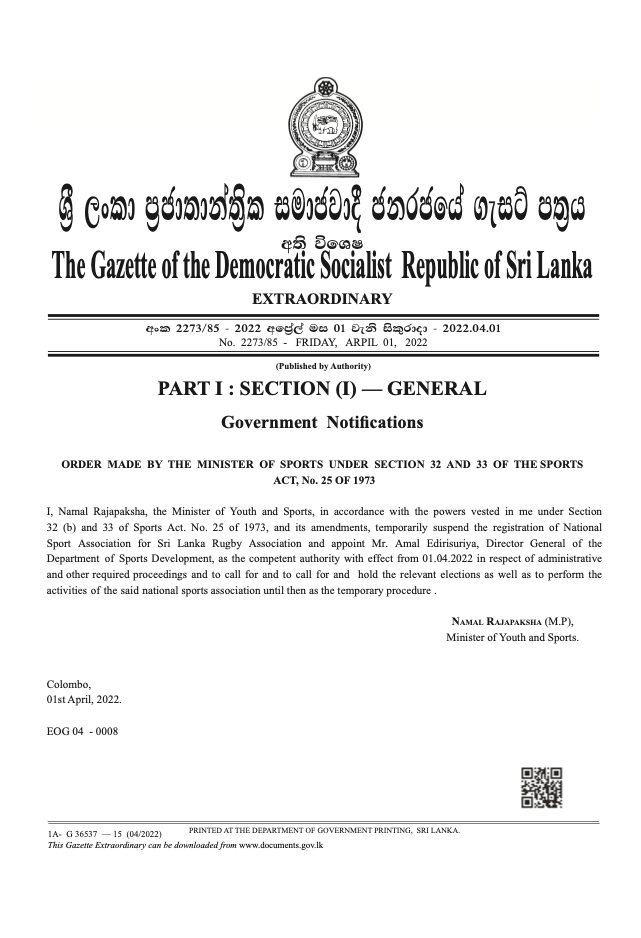
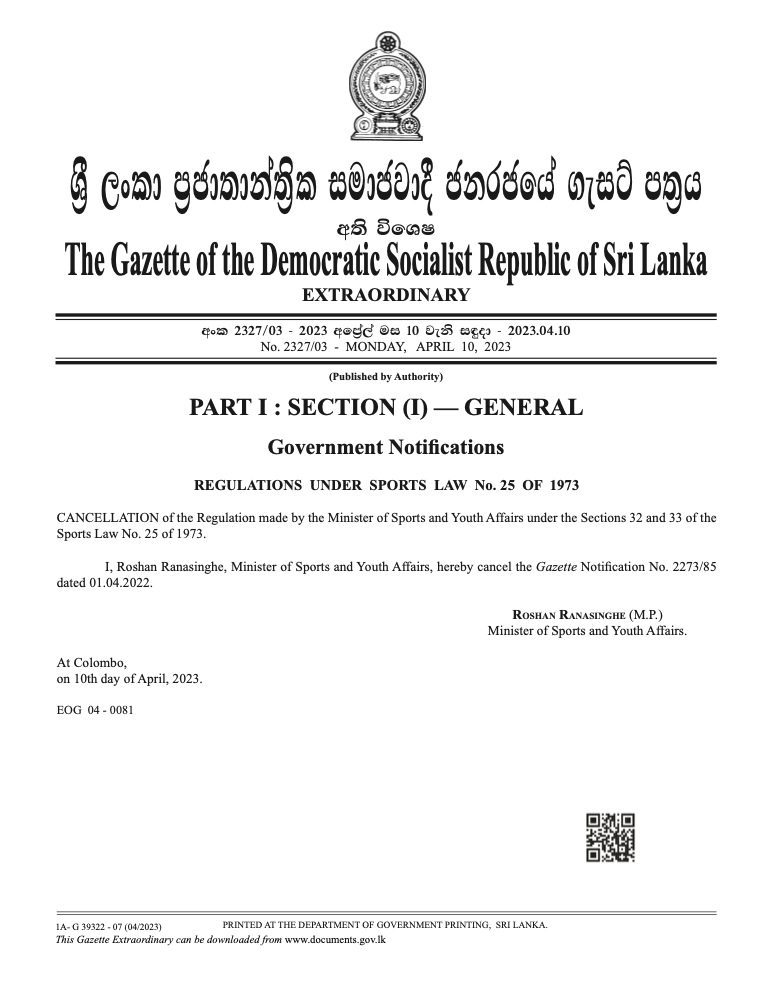
Later, on the 11th April 2023, the new Sports Minister Roshan Ranasinghe revoked Namal’s gazette, but by then, the damage was done. The interruption meant that no member of the 2020–2022 SLR Executive Committee could claim to have completed a full two-year term. The constitution is crystal clear: eligibility requires having served at least one full term in the last five years at the time of submitting nominations. Thus, Pavi Fernando and indeed every other member of that executive remains ineligible.
CR & FC’s Shadow Over the Game
The storm is further clouded by CR & FC’s own recent conduct. In 2024, the club refused to release its players for national duty at a sevens tournament, prioritizing their own domestic campaign instead. Despite this being a violation of sports law, no punishment followed. Instead, former Sports Minister Harin Fernando, a known CR & FC affiliate, had already directed ministry funds to install expensive floodlights at the club’s grounds, a decision widely criticized as favoritism.
Now, with CR & FC’s Rugby Chairman Pavi Fernando pushing for the presidency, many fear his elevation would turn Sri Lanka Rugby into an extension of club politics.
Castles in the Sky
Fernando has launched an ambitious manifesto, promising reform and vision. But to rugby faithfuls hoping for change, his candidacy increasingly looks like castles in the sky, grand dreams without constitutional or ethical foundation. His nomination, propped up by CR & FC loyalists and even backed by Referees’ Society President Dinka Peiris in a controversial public endorsement, is not only legally flawed but also dangerously symbolic of how governance in the sport is sliding into personal agendas and favoritism.
The Bigger Picture
What makes this episode sting most is the shattered hope of those who longed for a new era of accountability and transparency in rugby. Instead of restoring faith, Pavi Fernando’s campaign has exposed the cracks: ignorance of constitutional law, political interference, ministerial meddling and the prioritization of club over country.
For now, the constitutional road is clear: Pavi Fernando remains ineligible, and unless rugby’s governance embraces integrity over hype, Sri Lanka Rugby risks sinking deeper into controversy and disrepute.