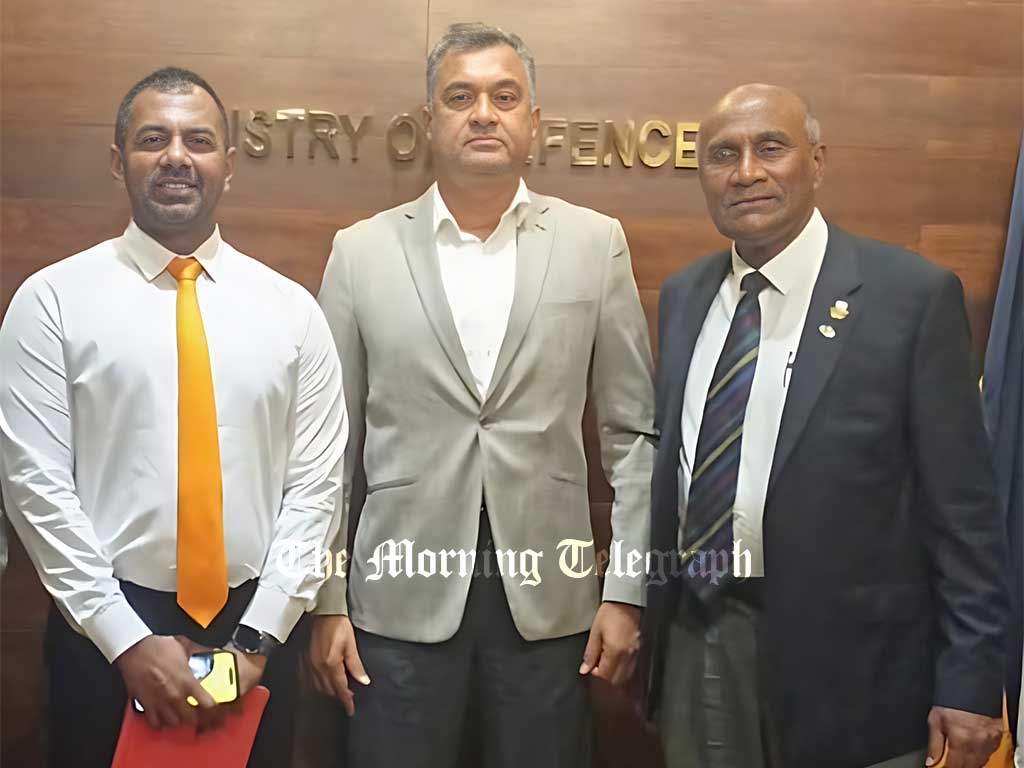
A picture, they say, speaks a thousand words. And in Sri Lanka’s rugby politics, sometimes a single photo can reveal more than weeks of speculation. The image in question is striking: Retired Air Vice Marshal Sampath Thuyacontha, now the Secretary to the Ministry of Defense, sandwiched inbetween Pavithra “Pavi” Fernando, the CR & FC Rugby Chairman and aspirant for the presidency of Sri Lanka Rugby, flanked by none other than Retired Air Force Group Captain Nalin De Silva, an Asia Rugby official freshly appointed as Regional Advisor for South Asia.
The trio were not convened to discuss national security or defense strategy. Instead, what lay on the table was Fernando’s rugby manifesto, a document spelling out his plans for the sport should he succeed at the ballot on September 9th. The optics say: Asia Rugby’s newly appointed representative, the Defense Secretary, and a presidential hopeful in deep discussion, suggesting what many now fear, canvassing the tri-forces vote in a bid to secure an election Pavi Fernando is technically ineligible to contest.
Asia Rugby itself had only days earlier (on July 8th) announced the appointment of five regional advisors, including De Silva, describing the move as a “defining step” in strengthening local governance. Yet, the timing of De Silva’s sudden involvement in Fernando’s campaign raises alarm bells. Critics argue this is clear meddling by the continental body in the domestic affairs of a member union, violating the principle of neutrality. The question is unavoidable: is Asia Rugby, knowingly or otherwise, attempting to tilt the scales of Sri Lanka Rugby’s most contentious election in years?
Pavi Fernando, meanwhile, continues to face the immovable wall of Sri Lanka Rugby’s constitution. Candidates for the presidency must have served a term in executive office within the past five years, something Fernando has not. Despite this, he insists multiple legal teams have advised him to “press on,” even as whispers grow louder that his campaign is an exercise in doing the right thing the wrong way. Deep down, he must know the rulebook disqualifies him, yet his persistence suggests a man trying to force legitimacy through momentum and influence.

The involvement of Sampath Thuyacontha, a senior ex-military man now sitting at the helm of the Defense Ministry, adds yet another troubling dimension. This is not merely a case of a club chairman canvassing votes. It is an episode where the most powerful state institutions risk being dragged into what should be an independent, sporting election.
Adding fuel to the fire, the wider rugby community remembers how CR & FC, Fernando’s own club, refused to release its players for national duty at a Sevens tournament in 2024, prioritizing domestic competition over representing the country. Even more scandalous, the then Sports Minister Harin Fernando spent millions of ministry funds to install floodlights at CR & FC grounds, a move viewed as blatant favoritism. If Pavi Fernando were to become SLR President, many argue, it would be a dead giveaway that CR & FC stands to benefit disproportionately, repeating a cycle of club-first, country-last decision-making.
And here lies the bitter irony. The National People’s Power (NPP) government swept to power promising to end decades of corruption and insider manipulation in Sri Lanka’s institutions. Yet, this single photograph, Pavi Fernando with an Asia Rugby official and the Defense Secretary, suggests the same old playbook is alive and well. Whether by accident or design, rugby’s fate once again seems entangled not in merit, but in political influence and foreign interference.