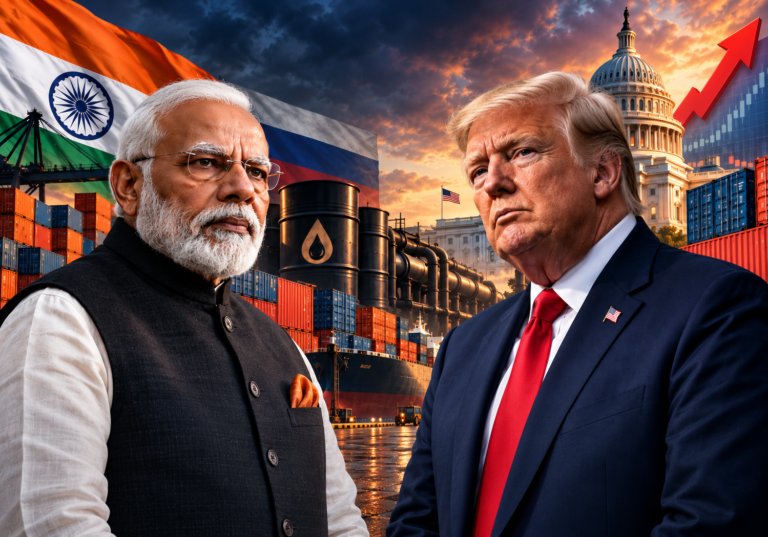
A federal appeals court has declared most of Donald Trump’s global tariffs unlawful, branding them “contrary to law” and setting up a Supreme Court showdown that could reshape America’s trade policy and presidential powers.
A US appeals court has ruled that most tariffs imposed by former US President Donald Trump are illegal, setting up a legal clash that could upend his trade and foreign policy agenda.
The 7-4 ruling affects Trump’s so-called “reciprocal” tariffs applied on dozens of countries as well as levies slapped on imports from China, Mexico and Canada. In its judgment, the US Court of Appeals for the Federal Circuit said the tariffs were not authorized under the International Emergency Economic Powers Act (IEEPA), dismissing Trump’s defense and calling the duties “invalid as contrary to law.”
The decision will not take effect until October 14, giving the administration time to ask the Supreme Court to hear the case. The ruling also struck down tariff-reduction deals that certain nations negotiated with Washington, raising doubts about their legitimacy.

Trump lashed out on Truth Social, describing the appeals court as partisan. “If allowed to stand, this Decision would literally destroy the United States of America. Today a Highly Partisan Appeals Court incorrectly said that our Tariffs should be removed, but they know the United States of America will win in the end,” he wrote. “If these Tariffs ever went away, it would be a total disaster for the Country. It would make us financially weak, and we have to be strong.”
Trump had imposed the tariffs under IEEPA, which gives presidents the power to act against “unusual and extraordinary” threats. Declaring a national emergency on trade, he argued that trade imbalances endangered US national security. But the court ruled that tariffs were a Congressional power, not a presidential one.
The judgment stressed that when Congress wants to delegate tariff authority, it uses explicit terms like “tariff” or “duty.” The 127-page ruling argued that the 1977 statute was never intended to give the president unlimited power to impose tariffs, and the IEEPA contains no provisions or safeguards related to duties.
The lawsuits leading to the ruling were filed by small businesses and a coalition of states after Trump issued executive orders in April imposing a baseline 10 percent tariff on nearly all imports and “reciprocal” duties on dozens of countries. Trump hailed the orders as America’s “liberation day” from unfair global trade practices.
In May, the Court of International Trade in New York ruled the tariffs unlawful, but enforcement was paused during the appeals process. The new ruling not only strikes down tariffs on China, Mexico and Canada but also casts doubt on Trump’s claim that they were needed to combat drug imports. However, tariffs on steel and aluminium imposed under a separate law remain intact.
The White House argued that invalidating the tariffs would cause catastrophic consequences, potentially triggering a financial collapse comparable to the 1929 stock market crash. Lawyers claimed revoking tariff authority would cripple the economy and national security. Trump’s team further warned that losing the tariffs would undermine US leverage to collect “trillions of dollars” from other nations.
The case is now expected to head to the US Supreme Court, where six of nine justices are conservatives, including three Trump appointees. The court has recently been sceptical of expansive presidential actions not explicitly backed by Congress, most notably invoking the “major questions doctrine” to block Democratic policies on climate change and student loans.
The final outcome could determine whether Trump’s sweeping tariff agenda is another case of presidential overreach or a legitimate extension of executive power.