A single decision changed who would lead the nation.
In the aftermath of President Premadasa’s assassination, his widow Hema sought to enter politics through the Colombo Central seat, as veteran organiser Sirisena Cooray had decided not to contest the 1994 general election. At the same moment, Ranil Wickremesinghe reeling from humiliating defeats in Biyagama at the 1993 provincial polls and again in Gampaha, shifted his ambitions to Colombo.
With Cooray’s endorsement, Ranil pressed party leader President D. B. Wijetunga for the Colombo Central slot. Together, Ranil and Cooray manoeuvred to erase Hema’s name from the nomination list. She only discovered her exclusion when she turned up at the Colombo Municipal Council nomination hall.

Gamini Dissanayake, although a critic of Premadasa, was unsettled by this slight. When he rose as Opposition Leader and later as the UNP’s presidential candidate in 1994, Gamini courted Sajith Premadasa, promising him Colombo Central. But Gamini’s assassination altered the landscape, Ranil became leader and bluntly told Sajith, “If you want to do politics, go to Hambantota.” Realising Colombo Central was closed to him, Sajith accepted Hambantota and began his political journey there.
Sajith’s emergence rattled the Rajapaksa family. To shield their base, Ranil deployed Hambantota MPs Mervyn Silva and Ananda Kularatne to obstruct him. Still, Sajith won for the UNP in Hambantota in both 2000 and 2001, further irritating the Rajapaksas.
When Ranil assumed the premiership, many expected Sajith to be rewarded with a major ministry. Instead, Ranil limited him to Deputy Minister of Health. Sajith, patient as ever, waited, confident his day would come.
After the UNP’s defeat in 2010, pressure grew within the party to elevate Sajith. Yet with Mahinda Rajapaksa’s backing, Ranil outmanoeuvred the rebellion by swaying central committee members with incentives. When demands rose for Karu Jayasuriya or Sajith to contest the presidency in 2010, Ranil decreed no UNP member could run unless he himself was a candidate. To block both rivals, Ranil made a deal with Maithripala Sirisena.
When Maithripala emerged as the common candidate, Chandrika, Mangala and other SLFP stalwarts rallied behind him, sidelining Ranil’s claim to the premiership. With Mangala insisting no PM candidate had been finalised, Ranil turned to Sajith.
On the campaign trail, Sajith declared that without Ranil as Prime Minister, the UNP would not support Maithripala. This forced Chandrika, Mangala, and the SLFP to concede, recognising Ranil as PM-in-waiting.
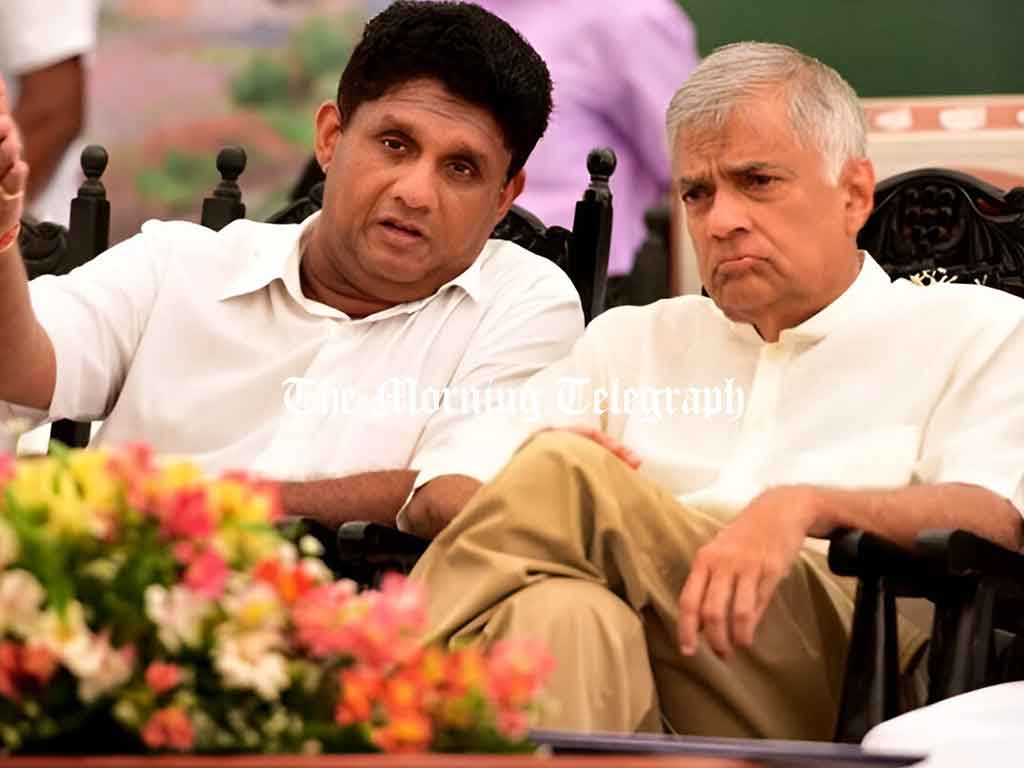
After Maithripala’s 2015 win, Ranil became Prime Minister. Yet tensions with the President soon surfaced. On more than sixty occasions, Maithripala even invited Sajith to take the premiership, clearing the path for his leadership of the UNP. Sajith, however, declined, unwilling to betray Ranil even when opportunity beckoned.
By 2018, Maithripala publicly declared Ranil should be replaced, and that Sajith should take over with backing from anti-Ranil forces within the UNP.
But Sajith refused to undermine his leader. Even when Mangala, a close Ranil ally, suggested Sajith be nominated for the 2019 Presidential Election, Ranil struck back, appointing a committee to probe alleged financial misconduct in the Central Cultural Fund under Sajith’s ministry.
It was widely acknowledged that Ranil worked with Mahinda to ensure Sajith’s defeat in 2019, even suppressing files from the Immigration Department that could have challenged Gotabaya’s Sri Lankan citizenship.
The Sunday Times, owned by Ranil’s uncle, reported that when Sajith lost the presidency and Ranil lost the premiership, the files on the Central Cultural Fund were left behind in a drawer at Temple Trees.
Mahinda later handed these files to the Bribery Commission. Afterwards, he invited Ranil, out of parliament after the 2020 defeat, back through the national list. The Rajapaksas’ plan was clear: revive Ranil as Opposition Leader to weaken Sajith.
During the aragalaya, when Gotabaya was preparing to cede the premiership to Sajith, Mahinda and the Rajapaksas intervened, insisting Ranil take the post instead. Sajith listed conditions for acceptance. Ranil, however, agreed without any, striking a deal with the Rajapaksas.
Once President, Ranil fuelled Anura Kumara’s attacks on Sajith. The much-discussed Sajith–Anura debate dominated national headlines. Though media outlets promised to televise it, Sajith declined, knowing Independent Television, under Ranil’s influence, would tilt the stage. Ranil instructed Anura to press hard against Sajith while spreading stories of investigations into the Cultural Fund. Rumours swirled that Sajith’s allies would abandon him for Ranil, a narrative constantly recycled by media to Anura’s advantage.
In 2019, Ranil mostly campaigned in plantation regions, the North and East—areas with minority voters favourable to Sajith. He publicly stated that Sajith could not defeat Anura.
Ahead of the postal vote, Anura gave an interview to Independent Television. Simultaneously, Thalatha Athukorala defected from Sajith to Ranil, claiming Anura would triumph. Anura and the JVP capitalised, citing Geetha’s selection over her as proof of betrayal.
Had Ranil not divided Sajith’s minority vote, Sajith might have been President. Ranil believed that after Sajith’s defeat, Anura would finish him off, clearing the way for Ranil to return as Opposition Leader. Yet memories of 1988–89, when ministers and MPs of the J. R. and Premadasa regimes were hunted down, kept the JVP hostile to Ranil, whom they still accused of running Batalanda torture chambers.
The JVP vowed Ranil must answer for the deaths of their youth. When those demands resurfaced, Anura’s government targeted him.
Ranil eventually faced imprisonment. In earlier years, when Ranil was UNP leader, S. B. Dissanayake defended him, landing in prison himself for contempt of court. A march was organised from S. B.’s hometown Hanguranketha to Colombo, but Ranil halted it midway, saying the cost of living, not S. B.’s fate was the greater concern.
When Sarath Fonseka stood up for Ranil and was jailed, Ranil offered no protests in his defence. Fonseka was left isolated.
“Ranil defeated me. Ranil defeated Anura. Why risk ourselves for Ranil?” many asked.
Yet when Ranil was imprisoned, Sajith could have echoed the same. But he did not. Though the government assumed Sajith and the SJB would abandon Ranil, they grew unsettled when Sajith intervened.
One can only imagine Ranil’s thoughts when Anura’s government, once a supposed ally jailed him and stripped him of power, while Sajith, long treated as an adversary, came to visit him.
As a Facebook post circulated, the last head of state before Ranil to go to prison was King Sri Wickreme Rajasinghe, captured by the British with the collusion of Sinhala elites.
Ranil’s battles extended beyond Sajith to the SLFP opposition. Yet, through it all, Sajith never betrayed Ranil.