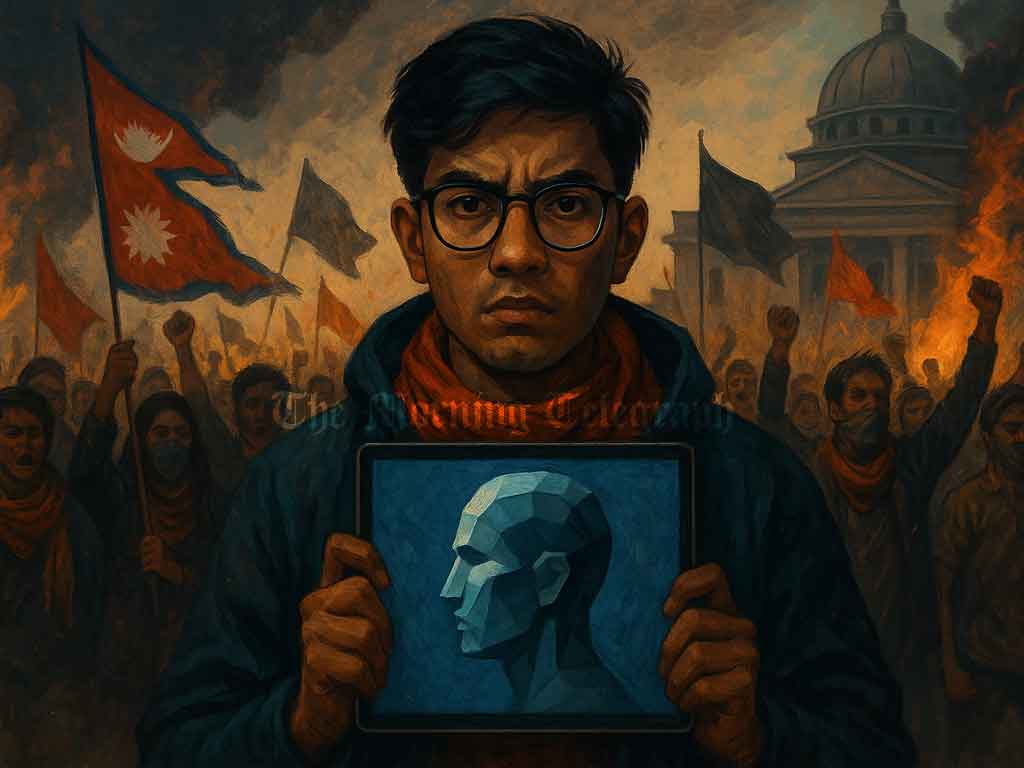
In a bold twist of political defiance, Nepal’s Gen Z turned to artificial intelligence to decide the nation’s future, using ChatGPT to select an interim leader after forcing Prime Minister KP Sharma Oli from power. For many, this marks not only a rebellion but a radical experiment in reshaping governance through technology and collective youth action.
In one of the most extraordinary political developments in Nepal’s modern history, a wave of youth-led protests driven by Generation Z forced the resignation of Prime Minister KP Sharma Oli within just 48 hours. What began as an uprising against corruption, nepotism, and restrictions on digital freedoms quickly snowballed into a full-blown movement that shook the foundations of power in Kathmandu. Yet removing Oli was only the first step. The next challenge was determining who would lead the interim government. Instead of relying solely on political elites or party deals, Nepal’s restless Gen Z looked elsewhere, and in an unprecedented twist, they turned to artificial intelligence. ChatGPT, the AI chatbot, was consulted by youth activists to help guide the choice of a new leader.
According to The Times, members of the online forum Youths Against Corruption turned to ChatGPT to identify potential candidates, and the AI produced a diverse shortlist: Sagar Dhakal, an Oxford-educated engineer; Sumana Shrestha, a reform-minded former education minister; Balen Shah, rapper and mayor of Kathmandu; and Sushila Karki, Nepal’s first and only female chief justice. The chatbot did not stop there. It also weighed the strengths and weaknesses of each candidate, sparking intense debate among the young activists. In one exchange, ChatGPT recommended Sushila Karki as a transitional leader, stating, “She seems likely to command trust across different groups and could help oversee reforms and the path to fair elections.” For long-term leadership, the AI suggested Balen Shah, provided he could garner enough political support to resist the pull of entrenched power structures.

The recommendations quickly spread through Discord servers, livestreams, and encrypted chats, where young activists dissected the pros and cons of each option. For a generation that has grown up online, turning to AI felt not only natural but symbolic of their desire to break from the failed politics of the past. This willingness to seek new solutions was born out of the chaos that had engulfed the country when Oli’s government abruptly shut down 26 social media platforms, citing security concerns. Instead of silencing dissent, the decision triggered widespread outrage. Demonstrators filled the streets, clashing with security forces as government buildings, schools, and media outlets were torched. Homes of political leaders were attacked, and even Tribhuvan International Airport was targeted. Within days, the violence escalated, leaving at least 20 people dead and countless others injured.
It was in this turmoil that Gen Z activists under the banner Hami Nepal elevated Sushila Karki, 73, to lead talks with the military. Karki’s selection was widely seen as a move to stabilize negotiations while symbolizing a generational bridge between the old guard and the new. In response, the military imposed a strict curfew in Kathmandu, adding another layer of uncertainty to an already fragile moment.
Despite the enthusiasm for ChatGPT’s involvement, critics have voiced serious concerns. Many argue that AI cannot replace legitimacy, research, or democratic mandates. As one user warned on a forum, “To change laws, you need research, legitimacy and a real mandate. That’s not something you can just achieve using ChatGPT. If there’s even one wrong move made and political players from the outside take advantage, BOOM.” Others have raised questions about the representativeness of the movement itself. The Discord forums where decisions are debated are often chaotic, filled with memes, insults, and heated arguments. Some dissenters have reported being banned, and protest documents circulated by youth leaders were even branded with the Jolly Roger pirate flag, inspired by the anime One Piece. For critics, this symbolized the unruly, unpredictable, and at times unserious face of the movement.
Still, optimism has not faded. Balen Shah, the Kathmandu mayor included in ChatGPT’s shortlist, praised the youth’s determination, calling their efforts “fire, vision and honesty.” Dhakal also backed Karki’s leadership in a livestream, noting her credibility and her ability to guide the country through this transitional moment. For many protesters on the ground, Karki represents far more than a caretaker leader. They see her as the figure best positioned to steady Nepal through crisis while allowing time and space for the younger generation to push forward with their agenda for deeper reform.
The larger story, however, extends beyond individuals or positions of power. For Nepal’s Gen Z, this movement is about reclaiming agency in a political system that has long been held hostage by corruption, dynasties, and entrenched elites. The decision to involve ChatGPT was more than a gimmick; it was a declaration that this generation will not play by the old rules. It was a symbolic act of resistance, signaling their commitment to technology, transparency, and collective problem-solving.
The protests and subsequent reliance on AI reveal a generational shift in how governance itself is being imagined. For these young activists, legitimacy is no longer defined solely by institutions but increasingly by networks, platforms, and digital communities where consensus can be built in real time. As one youth organizer put it, “We are not waiting for politicians to tell us our future. We are creating it ourselves with tech, with creativity, and with courage.”
Whether this experiment succeeds or fails, it has already sent shockwaves through Nepal and beyond. It is a reminder that in the digital age, political power can be contested not only in the streets but also in the digital spaces where ideas are shared, debated, and amplified. Nepal’s Gen Z may have turned to ChatGPT out of desperation, but their decision represents something deeper: a radical reimagining of how politics could function in the 21st century. For now, their future will not be dictated by the failed leaders of the past but shaped by their own ingenuity, resilience, and willingness to embrace technology in pursuit of change.