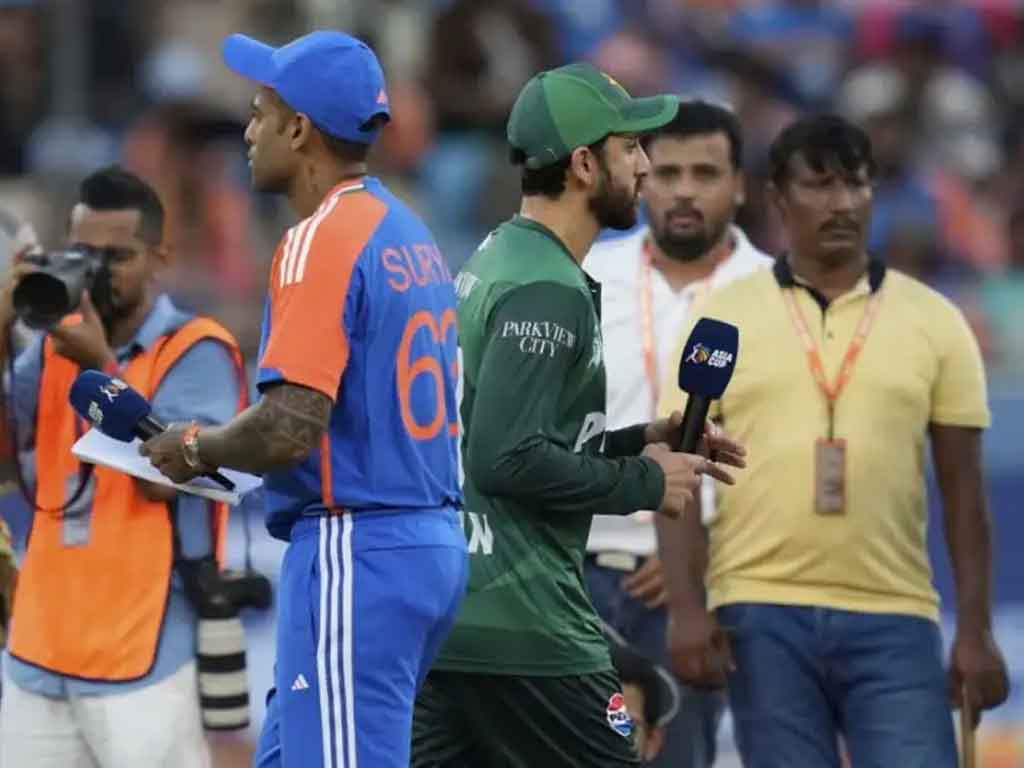
India and Pakistan met on the cricket field for the first time since their deadly military confrontation earlier this year, and while the game itself ended with a dominant Indian victory, the aftermath told an entirely different story. India’s seven-wicket win over Pakistan in the Asia Cup T20 on Sunday was overshadowed by a refusal to shake hands — a decision defended by Indian captain Suryakumar Yadav as being “aligned with the government and Board of Control for Cricket in India.” The move has triggered outrage, disappointment, and a storm of commentary, once again proving that cricket between these two nations is never just a game.
India’s refusal to engage in the customary handshake with their Pakistani counterparts immediately after the game was seen by many as a deliberate political message. Suryakumar explained in his post-match press conference that the team’s stance was rooted in solidarity with the Indian government’s position following the April 22 Pahalgam terror attack in Indian-administered Kashmir, which New Delhi accused Pakistan of backing. “We stand with the victims of the families of the Pahalgam terror attack and we express our solidarity. We want to dedicate today’s win to the armed forces,” he declared.
Pakistan’s camp, however, reacted with frustration. Head coach Mike Hesson, visibly disappointed, told reporters, “We were ready to shake hands at the end of the game. We went over there and they were already gone to the changing room, so that was obviously a disappointing way to finish the match.” The Pakistan Cricket Board went one step further, lodging an official protest with match referee Andy Pycroft, stating that “the behaviour of Indian players was against the spirit of sportsmanship.” The protest explained why Pakistan skipper Salman Agha did not appear at the post-match presentation.

The political backdrop added even more fuel to the fire. India and Pakistan have not played a bilateral Test series since the 2008 Mumbai attacks, and this Asia Cup encounter came on the heels of fresh hostilities in May that left more than 70 people dead in missile, drone, and artillery exchanges. While a ceasefire was eventually called, the wounds remain raw, and the refusal to shake hands was a stark reminder of just how deep the rift runs.
On the field, India’s spinners and all-round discipline completely outplayed Pakistan. Asked to bat first, Pakistan crumbled to 127-9 in their 20 overs. The innings began disastrously, with Hardik Pandya striking in the first over to dismiss Saim Ayub for a golden duck. Jasprit Bumrah followed up by removing Mohammad Haris for just three, leaving Pakistan reeling. Sahibzada Farhan attempted to anchor the innings, scoring 40, and briefly rebuilt alongside Fakhar Zaman, who contributed 17. But left-arm spinner Axar Patel broke the partnership, removing Zaman and then Pakistan’s captain Agha in quick succession.
Kuldeep Yadav’s left-arm wrist spin proved decisive. Striking twice in successive balls, he sent Hasan Nawaz and Mohammad Nawaz back for 5 and 0 respectively, plunging Pakistan to 64-6 inside 13 overs. Pakistan’s only resistance came late from Shaheen Shah Afridi, who smashed four sixes in his unbeaten 33 off 16 balls, pushing the total beyond 120. Still, it was far from competitive.
In response, India’s chase was clinical and aggressive. Abhishek Sharma lit up the innings with a fiery 31 off just 13 balls, hammering Shaheen Afridi for boundaries and sixes to set the tone. Although Shubman Gill fell cheaply, Abhishek’s fearless hitting ensured momentum remained with India. His dismissal, caught at long-off attempting another six, brought Suryakumar Yadav to the crease. The captain played with calm authority, anchoring the chase with an unbeaten 47. He sealed the win with a six — fittingly on his 35th birthday — as Indian fans erupted in celebration.
India’s chase ended at 140-4, reaching the target with 25 balls to spare. The victory not only secured two points but also virtually guaranteed their spot in the Super Fours stage, with their final group match against Oman still to come. Pakistan, despite the loss, remain in contention and will face the UAE next.
Yet the cricketing achievement was quickly buried under the weight of the political theatre. India’s players walked straight off the field without handshakes, a break from cricketing convention that shocked many observers. For critics, it was a blatant politicisation of sport. For supporters, it was a symbolic stand in solidarity with victims of terrorism and the armed forces. Either way, the absence of handshakes became the story of the night.
Mike Hesson’s remarks summed up Pakistan’s disappointment: “Sportsmanship matters. We were ready. They weren’t.” Pakistan’s official protest ensured the matter will not disappear quietly. The International Cricket Council may now face pressure to review the incident, even though political sensitivities around India and Pakistan fixtures make any disciplinary action unlikely.
This episode highlights the increasingly complex intersection of politics and sport in South Asia. While cricket has long been a bridge between India and Pakistan, it is now equally a platform for political signalling. The refusal to shake hands after a game is not just poor sportsmanship — it is a deliberate act of messaging on the international stage. It may please domestic audiences, but it raises troubling questions about the role of sport in fostering peace and reconciliation.
For now, India walks away with the points, the net run rate boost, and the symbolic upper hand. Pakistan is left not just with defeat on the scoreboard, but also a fresh sense of grievance. In a tournament meant to showcase cricket, the Asia Cup once again reveals itself as a mirror of the bitter geopolitics that dominate the region.