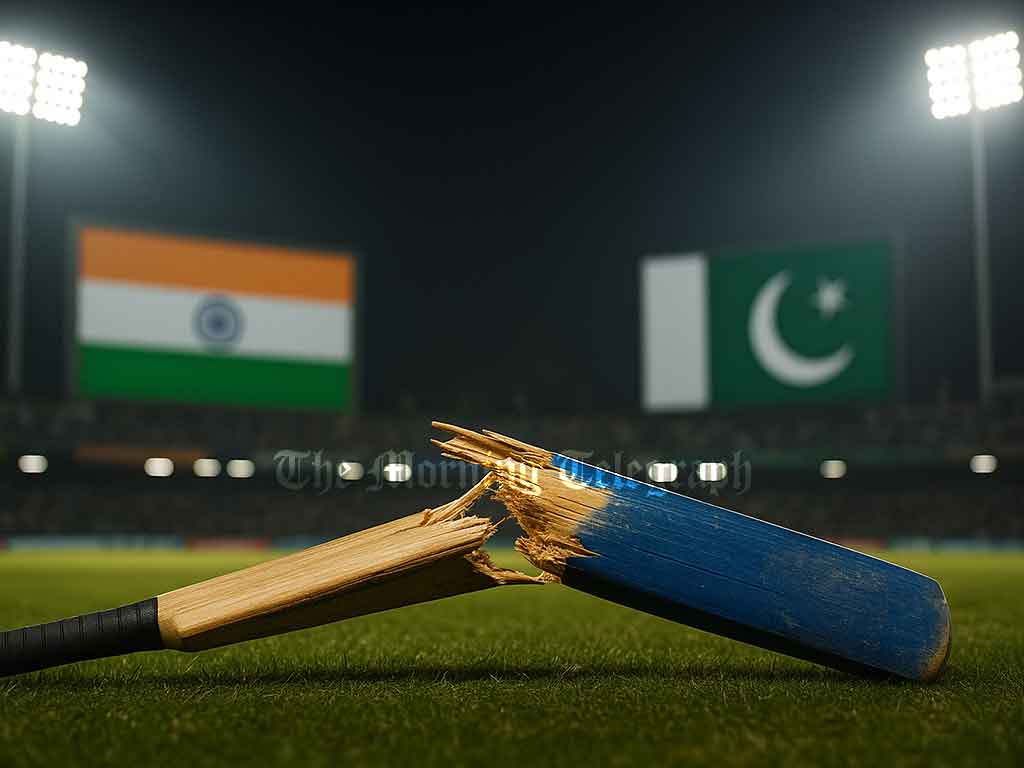
India’s refusal to shake hands with Pakistan at the Asia Cup has sparked outrage, exposing cricket’s descent from a gentleman’s game into a theater of politics, money, and arrogance. What unfolded on that night was nothing less than the death of cricket’s soul.
It has often been said that cricket is a gentleman’s game, but if the Asia Cup 2025 showed anything, it is that this claim no longer holds true. What unfolded when India refused to shake hands with Pakistan after their clash has shaken the cricketing world to its core. To many, it was the night cricket died.
The act itself may appear simple, but its implications run far deeper. Sportsmanship and respect, the supposed foundations of cricket, were brushed aside in favor of political messaging and national pride. India’s refusal to extend a hand to their opponents was a snub seen around the world, one that has left purists and fans questioning what the game has truly become.

Western critics were quick to pounce, mocking South Asian cricket for being dragged into political mudslinging. And perhaps they had a point. The gesture, or lack of it, was not about cricket at all. It was about one country asserting its superiority, militarily, economically, technologically, and now, on the cricket field — with little concern for the spirit of the sport.
The fallout is damning. The International Cricket Council (ICC), long accused of bowing to Indian influence, now faces further scrutiny. Money and power have overshadowed values and ethics, with the Indian Premier League (IPL) often cited as the clearest example. What was once a domestic competition has become a symbol of unchecked dominance, fueling the arrogance that surfaced on that fateful night.
Sri Lankan fans are no strangers to India’s heavy hand in cricket governance. The refusal to shake hands may appear minor compared to other incidents, but symbolism matters. Cricket, more than any other sport in South Asia, is meant to unite. On that night, however, it divided.
Defenders of India have attempted to draw comparisons to Sri Lanka’s own protest against Bangladesh a few years back, when Angelo Mathews was dismissed in a highly controversial “timed-out” decision. But the two cases could not be more different. Sri Lanka’s protest stemmed from a questionable application of the laws of cricket that violated its spirit. India’s decision, however, was premeditated, aimed squarely at Pakistan for political reasons.
India’s captain Suriyakumar Yadav underlined the political undertones when he dedicated the win to his country’s armed forces. If the team had outright refused to play Pakistan, the action might have carried some logic, however divisive. But to play the game, use the opponent as a stepping stone, and then refuse a handshake, that is something else entirely. It was, as one commentator put it, “murder most foul.”
This is not an isolated moment. The IPL, despite its success, excludes Pakistani players altogether. The message is clear: Pakistan may be good enough to face on the field, but not good enough to shake hands with or share a dressing room in franchise cricket.
Sri Lanka’s women’s cricket has also felt the ripple effects of India’s selective power. Chamari Atapattu, arguably the island’s best-ever female cricketer, and one of the finest batters in the world, was overlooked for the women’s IPL despite her record. Sri Lankan fans know well how decisions are influenced by politics and not performance. Atapattu instead found her place in Australia’s domestic league, a stark reminder that friendship and opportunity are sometimes found outside the subcontinent.
The Indian media, often guilty of whipping up hysteria, continue to call the India-Pakistan rivalry the “biggest in the world.” In truth, it is one of the most lopsided, both in politics and in sport. Calling it the greatest contest is more about fueling nationalist sentiment than acknowledging competitive balance.
What India did that night was more than just a refusal of courtesy. It was a declaration that cricket is no longer governed by values, but by the brute force of money, power, and politics. Sri Lanka and others in the region see it clearly — cricket is being turned into private property, where the mighty dictate terms and the ICC looks the other way.
For the purists, the night cricket died will not be remembered for a scorecard or a six over midwicket. It will be remembered for the absence of a handshake, for arrogance triumphing over respect, and for a sport once cherished as noble now sullied beyond recognition.
That is, if gentleman’s cricket is still alive at all.
SOURCE :- DAILY MIRROR