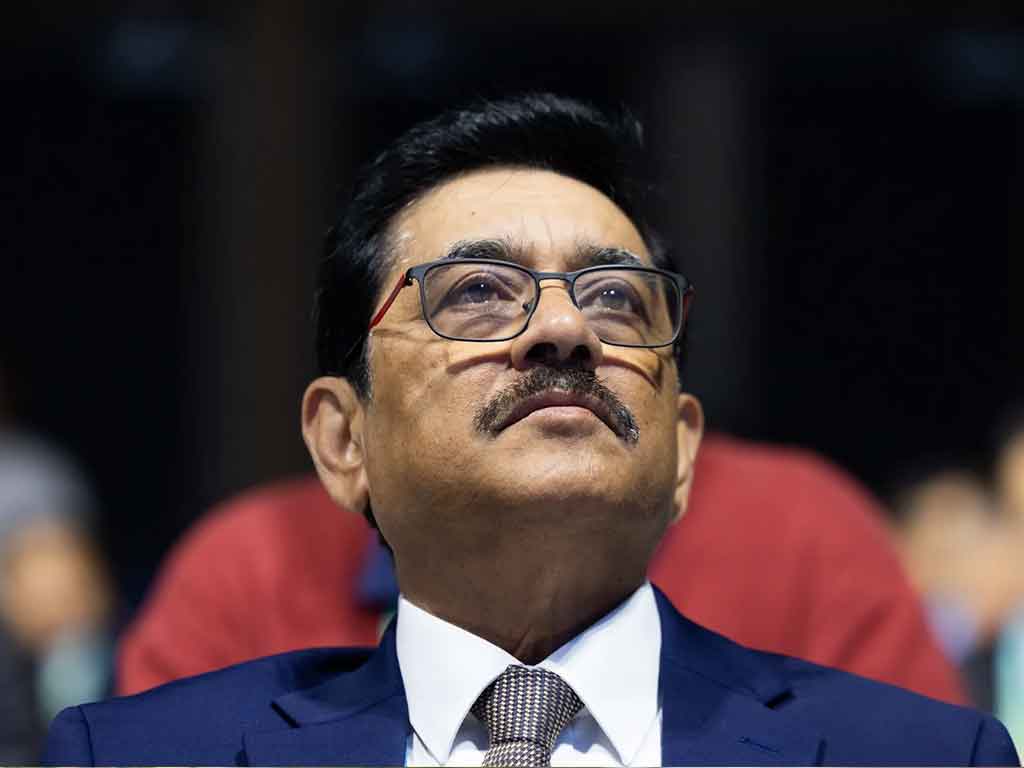
Sri Lanka’s Central Bank Governor, Dr. Nandalal Weerasinghe, stands at the crossroads of wealth, transparency, and national crisis. His asset declaration, amounting to nearly half a billion rupees across land, property, securities, and foreign holdings, is more than a bureaucratic requirement—it is a mirror of paradox, prudence, and the ethics of public service in a nation battling fiscal collapse.
Sri Lanka’s endless cycle of crisis and reform has produced many figures of power and responsibility, yet few have captured the imagination of the people as much as Dr. Nandalal Weerasinghe, the Governor of the Central Bank of Sri Lanka. At a moment when the nation teetered dangerously close to collapse, his return from abroad, his blunt declarations, and his unusually candid wealth disclosures sparked both admiration and controversy. In a country where financial obfuscation is the norm, his candour and transparency invited comparisons to something almost mythic. For many, he became Sri Lanka’s unlikely New Normal Messiah.
When Sri Lanka slid into its worst economic crisis in decades, many politicians hesitated to admit the severity of the disaster. Yet Dr. Weerasinghe, a career technocrat and respected economist, did not mince words. Standing before the nation, he declared that Sri Lanka was bankrupt. His statement cut through layers of denial and political spin, and it resonated precisely because it came from a man who had returned from the stability of Australia—a land synonymous with prudence and fiscal discipline. In a land accustomed to excuses and cover-ups, the sight of a central banker who descended from foreign shores not to seek refuge but to confront the chaos head-on carried symbolic weight. It reinforced the paradox that those who once left Sri Lanka’s shores often return better equipped, both financially and intellectually, to rescue the homeland they had departed.

The publication of Dr. Weerasinghe’s asset and liability declaration, detailing holdings worth over Rs. 245 million alongside accounts in US and Australian dollars, was not just another bureaucratic exercise. It carried deep symbolism at a time when the public trust in institutions had eroded. On one level, it revealed a man of substantial means, with a portfolio of immovable and movable assets carefully itemised. His real estate holdings included land, apartments, a commercial building, and a residential property constructed from the ground up. His movable assets, including gold ornaments and vehicles, reflected both tradition and modern prosperity. His financial securities, encompassing treasury bonds, shareholdings in local and foreign currency, and fixed deposits, underscored both wealth and financial expertise.
On another level, the disclosure itself was an act of rare transparency in a political culture where hidden assets, corruption scandals, and evasive declarations have long been the norm. Critics were quick to suggest that such personal prosperity sits uneasily with public service. Yet this interpretation overlooks the paradox at the heart of Sri Lankan governance: those who are capable of rescuing a bankrupt economy are often the very individuals who have mastered the art of financial prudence abroad. We may find it difficult, even grudging, to accept this, but the uncomfortable truth is that such stewards are fortunate assets for the country. Fortune alone is not sufficient, but when paired with transparency, fortune becomes pedagogy. Wealth then ceases to be merely personal, transforming into a public lesson on integrity, prudence, and responsibility.
The irony is multilayered. Dr. Weerasinghe’s exhaustive declaration stood in stark contrast to the absence of accountability among those whose mismanagement precipitated the crisis. Citizens could not help but notice the spectacle of politicians and bureaucrats who had frittered away public money, now residing comfortably abroad in Anglophone cities, untouched by the havoc they unleashed. The contrast was Shakespearean: the nation’s coffers emptied, citizens queuing for fuel and food, while the architects of financial ruin sipped tea in Sydney or Melbourne. Against this backdrop, the returning technocrat who disclosed his wealth openly became both an object of scrutiny and a symbol of something rare—accountability.
The deeper lesson is not that Dr. Weerasinghe is wealthy, nor merely that he returned from Australia at a time of national desperation. The lesson is that public service, when conducted with discipline, foresight, and transparency, can be personally rewarding while also serving the nation. His carefully curated portfolio of properties, securities, and movable assets is emblematic of a life steeped in prudence. If such disclosures are made openly, they stop being mere bureaucratic rituals and instead become instruments of pedagogy—examples of financial stewardship to guide both public servants and citizens.
Yet the paradox remains striking. How is it that expatriates and returning technocrats embody both immense wealth and moral authority at the same time? There is undoubtedly a performative dimension here, a kind of theatre in which the saviour is both the man of means and the man of letters. This dramaturgy may be necessary in a country where accountability has often been buried beneath euphemism and ceremonial language. Transparency itself becomes part of the performance, an assertion of legitimacy in a political culture where opacity has long been the rule.
The publication of Dr. Weerasinghe’s assets is therefore not merely about numbers or wealth; it is an invitation for reflection. It urges Sri Lanka to reconsider the relationship between competence, ethics, and prosperity. It forces uncomfortable questions: how should public servants accumulate and preserve wealth? Can their financial prudence be translated into the stewardship of national finance? And how might such disclosures shift political culture toward greater accountability? His wealth, though impressive, is also illustrative. It demonstrates that those entrusted with national finance must themselves be literate in the mechanics of accumulation, not merely to secure their own future, but also to strengthen the institutions upon which the nation depends.
In a country plagued by chronic mismanagement, currency devaluation, and fiscal insolvency, there is comfort in knowing that individuals of calibre, who have mastered prudence abroad, are willing to descend into the fray. Yet the challenge is not simply to rescue the nation but to cultivate a culture in which prudence and accountability are emulated widely. If interpreted this way, Dr. Weerasinghe’s asset declaration becomes more than bureaucracy—it becomes pedagogy, satire, and philosophy rolled into one. It embodies the idea that fiscal competence and moral responsibility can coexist.
Sri Lanka, caught in its perpetual oscillation between crisis and reform, owes a debt not only to the returning technocrat but also to the ethos he represents. In celebrating the wealth he has amassed and the transparency with which he has disclosed it, the nation is forced to confront an uncomfortable but liberating truth: that fiscal competence and public service need not be mutually exclusive. Those who traverse hemispheres to serve their homeland bring with them lessons of prudence and principle that illuminate a path for others to follow. It is, in its own way, the alchemy of public service—a blend of prudence, discipline, and even satire, necessary to cut through the cynicism of political culture.
Thus, Sri Lanka may hail, with only a touch of irony, its New Normal Messiah. He is not merely the man who arrived from the Antipodes to save a bankrupt nation, but the one who, through example and disclosure, demonstrated that the imperatives of personal wealth and public duty can coexist. His story challenges a weary and skeptical public to see financial stewardship not as mere accumulation of assets, but as pedagogy and accountability. In a country exhausted by corruption and incompetence, his disclosure serves as a cultural artifact, a reminder that transparency, prudence, and responsibility are not optional luxuries but essential foundations for national recovery.