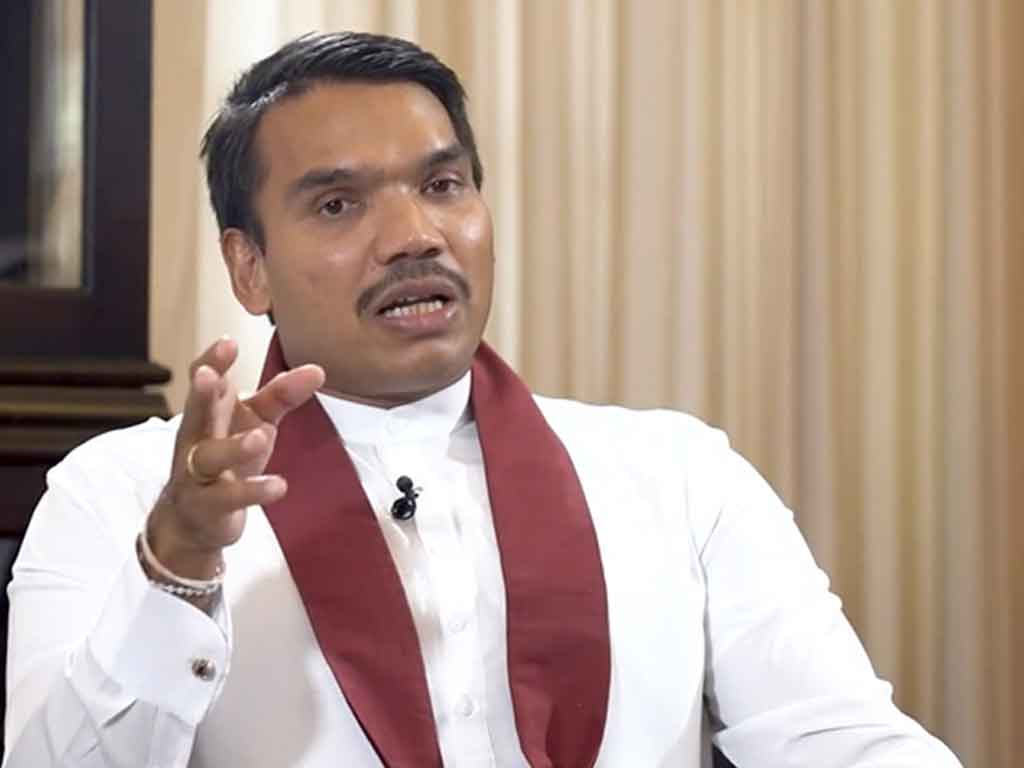
Sri Lanka Podujana Peramuna MP Namal Rajapaksa has launched a scathing attack on the government and the Criminal Investigation Department (CID), accusing them of manufacturing false evidence in the Wasim Thajudeen murder case to gain political advantage. He claims the investigation has become a political tool rather than a pursuit of justice.
Sri Lanka Podujana Peramuna MP Namal Rajapaksa has issued one of his strongest statements yet over the Wasim Thajudeen case, accusing the government and the Criminal Investigation Department (CID) of fabricating false evidence and exploiting the case as a political weapon. He alleged that instead of conducting impartial investigations, authorities are manipulating facts and misleading the public to score political points.
Rajapaksa pointed out that since 2015, both the former Yahapalana administration and the current government have launched waves of allegations against the Rajapaksa family, each time using fabricated evidence to paint them as culprits. “From day one, absurd allegations have been manufactured. This case has been dragged into a political circus rather than treated as a matter of justice,” he said.

Highlighting specific irregularities, Rajapaksa alleged that senior officials had once arranged for the Officer-in-Charge (OIC) of Narahenpita to read false evidence related to the Thajudeen case. Shockingly, he claimed, the same officials who were allegedly responsible for these fabrications continue to occupy high-ranking positions in government institutions today.
The MP also referenced other cases, including that of a former Navy Commander, where a police officer had reportedly told the court he was pressured to provide false evidence. According to Rajapaksa, this pattern demonstrates the CID’s willingness to bend facts to suit the political motives of whichever government is in power.
Rajapaksa was particularly critical of the way the police spokesperson handled recent developments, accusing him of deliberately presenting unverified statements to the media instead of addressing the court. “If there are facts, present them in the judicial process, not in the media. By doing this, the police spokesperson is fueling political discourse rather than ensuring justice,” he charged.
He further emphasized that the case should not be used as a political platform to tarnish reputations. Instead, he urged for a fair and impartial investigation. “If there has been injustice, then it must be exposed and justice delivered. But if the case is being used to manipulate public opinion and fulfill political agendas, then it only deepens the rot in governance,” he said.
Commenting on recent claims tied to the Thajudeen investigation, Rajapaksa criticized the narrative presented by investigators. Referring to the police spokesperson’s remarks that a woman had identified her husband in connection with suspicious footage linked to the case, Rajapaksa argued that the focus of the investigation should instead be on establishing who the husband is, where he has been living, with whom he has been associating, and his actual role in the matter. “Instead of making sensational claims in the media, the authorities must conduct a serious, fact-based inquiry,” he said.
The MP accused the government of deliberately using the Thajudeen case whenever it faces public scrutiny or tough questions. “Whenever the government cannot provide answers, it throws the Thajudeen case into the spotlight to divert public opinion and cover its failures,” he said. He warned that this tactic of distraction would not succeed in the long run.
Rajapaksa also issued a stern warning to officials. “If anyone, whether it is the police media spokesperson or any other person, tries to present false evidence at the behest of the government, or issues prejudicial statements that compromise the judicial process, they will be held accountable under the law in the future,” he stated.
Concluding his remarks, Rajapaksa reiterated that the Thajudeen case must not be turned into a political stage but handled with professionalism, transparency, and fairness. He stressed that justice must be the priority, not political advantage.
As the controversy deepens, Rajapaksa’s sharp rebuke signals a fierce battle between the opposition and the government over one of the country’s most high-profile murder cases. The central question remains: will the Thajudeen case finally deliver justice, or will it continue to be dragged through the mire of political opportunism?