Once the red jersey of CR & FC stood for dignity, pride, and tradition. Today, it is tainted by scandal. With Police SC and Tri Forces handed extra votes, respected nominees from Kandy and Havelocks silenced, and political deals openly exposed, the 8th October 2025 AGM risks becoming the darkest chapter in Sri Lanka Rugby’s history. What should have been a democratic contest has turned into a rigged power grab, leaving fans heartbroken as corruption eats away at the very soul of the game. And yet, hope remains if integrity, fairness, and transparency can finally rise above ego and greed, the red jersey can once again stand for honor and inspire a new generation.
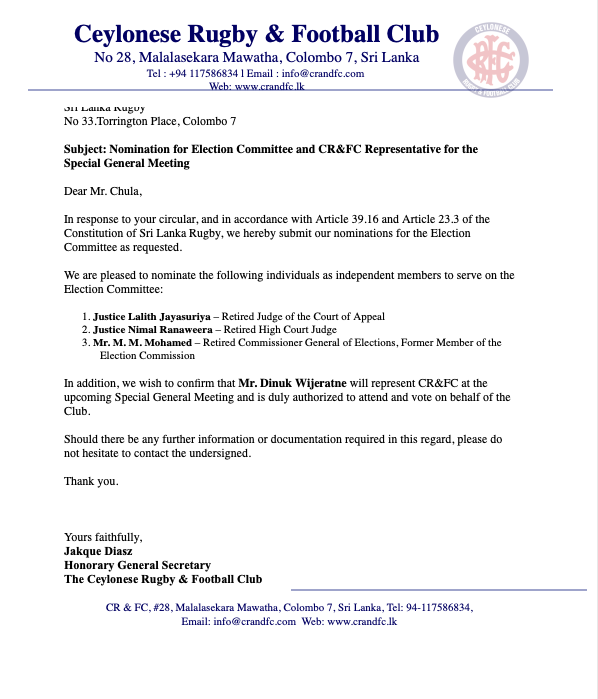
CR & FC’s determination to place their own members in the top positions has raised serious doubts about fairness, both on and off the field. It is evident that they not only fielded their candidates but also pushed forward the names for the very Election Committee meant to ensure impartiality, while nominees from other respected clubs like Kandy SC, CH & FC and Havelocks SC were brushed aside.
This pattern is not new, Sri Lanka Rugby has often been dominated by CR officials in the past, and now history appears to be repeating itself. Politically too, little has changed, the way rugby is being manipulated today mirrors the same interference and favoritism that plagued the game in earlier eras, regardless of who sits in government.

For over a century, the sight of CR & FC’s red jerseys inspired admiration, a symbol of tradition, respect, and discipline. Yet that proud image now risks being remembered for scandal instead of glory. Having long played second fiddle to Kandy SC on the field, CR & FC stands accused of leading one of the most shameful power grabs in Sri Lanka Rugby’s history, an election tainted by political interference, legal wrangling, and institutional manipulation. What should have been a democratic AGM on 8th October 2025 has turned into a battleground where constitutions are bent and state forces misused. Even the once-honored Police SC and Tri Forces are now seen as pawns in CR & FC’s campaign to seize control. For those who love the game, it feels like watching a century-old legacy decay, with corruption eating away at the very soul of Sri Lankan rugby.
The Candidates and the Machinery Behind Them
Despite his ineligibility, CR & FC have nominated Pavithra ‘Pavi’ Fernando as their candidate for President, with his opponent being Lasitha ‘Bongsa’ Gunaratne, another CR & FC veteran and former head of Sri Lanka Rugby also entering the frey. Either way it will be a CR & FC man who will eventually be occupying the SLR President seat. The nomination for Deputy President has also gone to CR & FC’s Shanitha Fernando uncontested, while further uncontested slots for Vice President (Chinthaka Perera – Police SC) and Secretary (Subash Jayatilleke – Air Force SC) have been secured by the Tri Forces.

Caption: The Election Committee, put forward by CR & FC, was formally approved at a Special General Meeting, an approval documented on page two of a three-page record currently in The Morning Telegraph’s possession.
Meanwhile at a Special General Meeting chaired by SDIG (Rtd) M.R. Latiff, three individuals, Justice Lalith Jayasuriya, Justice Nimal Ranaweera, and M.M. Mohamed were appointed to the Elections Committee, all of them nominated by CR & FC, which immediately raised doubts about neutrality and fairness.
The crisis deepened on 30th September 2025, when SLR’s Executive Director, Chula Ariyaratne, circulated an email confirming that respected nominees such as Pradeep Basnayake of Kandy SC (Deputy President) and S.W. Chang of Havelock SC (Vice President) had been struck off the list without a single explanation, raising serious doubts about the fairness and transparency of the entire process.
These developments have now cast a deep shadow over the integrity of the election, leaving many to believe that the Election Committee is acting as an extension of CR & FC rather than as an independent authority.
Under the new constitution, the limited number of office-bearer positions also means that leading ‘A’ Division clubs such as Kandy SC, CH & FC and Havelocks SC will be left without any official representation in the SLR Executive Committee, further tilting control into the hands of CR & FC and its allies.
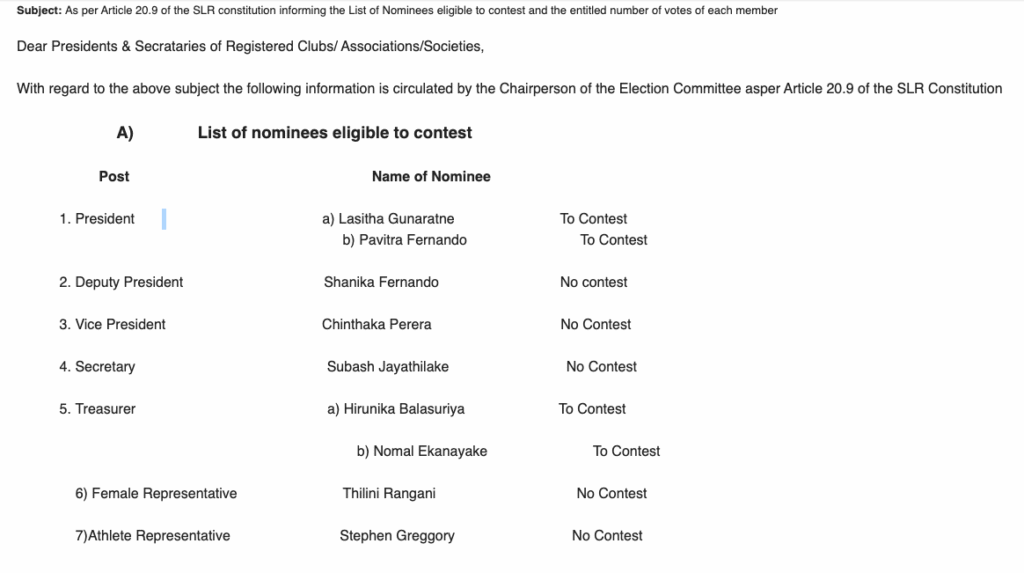
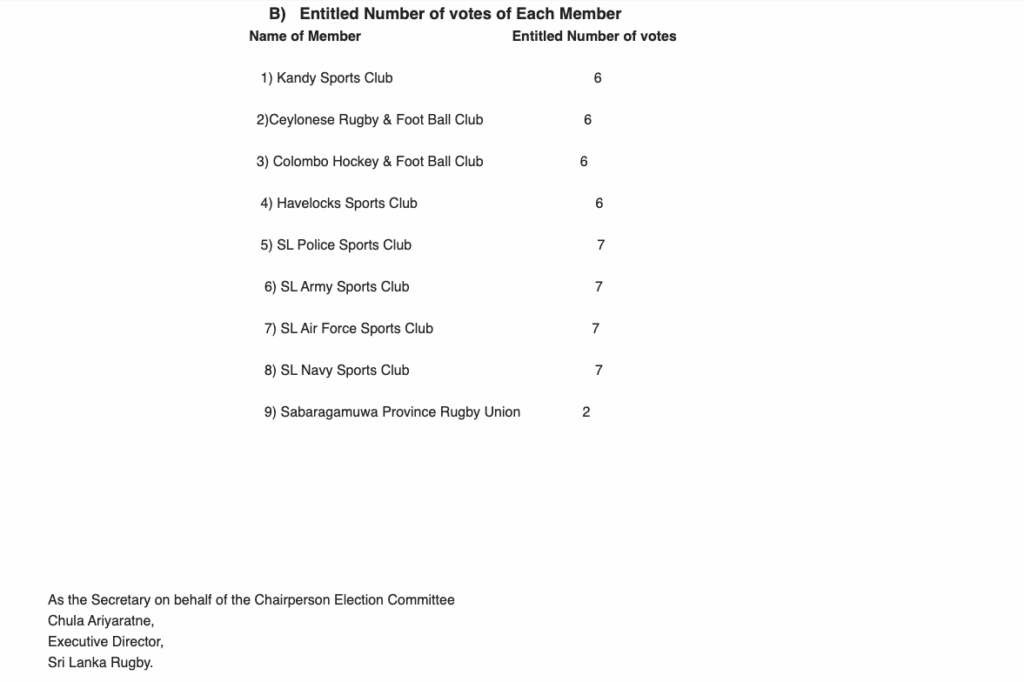
Caption: The Election Committee handed Police SC and the Tri Forces seven votes each, blatantly ignoring the constitution, which caps a club’s voting power at six
Votes That Don’t Add Up
The clearest abuse is seen in the voting structure itself. Police SC and the Tri Forces have each been allocated seven votes, despite the constitution explicitly limiting the maximum to six. That single “extra” vote may look insignificant on paper, but in a contest as tight as this, it could easily tip the balance between victory and defeat. To many observers, it is nothing less than open manipulation, a rigged process carried out in plain sight. In the past, criticism was directed at the Provincial Unions for swaying elections with their block votes, but today it is the Police and Tri Forces who hold the deciding power. This shift not only undermines the integrity of the election but also sets a dangerous precedent, where political interference outweighs fair representation, leaving the future of Sri Lanka Rugby to be shaped by political preferences rather than the sport itself.
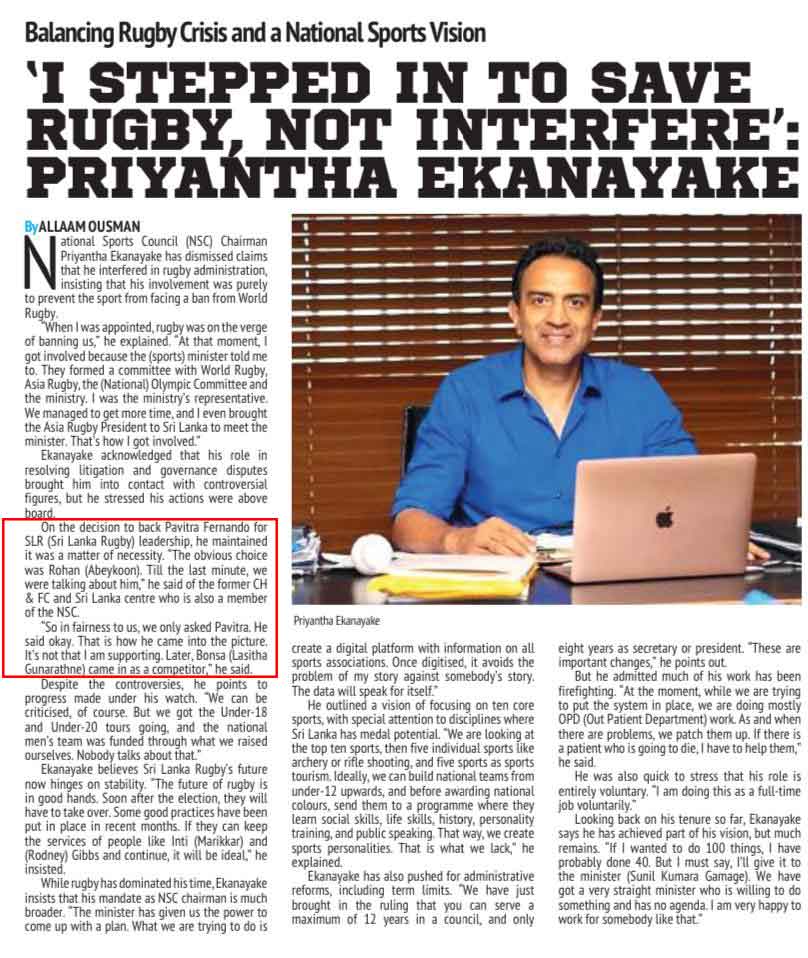
Caption: A Daily Mirror published story confirms that Chairman NSC Priyantha Ekanayake confessed that it was his decision to back Pavithra Fernando for the post of SLR President.
Political Hands at Play
The marks of political interference are impossible to miss. Priyantha Ekanayake the current Chairman National Sports Council and also a former CR & FC player admitted that he was the one who convinced Pavithra Fernando to step forward for the presidency, despite Fernando being clearly ineligible under the rules. What is even more telling is how that barrier of ineligibility appears to have been conveniently brushed aside by CR & FC’s nominated Election Committee, with Ekanayake seemingly enjoying the full support of Minister Sunil Kumara Gamage to bend the system and even break the law as he pleased.
Mishandled Election Process
The Ministry of Sports, under Sunil Kumara Gamage, has mishandled the election process from beginning to end. The very constitution the Ministry boasted of enforcing has been brazenly violated, with both the election and appeal mechanisms trampled and fairness denied. With World Rugby threatening a two-year suspension from 9th October 2025 if the AGM and elections do not take place, one would expect strict oversight. Instead, the Ministry lurches forward, desperate to avoid suspension but unwilling to confront the corruption festering within, choosing instead to shield those manipulating the system.
Even those meant to be impartial have been compromised. Even Dinka Peiris, President of the Referees’ Association, openly declared that his committee supports Pavi Fernando for President, stripping away the last pretense of neutrality in a process already drowning in political influence.
The Red Jersey in Shame
Once, the red jersey of CR & FC stood for pride, discipline, and respect. Today, it has become a symbol of political maneuvering, manipulated votes, and an election many already believe is rigged before it even begins. For players, fans, and all who love Sri Lankan rugby, this moment goes beyond a single AGM—it is about the very soul of the sport. A century-old legacy, once built on the sweat and glory of its ruggerites, now risks being remembered for corruption and power struggles. If World Rugby, which has always opposed political interference, fails to intervene, the game in Sri Lanka may sink deeper into darkness, leaving the proud red jersey forever stained by scandal.
If Sri Lanka Rugby is to survive and thrive, the sport itself must come before individuals and their egos. Integrity, transparency, and fairness must once again become the pillars on which the game is built. This may mean compromise, it may mean tough reforms, but it is the only way forward. Sri Lanka’s youth deserve better than to inherit a game crippled by greed and politics. Officials must take responsibility—not for themselves, but for the generations to come—to restore the sport’s dignity and allow rugby to flourish once more on Sri Lankan soil.