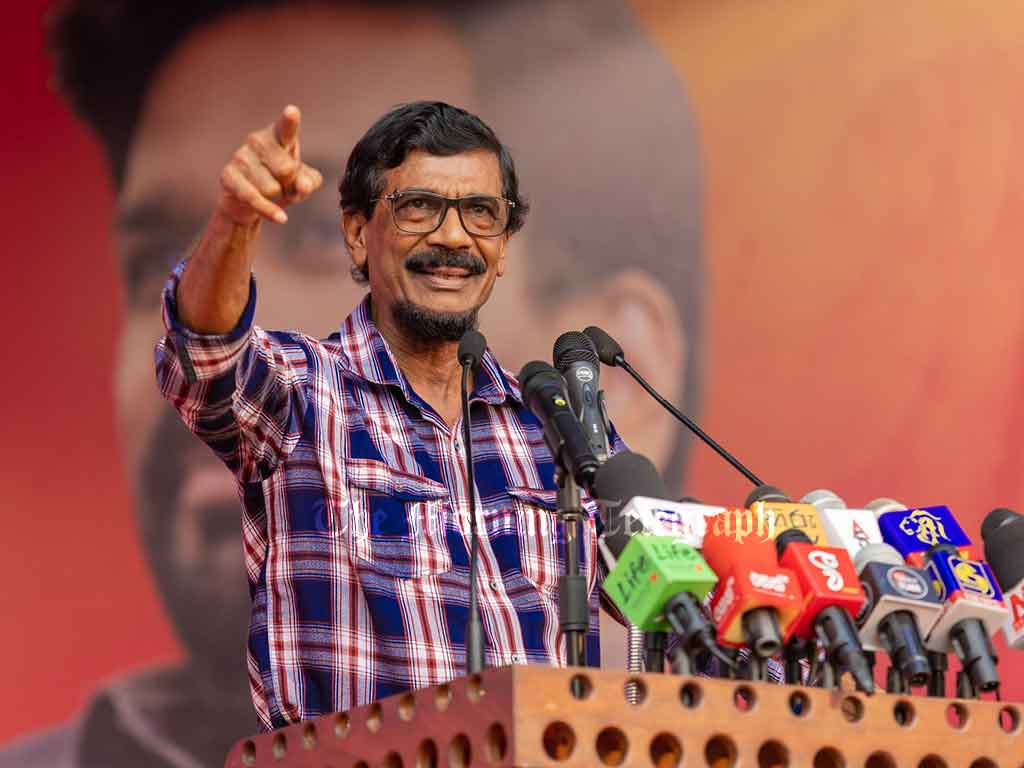
JVP General Secretary Tilvin Silva insists that his party’s unions have never crippled Sri Lanka’s development, denying decades-old allegations and warning only against harmful state sell-offs.
JVP General Secretary Tilvin Silva has strongly rejected allegations that his party’s trade unions have obstructed Sri Lanka’s progress for decades. Speaking during a political discussion on Siyatha TV, Silva responded to claims that the JVP had disrupted the country’s development system over the past 76 years.
The announcer suggested that the opposition believes the JVP is currently silent to allow the government space to rebuild the nation, but Silva firmly dismissed the accusations. He stated that JVP-affiliated unions have never engaged in activities that damaged the country’s economy or stability.

According to Silva, the JVP has consistently supported decisions that benefit the people and only opposed measures that threaten the nation’s long-term interests. He highlighted one example: the selling of state institutions. “If a decision is taken to sell a state institution or act against the country’s future, then we have opposed it,” Silva explained.
On the subject of strikes, Silva insisted that the JVP has not organized strikes in recent decades, but rather peaceful protests. He stressed that industrial action and disruptive strikes have not been part of the JVP’s union activity. Instead, the unions have chosen demonstrations as a way of voicing concerns.
The announcer raised allegations that JVP trade union leaders had interfered with private institutions, harming business and operations. Silva countered by dismissing these as baseless accusations. He challenged his critics to produce evidence, stating, “Name even one institution that we have destroyed.”
This statement reflects the JVP’s effort to rebrand itself as a responsible opposition movement, particularly as Sri Lanka struggles with its ongoing economic crisis. By rejecting the narrative of obstruction and emphasizing restraint, the JVP aims to distance itself from past accusations of radicalism and position itself as a guardian against policies such as privatization of state assets.
For many observers, Silva’s words highlight the ongoing tension between economic reform, privatization, and trade union activism in Sri Lanka. While the JVP seeks to assure the public of its constructive role, critics argue that its history of confrontation has long shaped perceptions. How this narrative develops could influence both political stability and investor confidence in the coming years.