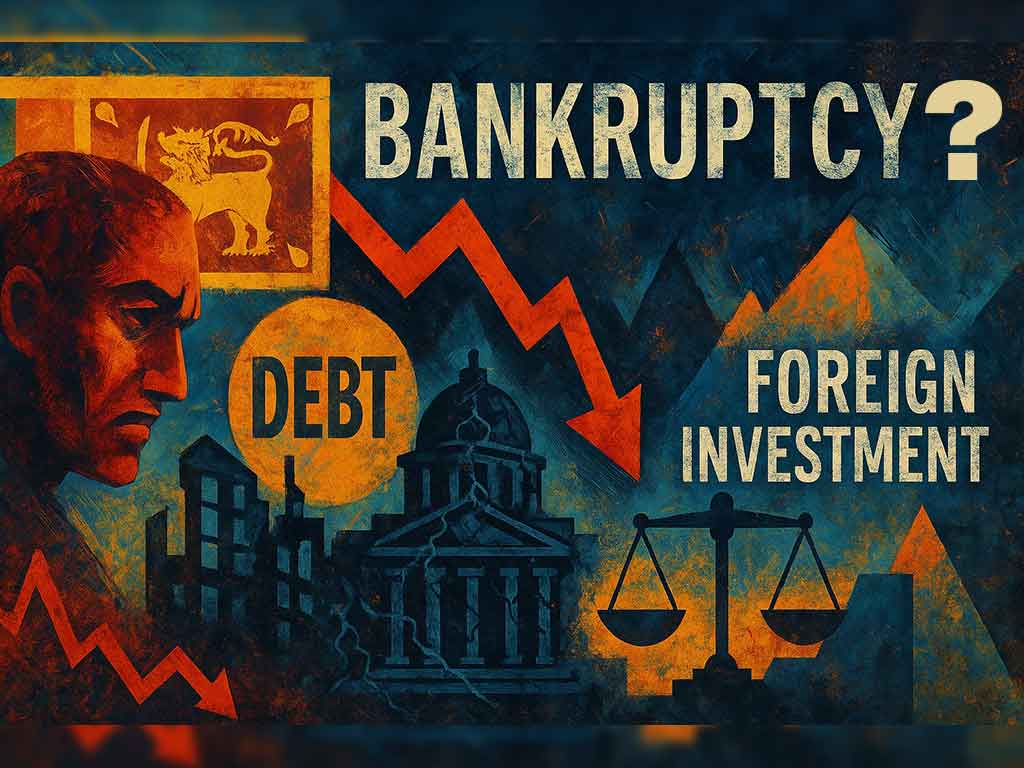
Sri Lanka is once again standing on the edge of economic disaster, with looming debt repayments in 2028, shrinking foreign reserves, and collapsing investor confidence. Despite warnings from international agencies, the government appears to be repeating the catastrophic mistakes of the past. Unless bold reforms and credible strategies are implemented, the nation risks plunging into bankruptcy for a second time within a decade.
Sri Lanka’s economic story has long been one of resilience tested by mismanagement, corruption, and poor decision-making. In 2020, leading U.S. credit rating agencies and the U.S. State Department raised alarms, warning Gotabaya Rajapaksa’s government that the country lacked sufficient revenue to meet debt obligations. At the same time, foreign direct investment was declining and the State Department explicitly said Sri Lanka did not offer a favourable investment climate. Instead of responding with reforms, Gotabaya’s administration brushed aside these warnings. By 2022, the country collapsed into bankruptcy, with the Rajapaksa family forced from office.

Today, nearly identical warnings are being issued, this time aimed at Anura Kumara Dissanayake’s government. Once again, the U.S. State Department and the World Bank have highlighted Sri Lanka’s lack of investor-friendly policies. Foreign investment stands at barely 0.5% of GDP when it should be at least 1.5%. Without sufficient inflows, the country cannot build reserves needed to repay the massive foreign debt falling due in 2028. The parallels are striking, and the risks even greater because the country has no margin left to absorb another collapse.
The Committee on Public Finance (COPF) recently revealed how unprepared the administration is. When pressed about this year’s debt instalments, officials from the Public Debt Management Office could not even provide clear figures. COPF Chairman Harsha de Silva openly questioned whether the government even knows the scale of its repayment commitments. His warning was blunt: if Sri Lanka cannot prepare now, how can it possibly manage repayment in 2028?
The danger is clear. If the government fails to secure reserves and restore investor confidence, Sri Lanka will have no choice but to declare bankruptcy again. Economists say the nation is standing on a financial volcano, with tremors already visible in the form of cancelled projects, missed opportunities, and shrinking investor trust.
Anura’s government, like many before it, has so far relied heavily on the International Monetary Fund (IMF) programme initiated under Ranil Wickremesinghe. But the IMF package, fragile and time-bound, is no substitute for long-term structural reforms. The IMF agreement expires in 2027, just a year before the bulk of debt repayments fall due. Without new strategies to attract capital, liberalize trade, and expand exports, Sri Lanka risks falling into the same trap that consumed previous administrations.
Already, policy inconsistencies have sent shockwaves to investors. The cancellation of the Adani wind power project, the largest foreign investment pledged after bankruptcy, was a glaring misstep. The U.S. Investment Climate Reform body criticized the decision, warning that such unpredictability deters serious investors. Similarly, tariff reduction agreements reached with Washington remain unimplemented, exposing the country to potential U.S. trade penalties. Instead of pushing forward with investment-friendly reforms, the government has turned to borrowing from China at high interest rates to complete the Mirigama–Kadawatha section of the Kandy Expressway.
Japan, once a reliable lender, has already refused new loans until Sri Lanka stabilises its finances. The Japanese ambassador made it clear that pouring money into an unstable economy only worsens the debt trap. If even Japan is reluctant to lend, it signals deep distrust in Sri Lanka’s fiscal management. By focusing on highways rather than revenue generation or industrial policy, the government is repeating the same mistakes that drove the country into bankruptcy in 2022.
History offers painful reminders. Chandrika Kumaratunga’s government in the 1990s simply continued the UNP’s outdated economic programme without introducing new policies. By 2000, the economy collapsed into deficit, and by 2001, her administration was forced out of power. Similarly, the much-celebrated economic gains of J.R. Jayewardene and Ranasinghe Premadasa lasted barely five years before disintegrating due to the lack of new reforms. Today, Anura risks falling into the same cycle—political rhetoric without structural economic change.
Ranil’s IMF-backed programme, though hailed as a stabiliser, is fragile. By 2026, the IMF predicts that Sri Lanka’s economy should recover to pre-2019 levels, but the World Bank insists that deep reforms are needed to achieve even that modest goal. Without significant changes, the IMF programme will expire in 2027, leaving Sri Lanka dangerously exposed just as massive repayments come due in 2028. The timing could not be worse.
The absence of reforms is glaring. There is still no clear plan to attract foreign investment, boost exports, or reduce dependency on borrowing. Instead, the government seems paralyzed, relying on slogans rather than strategies. Foreign investment remains stagnant. In stark contrast, J.R.’s government in 1977 established free trade zones that attracted waves of investors, creating garment factories and export growth. Ironically, the JVP—the very party now in power—protested those free trade zones, calling them a sellout to the West. Today, the JVP finds itself begging for foreign capital to pay off debts. The irony is not lost on observers, who describe it as political karma.
When Premadasa came to power in 1988, he launched the 200-garment factory project to attract foreign investment. At the time, the JVP railed against the programme, claiming youth were being exploited by foreign companies. Now, faced with the reality of debt and global finance, the JVP is forced to court the same foreign investors it once denounced. Without them, Anura’s government cannot hope to meet the 2028 debt burden.
The lessons of history are clear: governments that ignore reform and rely solely on debt collapse under their own weight. Sri Lanka has walked this road before, and the consequences were devastating. Yet, instead of innovating, the current leadership appears to be repeating the cycle. If bankruptcy strikes again, it will not only devastate the economy but also erode public trust, deepen poverty, and drive further political instability.
The deeper tragedy is that solutions exist but remain unimplemented. Economists argue that Sri Lanka must urgently diversify its exports beyond tea, apparel, and remittances. Investments in technology, renewable energy, and logistics could transform the economy. Streamlining bureaucracy, fighting corruption, and providing legal certainty for investors would go a long way in rebuilding confidence. Instead, projects like the Adani wind farm are cancelled, and corruption continues to corrode state institutions.
Debt transparency is another urgent reform. COPF’s revelation that officials could not account for debt instalments shows the depth of dysfunction. Without accurate data, planning is impossible. Harsha de Silva’s pointed questions—whether the government even knows its obligations—strike at the heart of the crisis. Accountability and transparency in debt management are non-negotiable if the nation is to avoid catastrophe.
Ultimately, the risk Sri Lanka faces is not just financial but systemic. A government without vision, reforms, or credibility cannot steer the country out of danger. If Sri Lanka fails to act now, it will enter 2028 unprepared, and bankruptcy will once again devastate millions of lives. The very people who rallied behind promises of change will pay the price of negligence.
Sri Lanka’s predicament is summed up by an old saying: “Karma is a bitch that follows you.” Once the loudest critics of foreign investment, the JVP now desperately needs it. Once the champions of radical politics, they now grapple with the harsh arithmetic of global economics. If they continue to ignore reforms, karma will deliver its verdict in 2028.