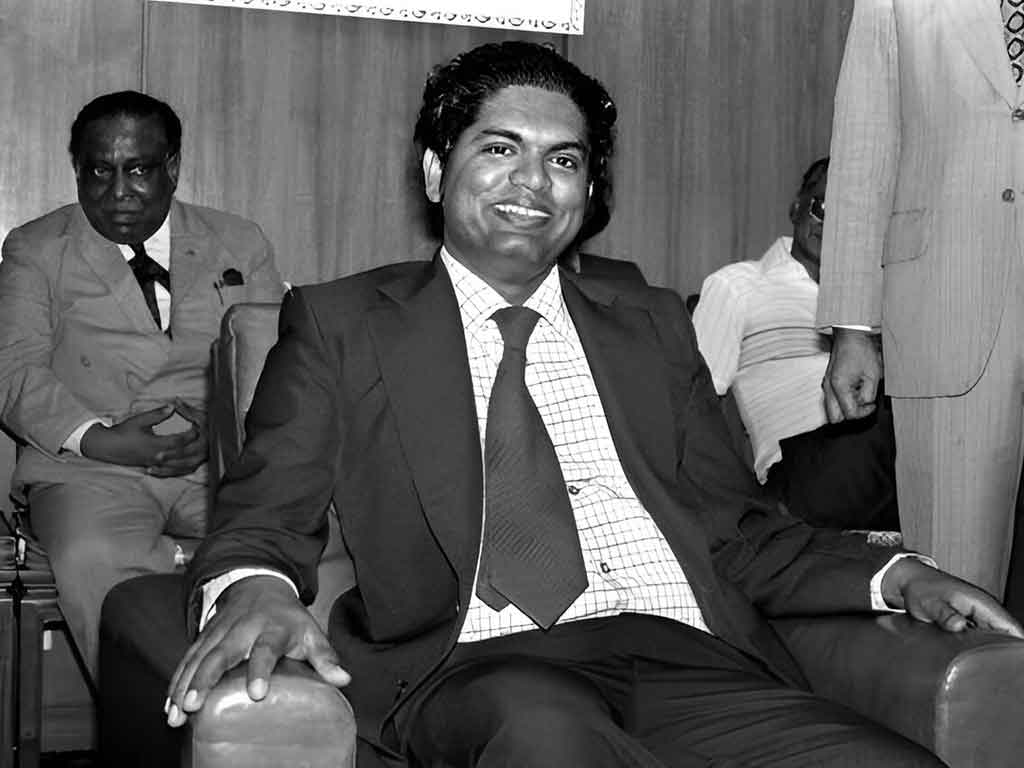
Lalith Athulathmudali’s bold cooperation with Israel during one of the most turbulent chapters in Sri Lanka’s modern history was a calculated gamble that blended diplomacy, pragmatism and strategy, yet decades later, it remains a relationship wrapped in controversy, suspicion and untold possibilities.
Many in Sri Lanka still believe Lalith Athulathmudali was the President the country never had. His assassination on April 22, 1993, cut short the ambitions of one of the most gifted statesmen of his generation. His sharp intellect, his mastery of strategic statecraft, and his unrivalled debating skills from his Oxford days made him a rare figure in the political arena of the 1980s. Those who admired him saw a statesman destined for greater heights, while those who opposed him found themselves threatened by his growing stature, his cosmopolitan worldview and his unapologetic connections abroad.
From his early academic career to his final years on the political stage, Athulathmudali’s name remained linked with Israel. These connections, cultivated long before his entry into national politics, were later weaponized by rivals like President R. Premadasa, who painted him as a Mossad agent conspiring with foreign powers. After the failed impeachment attempt against Premadasa in 1992, the president triumphantly returned to Parliament and ridiculed Athulathmudali as an Israeli operative making money from Jews. The accusation tapped into Premadasa’s deep-rooted suspicion of Israeli influence, his anti-Semitic undertones and his paranoia that Israeli agents were plotting to topple his regime. His fears were evident when he appointed a Mossad Commission under Justice Wadugodapitiya to investigate alleged Israeli activities in Sri Lanka, reminiscent of claims made in Victor Ostrovsky’s controversial memoir By Way of Deception.

But long before these political feuds, Athulathmudali had already built bridges with Israel. In the early 1960s, after returning from Oxford to teach at the National University of Singapore, he was introduced to Israeli officials through Dr. Peter Ellinger, a Jewish colleague who later recalled Lalith’s pivotal visit to Israel. The trip, organized in either 1962 or 1963, was recommended by Israeli ambassador Mordechai Kidron in Thailand. Though the visit lasted only three weeks, Athulathmudali’s short fellowship at the Hebrew University of Jerusalem left an indelible impact on him. He studied the language policy of Israel’s judiciary, which he found efficient and innovative compared to other Middle Eastern systems. The research later appeared in the Quarterly of Comparative and International Law in 1965, gaining recognition among scholars worldwide.
Ellinger noted that this experience was more than academic. Athulathmudali’s professional and social interactions in Israel created long-term bonds that would influence his later political career. Israel’s Ministry of Foreign Affairs reportedly sponsored his visit, suggesting that even then, the Israelis saw in him a young leader worth cultivating. Their assessment proved accurate as Athulathmudali rose through the ranks in Sri Lanka, eventually becoming Minister of National Security under President J. R. Jayewardene.
During the 1980s, Sri Lanka faced the escalating Tamil insurgency and the challenge of securing military assistance. Western allies, reluctant to intervene in what they saw as a localized conflict, withheld crucial support. This vacuum left leaders like Athulathmudali and Ravi Jayewardene searching for new partners. It was here that Israel re-entered the story. With discreet encouragement from U.S. envoy Walter Vernon, Colombo permitted an Israeli section to be established within the American embassy, marking the first time the U.S. hosted representatives of another country inside its diplomatic compound. The move highlighted both Washington’s interest in Israel’s role in South Asia and Sri Lanka’s desperation for reliable military support.
Athulathmudali’s cooperation with Israel was not without consequences. India, under Prime Minister Indira Gandhi, was infuriated by Sri Lanka’s growing security ties with Tel Aviv. The relationship between Colombo and New Delhi, already strained by India’s support for Tamil militants through RAW, worsened further. Critics argued that Athulathmudali’s overtures to Israel fueled India’s suspicions and deepened its interference in Sri Lankan affairs. Yet Lalith remained steadfast. Unlike other Sri Lankan politicians who played a double game with Israel, publicly denouncing ties while privately benefiting from them, Athulathmudali openly admitted that Israel was vital for Sri Lanka’s defence.
In an interview with the New York Times in 1984, he bluntly stated that Sri Lanka turned to Israel after the United States, Britain and West Germany rejected requests for assistance in improving the intelligence system and training counterinsurgency units. He revealed that about ten Israeli agents had been deployed to train 100 Sri Lankan officers, candidly acknowledging, “Our intelligence system was not geared to this kind of thing.” It was an admission rare for a South Asian leader, especially in a region where Israel’s presence was politically sensitive.
The relationship had tangible consequences. In 1984, after an attempt by the EROS group to assassinate Israeli agent David Matan at Colombo’s Oberoi Hotel, Israel shifted its operations to the Liberty Plaza building. Disguised as agricultural advisors, Israeli officials operated under cover, aided by the fact that the premises were rented through the Port Authority, which came under Athulathmudali’s ministry. It was a covert arrangement that underscored both the risks and the resilience of the partnership.
Athulathmudali’s pro-Israeli stance was once described by India’s High Commissioner J. N. Dixit as evidence of his “anti-Indian sentiments.” This criticism, however, only highlights the geopolitical balancing act Sri Lanka faced. For Athulathmudali, aligning with Israel was not an act of hostility toward India but a pragmatic decision rooted in the reality that India was actively arming the very insurgents destabilizing Sri Lanka. His worldview was one of calculated realism: embrace the power willing to help you survive, even if it antagonizes others.
What sets Athulathmudali apart was his consistency. He neither cloaked his dealings in secrecy nor shifted his position to appease his critics. He recognized the strategic imperative of working with Israel, not just for intelligence and military training but also for the symbolic value of aligning with a nation skilled in counterterrorism and survival. He saw in Israel a partner that mirrored Sri Lanka’s own vulnerabilities, and he was willing to endure domestic criticism to pursue that path.
In retrospect, Athulathmudali’s ties with Israel were not merely about military hardware or intelligence sharing. They reflected a deeper vision of foreign policy, one that was proactive, unapologetic and willing to defy conventional diplomatic boundaries. His cooperation with Israel during the critical years of the 1980s was bold and deliberate, carried out without hesitation or deceit. For a country wracked by insurgency, betrayal and international isolation, his approach was as controversial as it was necessary.
Had Athulathmudali lived, Israeli influence in Sri Lanka might have been far more entrenched, shaping not just counterinsurgency operations but also broader diplomatic alignments. His assassination robbed the country of a leader who might have redefined Sri Lanka’s foreign policy in ways that balanced East and West with unflinching pragmatism.
Decades later, the legacy of Lalith Athulathmudali’s relationship with Israel continues to stir debate. To some, he was reckless, willing to gamble with the nation’s sovereignty by bringing in a foreign intelligence power. To others, he was visionary, recognizing that survival demanded alliances that others were too timid to pursue. What is undeniable is that Athulathmudali’s Israeli connection remains one of the boldest undertakings in Sri Lanka’s modern political history, an alliance forged in necessity, remembered in controversy and still debated in whispers whenever the subject of Sri Lanka’s security past arises.