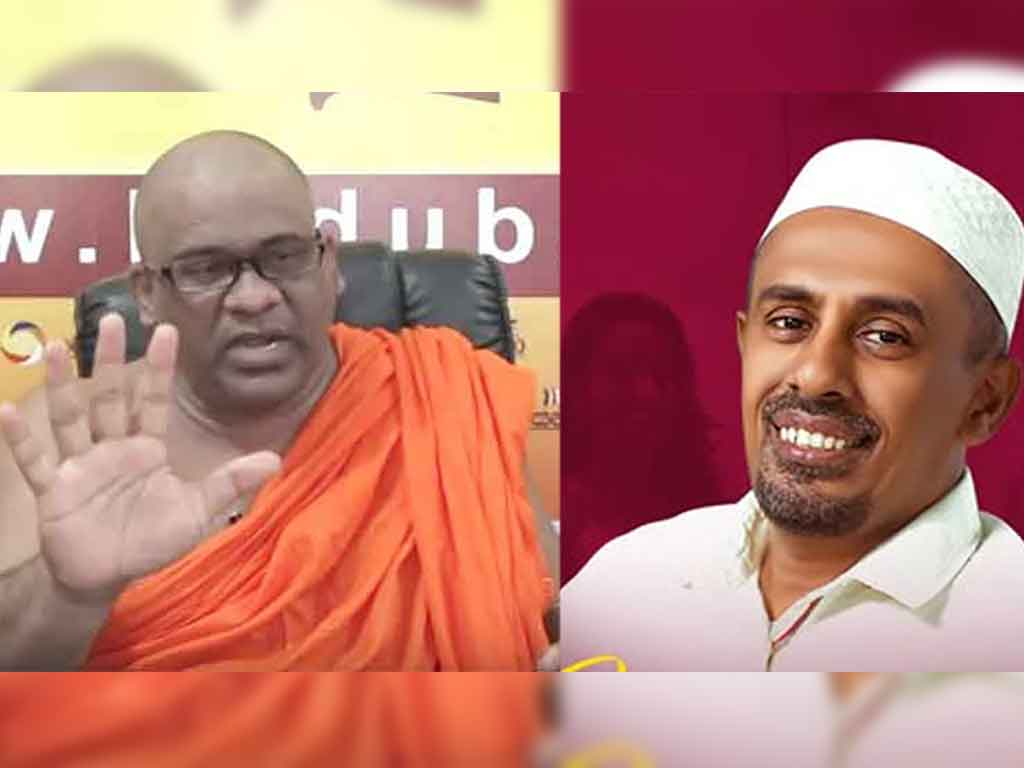
A storm of controversy has erupted after the newly appointed Deputy Minister of Religious and Cultural Affairs, Munir Mulawfar, was urged by Bodu Bala Sena General Secretary Venerable Galagoda Aththe Gnanasara Thero to publicly clarify his organizational affiliations and religious ideology, as suspicions mount across the country regarding his past connections.
Venerable Gnanasara Thero stated that this demand was made not out of personal animosity toward the Deputy Minister but as a call for transparency and accountability. He argued that the public deserves to know what organizations Munir Mulawfar has worked with, the Islamic sect he represents, and the ideology he follows. According to the Thero, such clarity is vital to dispel doubts in a climate already shaken by previous extremist activity and the scars of the Easter Sunday bombings.
Gnanasara Thero recalled how, as early as 2014, he had raised concerns about attacks carried out against Buddhists and the growing presence of groups with links to international terrorism. He pointed out that his warnings were ignored by successive governments, which instead accused him of spreading racism or stirring religious fanaticism. When the Yahapalana government came into power in 2015, the Thero said that many groups linked to global terrorist networks had found political cover. He emphasized that such negligence ultimately paved the way for the 2019 Easter Sunday tragedy.

The Thero further noted that before the current National People’s Power government took office, political movements such as the Janatha Vimukthi Peramuna repeatedly dismissed the existence of Islamic extremism in Sri Lanka. Instead, they claimed warnings of radicalism were tactics to mask political failure. Yet, according to Gnanasara, the reality proved otherwise, and the warnings issued by the Bodu Bala Sena were vindicated in the aftermath of the devastating attacks.
In explaining the complexity of the issue, Gnanasara Thero outlined four major Islamic organizations with global influence that have also left their mark in Sri Lanka. These are Thawheed Jamath, which upholds strict monotheism; Tabligh Jamath, focused on religious propagation though banned in Saudi Arabia; Jamaat-e-Islami, a movement aiming to Islamize the state; and Ikhwan al-Muslimeen, the Muslim Brotherhood group aligned with the teachings of Yusuf al-Qaradawa, who popularized the ideology of suicide bombings.
The Thero alleged that 29 splinter groups stemming from these four movements carried out extremist campaigns in Sri Lanka. He accused them of desecrating Buddha statues, damaging interfaith trust, and maintaining direct or indirect links with international terrorist networks. According to him, such developments have tarnished the Muslim community itself while advancing violent extremist agendas.
Gnanasara Thero claimed that Deputy Minister Mulawfar has had active engagement with groups linked to Jamaat-e-Islami. He referenced Mulawfar’s participation in programs organized by the CIS organization led by Ustad Mansoor, which was identified as having worked in association with extremist elements. The Thero also alleged that Mulawfar delivered sermons at Jamaat gatherings and took part in activities of the Shura Council, which was formed in Sri Lanka after a delegation met with Yusuf al-Qaradawa in 2013.
The Venerable Thero warned that content available on platforms like YouTube provides evidence of the Deputy Minister’s past involvement with these organizations. He also highlighted the role of institutions like the Jamia Nalimiya Islamic Center, which he claimed produces officials who later secure placements in key state sectors such as education, health, and administration. According to him, this creates a long-term systemic risk that must be openly addressed.
Gnanasara Thero stressed that this issue extends beyond political differences or government negligence. He described it as a matter concerning the survival of the state itself. He noted that intelligence reports and warnings had been repeatedly shared with top officials, including the Defense Secretary, but he expressed deep concern that critical information often stalls at lower levels of bureaucracy for months without action.
Concluding his remarks, the Bodu Bala Sena leader insisted that Deputy Minister Munir Mulawfar must clarify his affiliations and ideology to the people of Sri Lanka. Such transparency, he argued, is essential for the security of the country, the preservation of religious harmony, and the rebuilding of trust between communities. Without it, the Thero warned, Sri Lanka risks repeating the errors that led to its darkest tragedies.