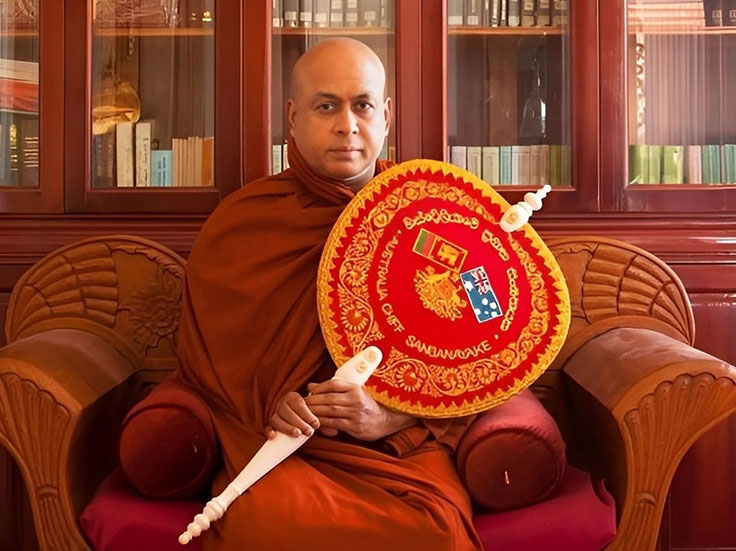
A Sri Lankan Buddhist monk in Australia is at the center of a shocking trial, accused of committing 19 counts of child sexual abuse spanning nearly a decade, leaving families devastated and raising questions about accountability within religious institutions.
The case involves Naotunne Vijitha Thero, the 70-year-old head monk of the Dhamma Sarana Temple in Keysborough, south-east Melbourne. Prosecutors allege that between 1994 and 2002, he abused six children aged four to twelve in various locations including his residence, a prayer room, and Sunday school classes. Now adults, the alleged victims have come forward decades later, testifying in harrowing detail before a Victorian State Court jury.

One of the most emotional testimonies came from a woman who accused Vijitha Thero of abusing her when she was just nine years old. “Vijitha Sadhu touched my body and kissed my lips. I had never been kissed before,” she told the court through tears. Her mother testified that she was devastated by the revelation, explaining that her daughter had remained silent for years, fearing no one would believe her.
Another mother recounted how her daughter was allegedly abused twice at the Keysborough Temple when she was eight or nine years old. The girl, now an adult, reported the incidents to police in 2022. According to her mother, she and her husband had been preparing food in the temple kitchen during a festival when Vijitha allegedly lured the child to his room. Afterward, he gave the girl a key tag with an elephant on it—an object she later discarded in disgust, telling her mother, “I don’t like that at all.”
The allegations detail a pattern of grooming, coercion, and repeated abuse in sacred spaces where families believed their children were safe. Witnesses testified that Vijitha and another monk lived at the temple full-time, while visiting monks from Sri Lanka often stayed there, creating an environment in which children had regular contact with clergy.
Family members of the alleged victims, including mothers and husbands, gave evidence during the second week of the trial. They described years of pain, suppressed memories, and the courage it took for survivors to come forward. The accounts paint a disturbing picture of abuse that, according to prosecutors, went unchecked for years within a respected religious institution.
Defense attorneys maintain that Vijitha Thero denies all allegations, insisting the claims are fabricated. However, the detailed consistency of testimonies from multiple families has strengthened the prosecution’s case, suggesting a broader pattern rather than isolated incidents.
The trial, presided over by Judge Pardeep Thiwana, has highlighted the long-lasting trauma endured by survivors of child sexual abuse, particularly when the alleged perpetrator is a trusted spiritual leader. Legal experts note that cases of this nature are often difficult to prosecute due to the long passage of time, lack of physical evidence, and the emotional toll placed on victims.
Nevertheless, the bravery of the survivors in recounting painful memories decades later is being seen as a pivotal moment in confronting abuse within immigrant religious communities. Advocates stress that such cases reinforce the importance of transparency, safeguarding measures, and accountability in institutions serving vulnerable children.
The trial continues, with the jury expected to hear further testimonies and cross-examinations in the coming weeks. For many families, the proceedings represent not only a search for justice but also a reckoning with the betrayal of trust that has scarred their lives for decades.
As the court deliberates, the allegations against Vijitha Thero cast a long shadow over the Dhamma Sarana Temple and the broader Sri Lankan Buddhist diaspora in Australia. The outcome will be closely watched, not just for its legal significance but for its implications on faith, trust, and the duty of care owed to children in religious communities.