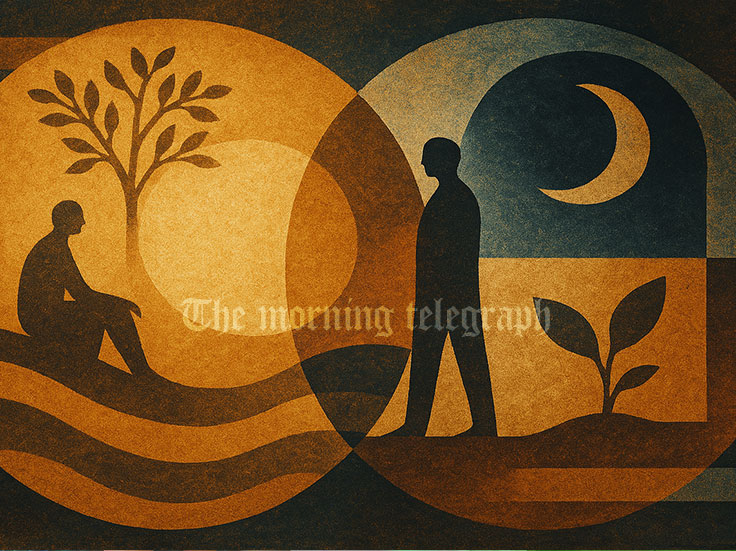
A reflection on renewal, duality, and the quiet architecture of being human
By Roshan Jayasinghe
I have learned that truth doesn’t arrive in thunder. It comes quietly, when I stop trying to explain life and simply sit with it. What follows isn’t a lesson, but a remembering.
When you start seeing clearly, the world stops being background.
You notice the exchanges that make everything work, the quiet way life gives and receives without asking to be thanked.
Fairness turns from an idea into a kind of posture. You stop grabbing and start tending. Maybe stewardship is just that: remembering to care for what you’ve been using all along.
We don’t own this place. We participate in it. That’s enough.
We do not own the world; we take part in its continuance.
Inheritance of the Earth
The older I get, the more I see how the earth remembers. It keeps record in soil and water, in the lean of trees toward light.
Everything we touch leaves a trace.
Everything we use writes something back.
Nature has its own fairness.
A fallen leaf feeds the ground, the ground feeds the tree, the tree feeds the air. It’s an economy that never needed a law degree to understand itself.
We broke that rhythm when we decided to own things, when we measured worth by what we could keep instead of what we could return.
But the earth doesn’t hold grudges. It waits. It keeps teaching. Even now, it’s offering us a choice: to keep taking, or to join the rhythm again.
And maybe maturity is knowing the difference between ownership and care.
The measure of fairness is not how much we keep,
but how gently we hold what was never solely ours.
The Responsibility of Renewal
Time doesn’t move forward; it turns.
It circles back on itself like a tide remembering its shore.
The ground beneath me carries footprints of people I never met,
but whose choices I’m still walking in.
Renewal isn’t about fixing the world. It’s about remembering we’re part of it.
Change doesn’t always roar. It begins small, the pause before we buy, the decision to repair instead of replace, to plant something and not post it.
The elders knew this rhythm.
A fisherman spoke to the sea.
A farmer watched the sky before he cut. They weren’t superstitious; they were in relationship.
We have mastered convenience and forgotten consequence.
We call it growth, but growth without awareness is just appetite.
To renew isn’t to start over. It’s to rejoin the cycle that keeps life alive.
That small act of alignment is enough.
What we inherit is not the world itself,
but the consequences of how we’ve lived within it.
The Architecture of Belonging
After seeing and tending comes the softer question, where do we fit in all this?
Belonging isn’t a feeling to chase.
It’s what shows up when you stop performing your place in the world and simply live inside it.
It’s not comfort; it’s coherence.
It’s when you are seeing, your living, and your caring finally move in the same direction. It’s the peace that comes when your life stops contradicting what you know to be true.
To belong is to remember that we are not here to take from life, but to take part in it.
The moment you stop trying to belong, you realise you already do. The trees don’t need approval. The sea doesn’t need applause. They just are, and that’s enough for them to belong to everything, maybe for us too.
The Dual Lens, Where Teacher and Learner Are One
Everything moves in pairs: night and day, stillness and motion, holding on and letting go.
The world isn’t made of opposites that fight; it’s made of opposites that depend on each other to exist.
The root holds the branch. The branch gathers light for the root. The quiet gives meaning to the sound.
When we try to live only one half, we fall out of rhythm. We cling to certainty and lose truth. We chase peace and forget growth.
But when we let both halves speak, something opens. We find balance again.
There’s no teacher apart from this rhythm. No classroom except the universe itself.
Everything that happens is a lesson in relationship, between what we can see and what we can’t.
The learner and the lesson are the same thing. It’s all just life teaching itself how to be.
Wholeness isn’t the end of duality; it’s learning to move with both halves without breaking the rhythm.
To live fairly.
To live gently.
To belong deeply.
Not three roads, just one circle that keeps turning.
Fairness helps us see.
Renewal helps us move.
Belonging helps us stay.
And in the end, duality reminds us that none of it was ever separate.
We are seed and soil, sky and shadow, teacher and learner.
The universe isn’t something we look at, it’s something we move with.
And if we listen closely enough,
we’ll hear it whisper the oldest truth there is: everything we seek is already part of what we are.
About the Author
Roshan Jayasinghe writes about consciousness, fairness, and the living relationship between humanity and nature.
His work explores the quiet meeting point between clarity and compassion, where awareness becomes a way of life.