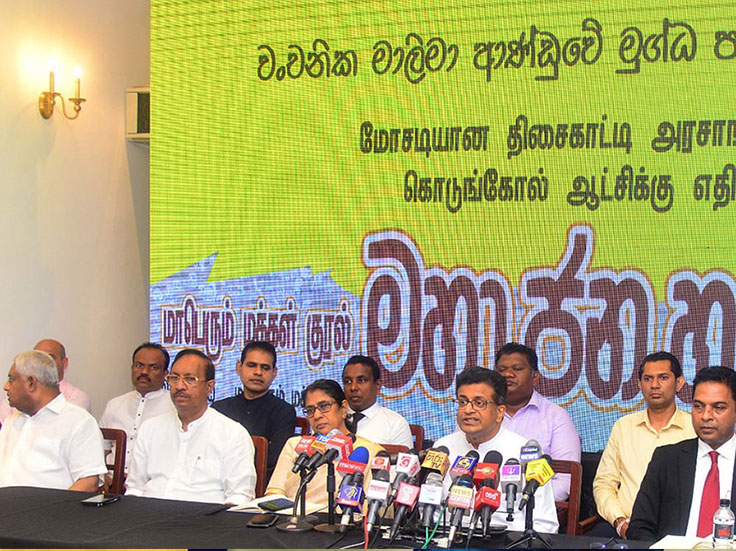
Bold voices from across Sri Lanka’s fractured opposition came together in Colombo, declaring that the greatest danger to citizens’ right to live has arisen since the end of the LTTE war, accusing the government of tyranny, deception, and unleashing violence reminiscent of fascist regimes.
A media conference organized by the People’s Voice coalition was held at the Nippon Hotel in Colombo on October 27, with representatives of multiple opposition parties and former ministers in attendance. The gathering, branded under the theme “Against the tyrannical rule of the fraudulent government,” marked a rare show of unity across Sri Lanka’s divided political spectrum. Among the speakers, Pivithuru Hela Urumaya leader Udaya Gammanpila delivered the most scathing assessment, claiming the administration of President Anura Kumara Dissanayake has stripped away the basic right to life.

The People’s Voice coalition, consisting of parties and individuals from the Samagi Jana Balawegaya, Sri Lanka Podujana Peramuna, Sri Lanka Freedom Party, United National Party, Pivithuru Hela Urumaya, National Freedom Front, and several other political groups, has been meeting weekly since April. They claim their discussions have centered on Sri Lanka’s collapsing governance, unfulfilled promises, and deteriorating democratic standards. According to Gammanpila, it has been over a year since the president assumed office and nearly a year since parliamentary elections gave the government control, yet almost none of the 1,329 pledges in the election manifesto have been fulfilled. He dismissed the government’s excuses of lacking a parliamentary majority, arguing that the November election had already removed that barrier.
He declared that what has emerged in place of reform is the gravest threat to life seen since the defeat of LTTE terrorism. Gammanpila alleged that executive and judicial powers have been outsourced to criminal gangs, citing the case of Lasantha Wickremesekera, a local government chairman treated as if he were under a death sentence despite still being a suspect before court. He accused the government of transforming state institutions into tools of intimidation, saying the police now resemble Hitler’s Gestapo, protecting ministers as they forcibly occupy opposition offices. The chilling remark by a mayor that he was prepared to kill one hundred thousand people to retain power was raised as evidence that Sri Lanka has crossed into authoritarianism.
Drawing historical parallels, Gammanpila recalled how world leaders such as Joseph Stalin, Franklin Roosevelt, and Winston Churchill set aside ideological and historical divides to unite against Hitler’s fascism. He argued that Sri Lanka now requires a similar act of collective responsibility to protect democracy and the right to life. In his words, “Adolf Hitler, who was sleeping in the body of the then President or Mr. Anura Kumara Dissanayake, is now waking up.”
The opposition leaders underscored that their movement was not merely about partisan politics but about ensuring Sri Lankans do not lose their last hold on democracy. They urged all political actors and citizens to put aside ideological differences, historic grievances, and personal ambitions to rally for the preservation of democratic rights. Gammanpila announced that a massive rally will be held in Nugegoda on November 21 at 2 p.m., framing it as the defining moment for all who wish to resist lies, terror, and corruption.
The press conference was attended by prominent political figures including Sri Lanka Podujana Peramuna General Secretary Sagara Kariyawasam, UNP General Secretary Thalatha Athukorala, SLFP Vice President Mahinda Amaraweera, and former Minister Anura Priyadarshana Yapa. Others present included Tiran Alles, Asanka Navaratne, Sugeeshwara Bandara, DV Chanaka, Prasanna Ranatunga, Sagala Ratnayake, Sanjeewa Edirimanne, Mohamed Muzamil, Ajith Rajapaksa, and Premnath C. Dolawatta, signaling an unprecedented coalition of forces rallying behind the People’s Voice platform.
Speakers emphasized that protecting the people’s right to life is now inseparable from protecting democracy itself. They warned that Sri Lanka risks sliding into authoritarianism if immediate collective action is not taken. The November rally in Nugegoda was billed as the place where Sri Lankans who believe in freedom, justice, and democratic survival must converge. According to the opposition, the only way forward is for all parties and citizens to unite and force the government to restore democracy and fulfill its abandoned promises.
The call for unity echoed throughout the event: unite for democracy, unite for the right to live, unite to end lies and corruption. In the opposition’s narrative, Sri Lanka today faces a turning point as critical as the final battle against the LTTE. This time, however, the enemy is not separatist terrorism but the emergence of authoritarian rule, corruption, and fear that they claim threatens the very essence of the nation’s future.