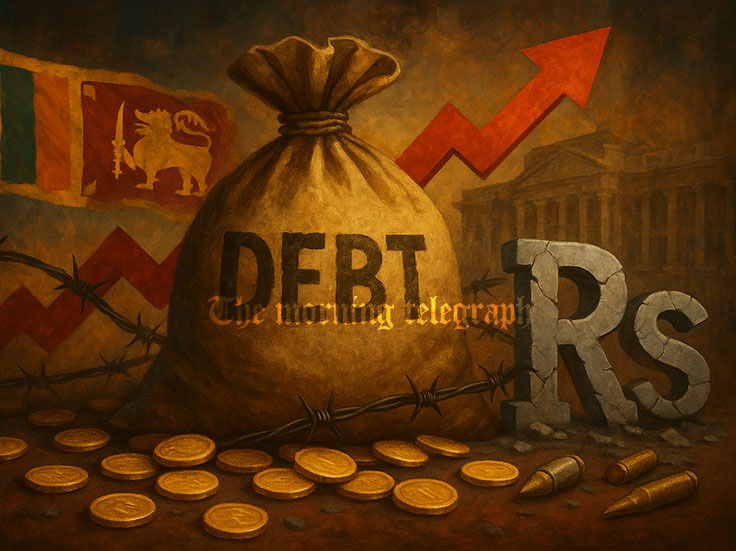
A staggering surge in government borrowing raises fresh alarm over the country’s fragile economic recovery, exposing the mounting pressure of both domestic and foreign debt.
Sri Lanka’s debt burden has escalated sharply in the first half of 2025, with official data confirming a massive rise in government borrowing. The Central Bank’s Weekly Economic Indicators Report, issued on June 24, 2025, reveals that the total public debt at the end of December 2024 stood at 28,738.70 billion rupees. By June 2025, that figure had risen to 29,634.78 billion rupees, marking an increase of 896.08 billion rupees within just six months.

This sharp rise highlights the growing challenge facing the country’s economic policymakers, who continue to rely heavily on borrowing to stabilize the economy, fund expenditure, and service existing debt obligations. The latest figures show that both domestic debt and foreign debt contributed to the surge, underscoring the dual pressure Sri Lanka continues to face in the post-crisis period.
Of the total increase, domestic debt climbed by 496.42 billion rupees during the period. Analysts point out that rising local borrowing typically signals liquidity strain in government finances, with treasury bills, treasury bonds, and Central Bank financing playing a key role in filling the gap. Alongside domestic debt, foreign debt also rose considerably, increasing by 399.66 billion rupees in the same period. This reflects the ongoing exposure to external lenders, currency risk, and interest rate fluctuations tied to international borrowing.
The debt rise comes at a time when Sri Lanka is still under the scrutiny of global financial institutions, having entered an IMF-backed reform program aimed at restoring fiscal discipline and reducing long-term debt dependency. However, the first six months of 2025 show that debt restructuring alone has not eased the country’s borrowing needs, and public finances remain deeply strained.
Economists warn that the continuous rise in total government debt may intensify pressure on inflation, taxation, and future generations, as repayment obligations grow alongside interest payments. They also caution that unless economic growth expands at a faster rate than borrowing, the national debt will continue to spiral, risking another financial shock.
The Central Bank’s report confirms that Sri Lanka’s debt path remains steep, and the country’s economic stability now depends not only on fiscal reforms, but on sustained revenue growth, disciplined spending, and strategic use of future loans.
Sri Lanka enters the second half of 2025 with nearly 30 trillion rupees in debt, and the question remains: how long can the country continue borrowing to stay afloat?