Sri Lanka’s former revolutionary movement once saw India as the enemy of sovereignty — now its leaders are flying to New Delhi for survival, strategy, and political legitimacy in a world where geopolitics punishes isolation and rewards alignment.
Sri Lanka’s political realignment toward India is not an accident, not a diplomatic courtesy, and not a sentimental gesture rooted in shared history. It is a calculated move born out of geopolitical necessity, ideological evolution, and the quiet pressure of regional power balances that small states can neither escape nor dictate. The transformation is most clearly symbolised by Prime Minister Harini Amarasuriya’s visit to New Delhi in October, a moment that reveals not simply a change of foreign policy, but the collapse of a decades-old worldview that once defined the Janatha Vimukthi Peramuna and its satellite movements. What was once denounced as Indian expansionism is now interpreted as indispensable partnership. What once triggered armed revolt now shapes the foreign policy of an electoral majority. The shift is not ideological surrender, but geopolitical realism.

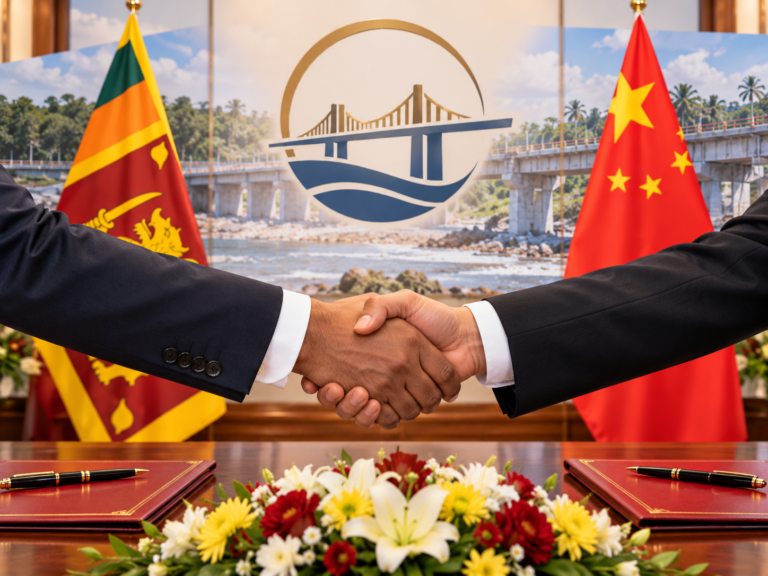
The visit came immediately after Amarasuriya’s return from China, where she held discussions with Xi Jinping and other senior officials on economic cooperation, infrastructure, and gender empowerment. The sequencing was not accidental. It signalled that Sri Lanka is no longer trying to choose between India and China, but instead attempting to choreograph dependence in both directions, hoping competition between the two giants can be turned into strategic leverage rather than strategic punishment. Yet the India visit carried a deeper message: no matter how many deals Colombo signs in Beijing, it is New Delhi that remains the unavoidable gatekeeper of Sri Lanka’s regional stability, maritime security, and geopolitical breathing room.
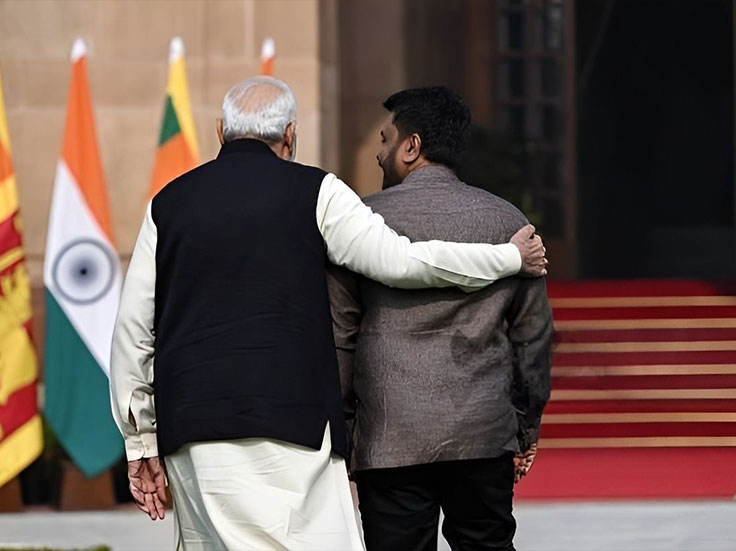
In her discussions with Prime Minister Narendra Modi, Amarasuriya spoke in the language of mutual prosperity, education reform, women’s empowerment, and cooperative development. The vocabulary was diplomatic, but the subtext was structural. India does not simply offer financial assistance or political goodwill. It offers strategic cover in a region where China’s economic footprint is increasingly tied to security implications, port access, and influence corridors across the Indian Ocean. The NPP government understands that aligning more deeply with India does not guarantee rescue from crisis, but failing to do so guarantees strategic vulnerability. Every Sri Lankan administration since independence has eventually discovered this principle, but the difference is that the current government is not pretending otherwise.
The meeting with NITI Aayog confirmed that Sri Lanka’s engagement is no longer limited to traditional diplomacy or ceremonial visits. It is an attempt to plug directly into India’s developmental state model, data-driven policymaking, logistics reform, digital governance, and skill-based growth structures. Sri Lanka is not looking for aid, but for templates to rebuild institutions that have collapsed under decades of debt, corruption, and political theatrics. The presentation of Gati Shakti, the National Education Policy, and artificial intelligence integration were not academic showcases but strategic offerings. If Sri Lanka wants to break from its pattern of economic relapse, institutional decay, and dependency cycles, it must borrow more than money. It must borrow systems.
What makes this moment historically significant is not the policy content, but the ideological reversal that made it possible. No mainstream political movement in Sri Lanka has spent more time building an anti-India worldview than the JVP. Its lectures, manifestos, and propaganda once treated India as an occupying threat, a regional hegemon, and the silent partner of Tamil separatism. The party’s second insurrection was fuelled in part by the Indo-Lanka Accord and the arrival of the Indian Peace Keeping Force. The ideological spine of the movement was built around the rejection of India’s geopolitical reach. Yet today the JVP, reborn as the parliamentary core of the NPP, is seeking economic depth, governance expertise, and strategic cooperation from the very state it once condemned. This reversal is not hypocrisy. It is evolution through defeat, reflection, and survival logic.
The end of the Soviet Union, the failures of armed uprising, and the rise of multiparty legitimacy forced the JVP to accept that ideology without power is theatre, and power without geopolitical calculation is suicide. The party rebranded from Marxist insurrectionism into democratic left-populism, but retained a strong anti-imperial vocabulary. What has changed is the target. India is no longer interpreted as the main threat to sovereignty. The threat is now structural dependency itself, whether it comes through debt, military pressure, energy control, or external political funding. This shift allows the NPP to frame partnership with India as a sovereign decision, not a colonial concession.
Yet not every fragment of the old worldview has dissolved. The Frontline Socialist Party, a splinter from the JVP’s ideological body, still holds to the anti-India thesis. It argues that the NPP has abandoned the anti-imperialist mandate, traded revolutionary ethics for parliamentary convenience, and opened the gateway for Indian corporate and strategic penetration in Trincomalee and Mannar. The FSP claims India’s housing assistance, energy projects, and logistical expansions are not humanitarian gestures, but entry points for influence. Their critique is not entirely dismissed within the political landscape, but the NPP’s calculation is clear. In the hierarchy of risks, Indian investment with strategic oversight is less dangerous than Chinese investment without exit clauses or diplomatic insulation.
India, for its part, is not engaging Sri Lanka out of charity. It is acting according to long-term strategic doctrines codified in Neighbourhood First, SAGAR, and now MAHASAGAR, all designed to keep Chinese naval encroachment outside India’s immediate periphery. Sri Lanka is not merely a trading partner, but a buffer zone for Indian maritime dominance, a supply node in the Indian Ocean’s security architecture, and a cultural bridge that prevents the Indo-Pacific from being divided into binary blocs. India does not seek to colonise Sri Lanka, but to prevent Sri Lanka from being weaponised by foreign powers against Indian security.
Sri Lanka’s ruling coalition appears to understand this better than any of its predecessors. The Rajapaksas tried to balance India and China while quietly favouring the latter, and eventually paid the price through diplomatic isolation and economic dependency. The current government is playing a different game. It is not pro-India in sentiment, but pro-survival in strategy. It sees India as the only regional power capable of offering political oxygen without debt bondage or territorial ties. This does not eliminate the Chinese footprint, but it forces Beijing to negotiate in a space no longer free of Indian counterweight.
The geopolitical realism shaping Sri Lanka’s foreign policy today is not ideological surrender but recognition of scale. China can build ports, highways, and data lines, but it cannot offer geographic shelter or cultural adjacency. India can offer diplomatic cover within regional forums, energy backup when reserves collapse, and pressure relief when Western financial institutions stall negotiations. Sri Lanka cannot afford to treat India as an optional partner, because India does not view Sri Lanka as an optional neighbor. The relationship is asymmetrical by geography alone.
The real political challenge for President Anura Kumara Dissanayake is not external alignment but internal containment. The NPP contains factions that still romanticise ideological purity and view all great power involvement as neo-colonial. The anti-India sentiment, once the JVP’s central doctrine, remains embedded in sections of its grassroots, union base, and student organisations. Managing that tension will determine whether the NPP becomes a stable governing force or another casualty of Sri Lanka’s cyclical political burnout.
Foreign policy in Sri Lanka has never been independent of domestic legitimacy. Governments fall not because of external alliances but because they fail to translate those alliances into visible stability and economic recovery. If India’s partnership delivers cost-of-living relief, public sector reform, energy security, and employment expansion, the ideological resistance will fade. If it delivers only headlines, the old narratives of sovereignty theft will reawaken.
The question is no longer whether Sri Lanka should align with India, but whether Sri Lanka can afford not to. In the emerging Indo-Pacific order, neutrality is a diplomatic fiction. Small states do not sit outside power blocs. They are absorbed by them, bargained within them, or disciplined by them. The only alternative to alignment is irrelevance. The NPP leadership has chosen alignment, not as loyalty to India, but as an exit route from geopolitical suffocation.
Sri Lanka is not returning to India. It is returning to strategy. The new realism is not ideological betrayal, but acknowledgement that sovereignty without leverage is symbolism, and sovereignty with partnership is survival. The JVP once rejected this truth. The NPP has accepted it. That is not defeat. It is maturity earned through history’s slow punishments.