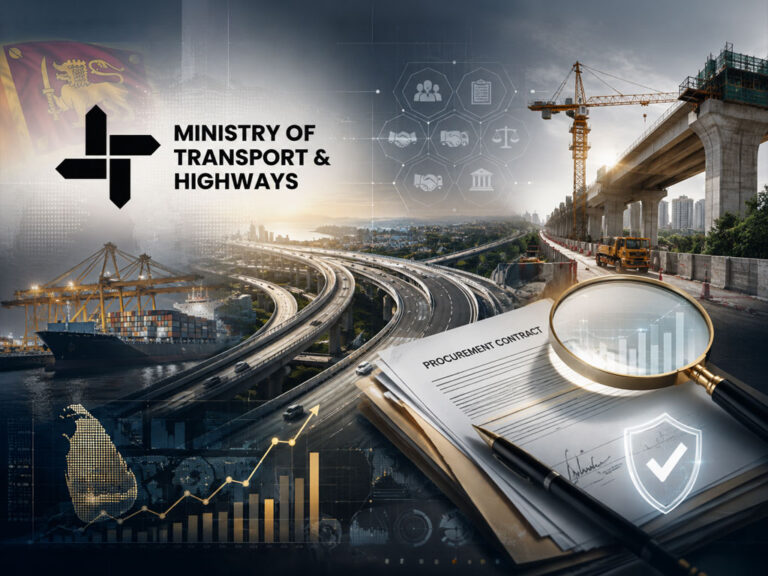
Four of Sri Lanka’s most prominent construction and highway contractors have been officially blacklisted for the first time in the history of the highways sector, marking a major shift in how the government intends to deal with fraud, forged documents and irregularities in multimillion-rupee public contracts. The Ministry of Transport, Highways and Urban Development has issued bans preventing the companies from bidding for tenders or entering subcontracts for periods ranging from six months to three years, signalling a strong message to the industry that inflated reputations and political proximity will no longer shield violators of procurement law.
The companies blacklisted are M/s Consulting Engineers & Contractors (Pvt) Ltd, which has received the maximum three-year ban, M/s V.V. Karunaratne & Company and M/s HOVAEL Construction (Pvt) Ltd, both banned for one year, and W.K.K. Engineering Company (Pvt) Ltd, sanctioned for six months. All four entities belong to the elite CS2 category, the highest contractor ranking issued by the Construction Industry Development Authority, meaning the penalties strike at the very top tier of Sri Lanka’s infrastructure sector. The action comes under Chapter 10.2 (B) of the new 2024 Procurement Guidelines, which came into effect in January and were introduced to close loopholes, strengthen accountability and prevent manipulation of the state tendering system.

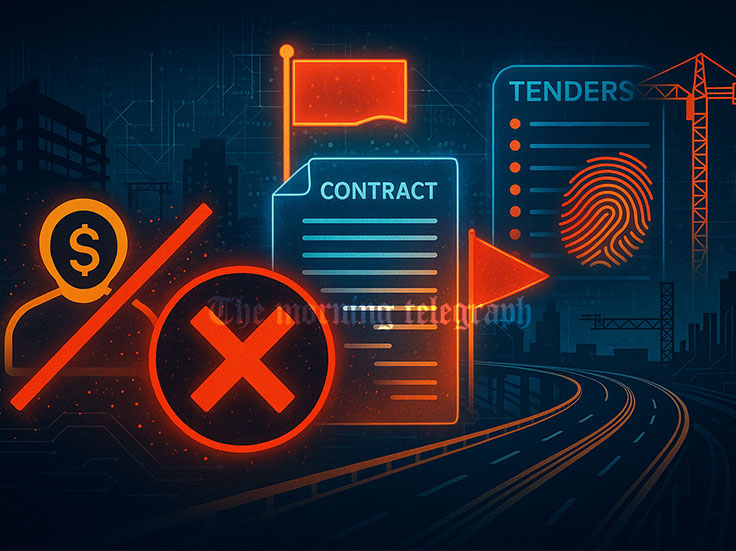
Three of the companies have been accused of submitting false information and forged qualifications in order to win a major contract linked to Section 3 of the Central Expressway Project, one of Sri Lanka’s most expensive and politically visible infrastructure developments. According to the guidelines, any bidder or contractor who falsifies documentation or misrepresents qualifications can be blacklisted, removed, or disqualified from future procurement participation. While all four companies retain the right to appeal, the ministry has confirmed that due process was followed, including the appointment of an independent committee, document analysis, and a formal hearing held on October 10, 2025, where the accused parties were given the opportunity to respond.
The decision also follows a directive issued in September by the Cabinet, which instructed the Ministry of Highways to take appropriate steps against suspected fraudulent and corrupt practices in public contracts. Minister of Highways Bimal Ratnayake subsequently submitted a Cabinet memorandum requesting the National Procurement Commission and the Construction Industry Development Authority to take formal action against the bidders identified by the Bid Evaluation Committee. The Standing High-Level Procurement Committee had earlier recommended sanctions based on evidence that the companies had submitted technical bids containing forged material and misleading representations in order to gain a competitive advantage.
The new procurement guidelines are designed to combat decades of irregularities and undisclosed patronage in Sri Lanka’s public construction sector, where bidding has often been skewed in favour of politically connected or long-established firms. The guidelines allow the government to blacklist not only contractors but also suppliers, service providers and even state officials who assist in procurement violations. They also underline that sanctions must follow a verifiable process, giving accused parties the opportunity to show cause before penalties are imposed, and requiring independent validation before final enforcement of punishment.
Under these reforms, the scope of enforcement has widened. A company can now be sanctioned for offences including forged documents, failure to meet contract obligations, collusion, undisclosed subcontracting or misrepresentation of technical or financial credentials. Officials involved in sanctioning such contracts can also be subject to investigation. This marks a shift toward a more transparent and rules-based procurement system where accountability does not end with the private sector, but extends to state officers who process, approve or overlook fraudulent documentation.
The blacklisting is also significant because such sanctions have rarely been applied to large, influential corporations in Sri Lanka’s construction space despite long-standing public allegations of corrupt tendering processes, inflated cost claims and politically influenced contract allocation. By applying penalties to CS2-level firms, the government has signalled that even top-tier contractors are no longer immune to the rules. The bans also prevent these companies from entering into subcontracts, closing off the common backdoor tactic of using proxy firms to gain tenders indirectly.
The companies have the legal right to appeal the decision, but even if reduced, the bans already affect current bidding cycles for expressway projects, bridge construction, urban road development and other state-funded infrastructure programmes that depend on competitive procurement. With Sri Lanka now under pressure from multilateral lenders to improve governance and prevent state sector losses, strict procurement enforcement is also seen as part of wider economic reform and anti-corruption obligations tied to debt restructuring and fiscal discipline.
The move is likely to trigger industry-wide scrutiny, as several other contractors are believed to have engaged in similar practices under earlier bidding cycles. Stakeholders expect further investigations, especially relating to Central Expressway contracts, where irregularities have been publicly discussed over several years. The penalties also align with global anti-corruption frameworks, as Sri Lanka seeks to rebuild international investor confidence after financial collapse.
The ministry has clarified that the aim is not only punitive but preventive, ensuring that future bids are evaluated on genuine merit, certified technical capability and verified documentation. The sanctions also serve as a deterrent to any company considering forged submissions in upcoming tender rounds.
With public infrastructure now a central pillar of Sri Lanka’s economic recovery narrative, this blacklisting marks a rare intervention in a sector long seen as protected by political cover and unchallenged industry dominance. Whether it becomes a turning point depends on whether the enforcement continues — or whether the appeals process quietly reverses the bans once public attention fades.