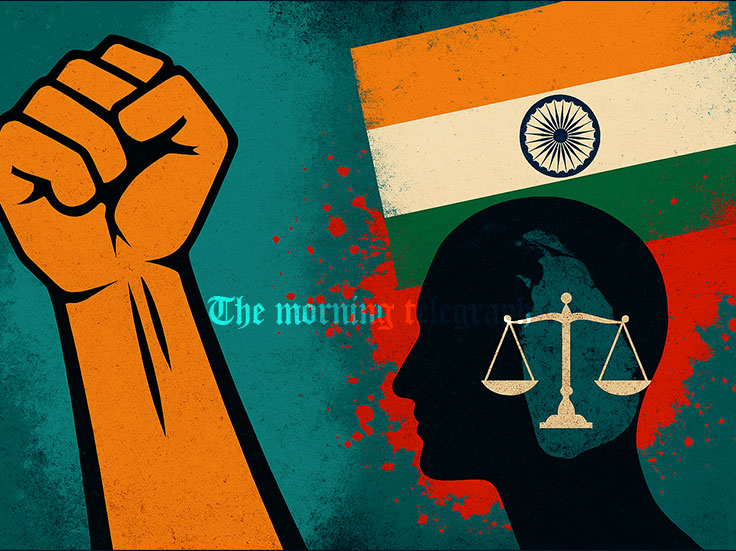
New Delhi wants to teach the neighbourhood how to govern, but the lesson it is really exporting is censorship, majoritarian rule, and a democracy in free fall wrapped in the language of moral superiority.
One could be forgiven for laughing out loud when India’s National Security Advisor Ajit Doval announced that “weak governance” is what caused regime changes in Sri Lanka, Bangladesh, Nepal and others. It takes a remarkable level of self-confidence, or selective amnesia, for a government currently ranked among the world’s most rapidly declining democracies to lecture anyone else on how governance should work. Yet this was precisely what Doval did, fists clenched, while glorifying the “Modi model” on India’s National Unity Day.
If this is India’s idea of unity, one shudders to imagine its idea of division.

The speech did more than insult political memory. It exposed the rich irony of a nation that insists it has abandoned the “big brother” mentality, while constantly reminding the neighbourhood who the eldest sibling is. Nothing erodes soft power faster than unsolicited sermons from a government that believes moral authority can be self-granted. Sri Lanka, whose current rulers perform gratitude rituals every time New Delhi throws a diplomatic biscuit, should take particular note.
Doval’s speech might have passed as generic rhetorical noise until he claimed that India was shifting into a superior “orbital level of governance,” a claim that becomes fascinating only when one compares it with the actual lived reality of Indians. If this is what an “orbital shift” looks like, then India has not ascended into good governance but descended into democratic turbulence, where dissent is criminalised and laws meant for terrorists are used on students, activists, comedians and journalists.
What exactly is this model that Sri Lanka and others are expected to emulate? A governance style where sedition laws are weaponised, Muslim lynchings go unpunished, internet blackouts are routine, and critics whether lawyers, trade unionists or journalists are surveilled, raided, or imprisoned? If so, then yes, India has indeed mastered a system. Just not the one its spokesmen boast about.
Even India’s once globally admired Right to Information framework is being quietly dismembered. Years after Sri Lanka copied India’s RTI model, India itself has begun dismantling its own, with commissioners left unappointed, hearings stalled, and citizens protesting outside state buildings to keep basic transparency alive. So while India calls itself a lighthouse of governance, its own institutions are flickering like a dying bulb.
Sri Lanka may be bankrupt, dysfunctional and recovering from a political collapse, but there is still a difference between a failed economy and a systematically mutilated democracy. India is not collapsing financially. Instead, it is collapsing constitutionally, morally, and institutionally. It is precisely this contradiction that makes Doval’s sermon so unintentionally comedic.
Meanwhile, Sri Lanka is hardly a model of virtue either. This is a country still governed by emergency laws from 1947, counter-terror laws from 1979, and a so-called ICCPR Act that was created not to protect rights but to erase them. The Act was passed to “fix” a Supreme Court decision the political class disliked, while conveniently omitting the right to life. And when civil society pleaded for constitutional recognition of life itself, the State shrugged.
Then, years later, that same ICCPR Act was turned into a speech-policing device and used to jail poets, teachers, comedians, students and activists for words, metaphors, and Facebook posts. Anyone giving Sri Lankan democracy a scorecard would have to deduct points for creativity: not even North Korea thought to enforce the ICCPR by throwing citizens in jail for quoting it.
But back to India, because the sermon came from there. In India today, Muslims live with the daily risk of being beaten to death over rumours of eating beef. Internet shutdowns are imposed with the enthusiasm of a teenager turning off Wi-Fi to avoid homework. And if someone questions the government, they may find themselves charged with sedition, terrorism, or “hurting national sentiment”, a crime so vague it may soon include waking up in the morning without chanting a patriotic slogan.
So what exactly is the governance masterclass being offered to Sri Lanka? Rule by majoritarianism? Militarised policing? Populist nationalism dressed as stability? A democracy where elections are held on schedule but freedom dies on time?
One might forgive India’s lecture if it came from a period when its democracy was admired. But this is not Nehru’s India, nor the India that built RTI, nor the India that once inspired constitutional imagination across the region. This is an India in decline, where power centralises, dissent criminalises, and minorities are thrown into the fire while the State claims to smell rosewater.
Sri Lanka does not get a free pass either. Its political elite destroyed the economy, looted public funds, and allowed corruption to eat every organ of governance. Yet it is still worth saying out loud: India’s democracy is no longer a model to imitate. And when New Delhi lectures neighbours, the region is not hearing wisdom, it is hearing projection.
If India wishes to be respected, it must fix its own collapsing democratic spine before diagnosing the posture of others. It is not “regime change” that toppled governments in the region. It was misrule, corruption, institutional decay and public rage. The same ingredients are now fermenting in India.
The real question is not: Can India teach Sri Lanka governance?
It is: How long before Indians themselves realise that the “orbital shift” is not a rise, but a free-fall?