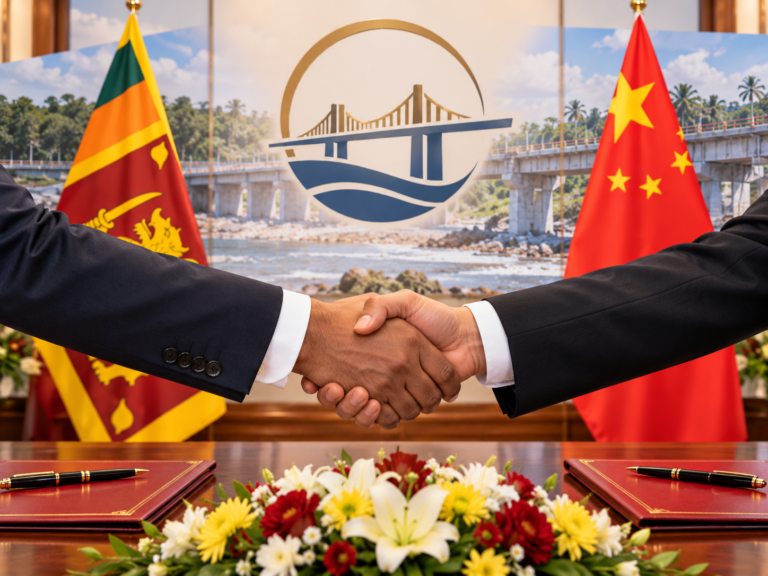
Amid rising geopolitical competition in Sri Lanka, Washington has shown interest in taking control of Mattala International Airport, signaling a strategic counter to China’s expanding influence through the Hambantota oil refinery project.
The United States has set its sights on Sri Lanka’s Mattala International Airport as Boeing representatives explore investment opportunities in aviation maintenance and training, in what analysts see as a clear response to China’s growing presence in the island nation’s south. The move comes nearly a decade after a similar Chinese proposal was shelved under political transition.

In 2014, China National Aero-Technology Import & Export Corporation (CATIC), a major state-owned firm, proposed establishing an aircraft maintenance facility in Sri Lanka to service Chinese-made aircraft used by the Sri Lanka Air Force. The plan aimed to save foreign exchange by conducting maintenance locally rather than overseas. At that time, China identified Trincomalee as a potential site, raising alarms in India due to its strategic proximity to the Bay of Bengal.
When the issue was brought up in Parliament, then Opposition Leader Ranil Wickremesinghe demanded clarity, and Foreign Minister G.L. Peiris confirmed that Trincomalee was among the proposed sites under review. However, with the government’s defeat in the 2015 presidential election, the Chinese proposal was quietly abandoned.
Fast forward to 2025, the geopolitical stage has shifted dramatically. A delegation from the US-based Boeing Company met President Anura and expressed interest in setting up an aircraft maintenance and technician training facility at Mattala. The visit followed the recent dismissal of Minister of Aviation Bimal Rathnayake, who had been known for his pro-China stance. Boeing’s approach appears timely, signaling renewed American engagement in Sri Lanka’s strategic infrastructure.
Earlier, in March, Bimal Rathnayake had announced plans to attract foreign investment to establish a maintenance, repair, and overhaul (MRO) facility at Mattala. However, his exit paved the way for Boeing’s proposal to gain momentum.
During Ranil Wickremesinghe’s administration, approval had been granted to hand over Mattala’s management to a joint Russian-Indian company, but strong US pressure led to the decision being overturned. Aviation Minister Nimal Siripala de Silva later revealed that Washington had cited sanctions against the Russian firm as justification, though Sri Lankan officials dismissed it as diplomatic maneuvering. After President Anura’s election victory in 2024, the agreement with the Russian-Indian venture was officially canceled.
Now, with Boeing’s entry, Sri Lanka appears poised to align the Mattala Airport project with American interests. Observers believe President Anura is unlikely to reject the proposal, seeing it as a strategic balance to the Chinese-backed Hambantota oil refinery project.
The potential Boeing-led development could transform Mattala into a key aviation hub while strengthening US presence in Sri Lanka’s southern corridor, long dominated by Chinese-funded infrastructure. As Colombo navigates between global powers, the future of Mattala may become a defining test of Sri Lanka’s geopolitical balancing act.