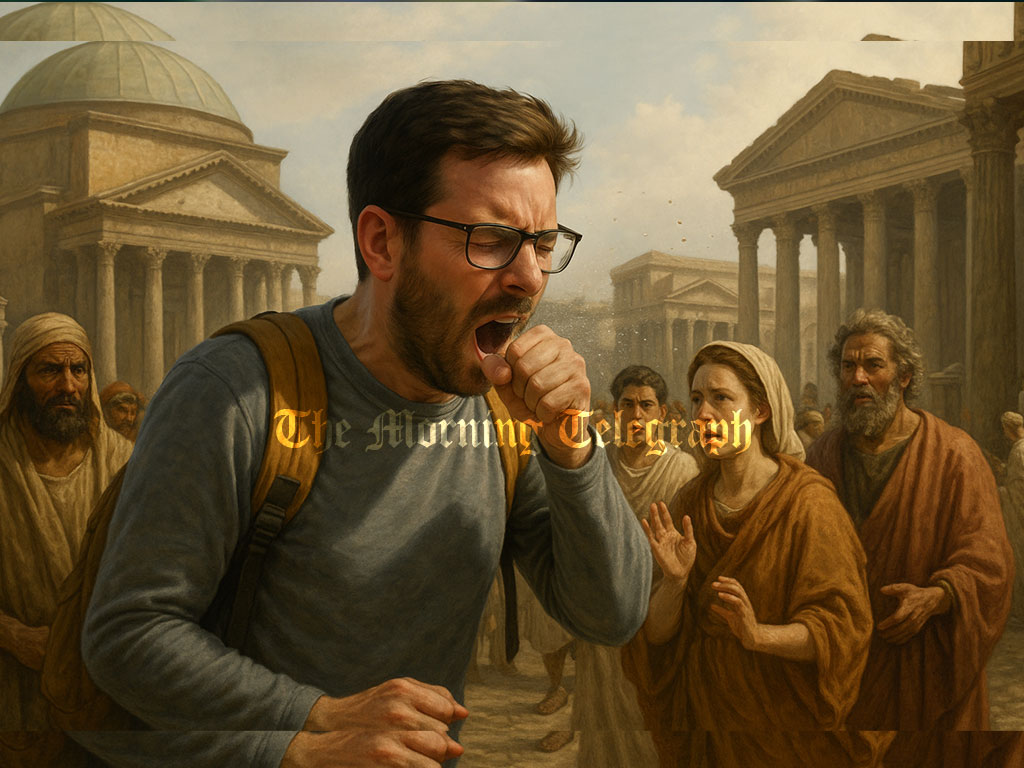
One sneeze. A single germ. Could it rewrite human history and delete you from existence? The terrifying science of time travel says yes.
The Allure and Peril of Time Travel
The concept of time travel captivates the human imagination. The prospect of witnessing prehistoric dinosaurs or the construction of the Egyptian pyramids is undeniably compelling. However, this dream harbors a terrifying scientific reality. Consider traveling 2,000 years into the past to the Roman era. The danger is not in confronting armies, but in something as simple and involuntary as a sneeze. This single act could function as a biological weapon with catastrophic consequences for the timeline.

The Pathogen Catastrophe
Your body is a reservoir of modern viruses and bacteria. These microorganisms have evolved over centuries, developing resistances unknown in the ancient world. The immune systems of people from 2,000 years ago would have no acquired immunity or natural defenses against these advanced pathogens. Your sneeze, releasing millions of these modern microbes, would act like a biological bomb. This event could trigger a pandemic of unprecedented scale, potentially wiping out a vast portion of the contemporary population. This is a stark illustration of the butterfly effect, a concept in chaos theory where a minuscule change in a complex system can lead to large-scale, unpredictable consequences. The death of a single key individual, or even the disruption of a local ecosystem, could prevent your own ancestors from meeting, thereby erasing your own future from history.
Confronting the Grandfather Paradox
The most famous temporal paradox is the Grandfather Paradox. This thought experiment questions the logical consistency of changing the past. If you were to travel back in time and kill your own grandfather before your parent was conceived, you would create an impossible situation. Your own existence would be negated, which then begs the question: how could you have traveled back to commit the act in the first place? This causal loop defies conventional logic and highlights the fundamental problems with backward time travel within a single, consistent timeline.
Theoretical Physics and Potential Resolutions
Theoretical physics offers potential resolutions to these paradoxes, primarily through two leading hypotheses. The first is the Novikov self-consistency principle. This principle asserts that the laws of physics prevent paradoxes from occurring. Any actions you take in the past were always a part of history. You would find yourself physically unable to kill your grandfather; the gun would jam, or you would be prevented in some other way, thus preserving the timeline’s consistency.
The second, and more widely discussed, theory is the multiverse theory or the many-worlds interpretation. This solution posits that every quantum event causes the universe to branch. Under this model, traveling to the past would not change your original timeline. Instead, your arrival would create a new, parallel universe. In this new branch, your actions, like causing a plague or killing your grandfather, would only affect that new reality. Your original timeline would remain untouched, but you would be forever trapped in a parallel world where you were never born, effectively becoming a temporal orphan.
The Final Verdict on Temporal Journeys
Time travel is far from a simple game. It represents a potential cosmic hazard capable of disrupting reality itself. The risks associated with altering the past, whether through a deadly pathogen or a direct paradox, are existential. The scientific theories that make it conceivable also suggest dire consequences, from erasing billions of lives to becoming stranded in an alien timeline. The final question remains: is the pursuit of this knowledge worth the unimaginable risk?