By Roshan Jayasinghe
In the first part of this reflection, we listened to a billionaire describe our economic system as a garden badly tended. Nick Hanauer spoke about capitalism not as an untouchable law of nature, but as a human design that has produced both great wealth and great harm. He named greed, bad ideas and neglect as weeds we have allowed to spread.
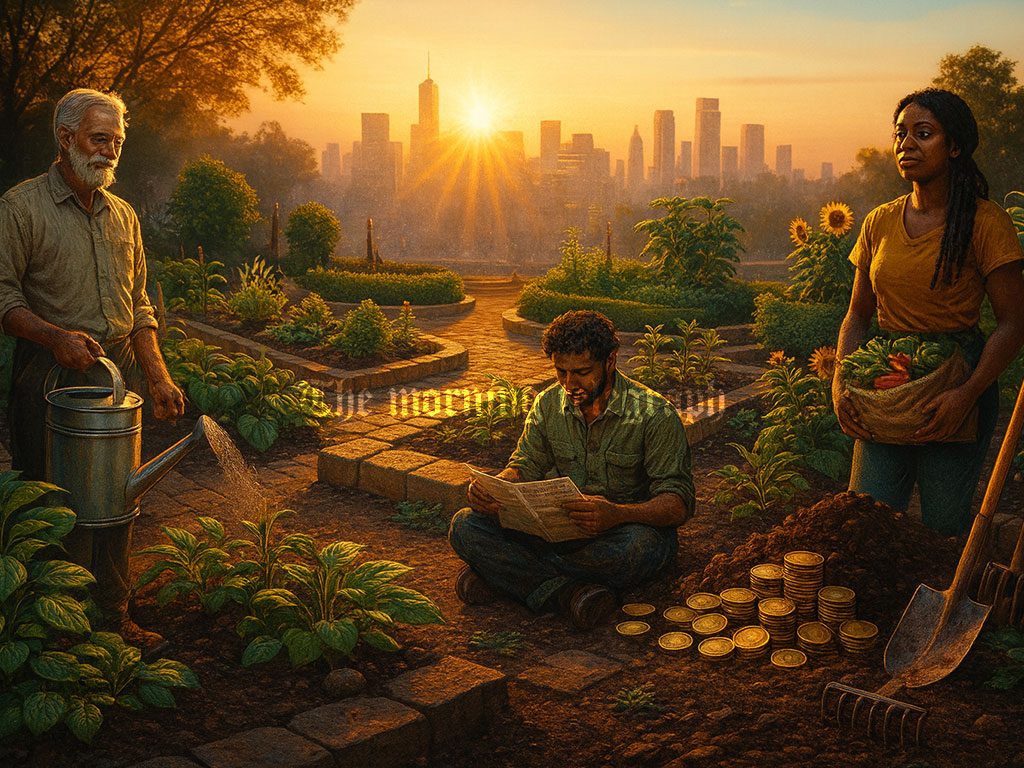
If the economy is a garden and not a jungle, then someone must be the gardener. That “someone” is not only a distant government, or a few executives in a boardroom, or a handful of economists. It is all of us, in different ways, standing in the same soil.
The question, then, is not only what is wrong with the system, but how we live inside it. How we carry ourselves, knowing we did not design this world and yet we keep it going every day with our work, our purchases, our silence, our speech.

This is not about theory. It is about how we, together, learn to live as custodians in a system we did not build but constantly feed.
We did not write this script, but we are on stage
One honest starting point is to admit where we actually stand. None of us wrote the grand script of global capitalism. None of us alone decided that shareholder profit should sit above all other concerns, or that growth should be the central measure of success. Those decisions were made over decades by governments, corporations, think-tanks and institutions most of us will never see from the inside.
At the same time, we are not simply victims tied to the railway tracks. Every day we swipe cards, agree to contracts, take jobs, offer services, keep quiet, speak up, buy, sell, click, share. We keep the wheels turning.
We, like the system itself, are not innocent and not evil. We are human. We have all had moments when we chose the easier option instead of the fairer one. We have all benefited from arrangements that did not treat everyone equally. We have all, at times, gone along with “how it’s done” even when something inside us shifted uncomfortably.
If we can acknowledge that, without drowning in shame, we are already standing on more solid ground. From there we can ask: as long as we are on this stage, how do we act with a little more honesty and care?
From ownership to custodianship in our own minds
One deep shift we can make together is in how we think about what we “have”. The dominant story trains us to repeat words like “my money”, “my business”, “my success”, “my land”, as if these things were extensions of our own body.
But if we look closely, nothing really stays. Money passes through our accounts. Jobs and titles change. Properties outlive their owners. Even our bodies are temporary homes. What we call “mine” is often just what is “in our care” for a while.
When we begin to see things this way, our relationship with them changes. Ownership carries the energy of clinging and defending. Custodianship carries the energy of tending and responsibility. The first says, “This is mine to take from.” The second says, “This is in our hands to look after.”
We will still use the language of ownership in law and daily life. Contracts and deeds will not vanish overnight. But quietly, inside our own heads and hearts, we can begin to hold what we have as custodians rather than conquerors. That alone softens the ground on which greed usually grows.
Rethinking “more” and “enough”
Another place where the jungle story has soaked into us is in our relationship with “more”. More money, more growth, more scale, more productivity. We have been told, again and again, that bigger is better and that there is no such thing as enough.
This way of thinking does not only live in boardrooms and markets. It has crept into our homes and minds. Many of us measure ourselves against others almost automatically: who has more, who is ahead, who is behind. We compare lives on screens and feel either proud or ashamed.
If the economy is a garden, constant endless “more” is a strange goal. No healthy garden is allowed to grow without limit. There is always some sense of proportion, of balance, of “this is enough for this space”.
We can begin to reclaim that sense together. We can ask, in our own circumstances, what “enough” actually looks like. Enough income to live with dignity, enough security to sleep at night, enough comfort to breathe without anxiety, enough room to be generous. Beyond that, we can start to ask what extra growth costs us: in time, in stress, in honesty, in the wellbeing of others.
None of us will answer these questions perfectly. We will still have ambitions, fears, desires. But as long as “more” remains unquestioned, the weeds of the garden will always find fresh soil. When “enough with integrity” becomes a value we recognise, even quietly, the shape of our choices slowly changes.
Seeing our own part without turning on ourselves
There is a danger in all this talk of responsibility. It is easy to swing from blaming “them” to blaming “ourselves” for everything that is wrong. But self-attack, like pure blame of others, also keeps us stuck.
A healthier move is to look honestly at where we are involved and where we are not.
We did not set interest rates or write trade agreements. Most of us did not decide how global supply chains would be structured. But we can notice smaller places where we are part of the pattern. Perhaps we have underpaid someone because we could. Perhaps we have taken work we knew was not clean because we were afraid of scarcity. Perhaps we have chosen the cheapest option again and again, even knowing deep down that someone else must be carrying the hidden cost.
Seeing these things is uncomfortable. It can feel like looking in a mirror under bright light. But this is the kind of discomfort that can make us more human, not less. It reminds us that change is not only something we demand from above. It is something we participate in from wherever we stand.
Changing how we move through the garden
Once we start to see ourselves as part of the garden, not just observers, our small daily movements take on a different kind of weight. Every way in which we interact with the system becomes a chance, however modest, to tend rather than trample.
We spend. We earn. We speak. These three flows alone shape much of our lives.
When we spend, we can become a little more curious about what sits behind the price tag. We will not always have the luxury of choosing the most ethical option. Many people simply do not have that financial space. But when there is a choice, we can begin to value honesty, durability and care alongside cost. We can pay attention to where something comes from, how long it will last, and whether it carries a hint of respect for the person who made it.
When we earn, we move inside organisations and networks that may not perfectly match our values. Even there, we can bring a different presence. Paying someone on time when we could delay. Telling the truth to a customer even when a lie would make the sale. Refusing to join in when colleagues make a game out of exploiting loopholes. Small gestures like these rarely make headlines, but they change the atmosphere around us. They say, quietly, “The garden is more than numbers.”
When we speak, we shape what is considered normal. Silence is sometimes wise, but it can also be a way of letting weeds spread without question. We do not need to shout or lecture. Sometimes a simple sentence is enough to remind a room that human beings, not just metrics, are involved. Are we comfortable with this? Does this feel fair? Would we be happy for this decision to be made about us?
The upside-down rules we have agreed to
Some of the strangest parts of our garden are the ones we have learned to call “just how it works”. Banking is one of the clearest examples.
A bank does not create its power from thin air. It gathers that power from millions of ordinary people who deposit their money and trust into those accounts. That collective pool of money becomes the raw material for loans, investments and speculation. At the end of the year, a handful of executives at the top award themselves bonuses that would take a lifetime for a normal depositor to earn.
Then we look at how that same bank sets interest rates. The person with property, assets and a steady income is offered the lowest rate and the best terms. The person who is poor, unstable or in real need is hit with the highest rate and the harshest conditions, precisely because they are poor. We dress this up with words like “risk-based pricing” and “creditworthiness” and “market logic”, but the effect is simple and obvious: we depress the people who are already struggling and indemnify those who are already safe. The many whose money makes the bank powerful are not the ones being served; they are the base that allows wealth to rise further upward.
The same upside-down logic shows up in something as ordinary as a late fee or an overdraft charge. A person is late paying a bill, a subscription or a rent instalment, often because they are short of money in the first place. The response of many service providers and banks is to add an extra fee on top of what is already owed. If an automatic payment goes through when there is not enough in the account, the bank does not ask what went wrong. It simply adds another charge to the person who already has the least capacity to absorb it.
On paper, this is explained as incentive and discipline. In human terms, it is nonsense. We punish the person for not having enough by taking more from the little they have. We create rules and penalties in the name of order, and then act surprised when people sink further into debt and despair.
Housing gives us another clear picture. There is land, there are homes, there are people who need somewhere to live. Yet homes are treated like chips on a casino table. Large investors buy up blocks of apartments, leave some empty, and watch prices rise, while ordinary families are told “that’s the market.” Rents climb, wages lag, and people live with constant anxiety about eviction or moving. Those who own ten houses are praised as clever, while those who can’t secure one are called irresponsible.
Taxes follow the same pattern. An ordinary worker who files late, or falls behind on what they owe, is chased with penalties, interest and letters. Miss a date, pay more. Late by a week, pay more. The system is efficient when it comes to squeezing a teacher, a driver, a small shop owner. Yet for large corporations and the ultra rich, there are entire industries devoted to finding ways around paying their share. Profits are shifted between countries, ownership is hidden behind layers of companies, and the whole thing is called “tax planning” as if it were a clever game. When anyone questions this, we are told “it’s legal”, as if legality and fairness were the same thing, forgetting who helped write those laws.
Health is another quiet arena where this shows. In many places, the simple act of getting sick can destroy a person financially. Medicines that cost cents to produce are sold at prices that swallow half a month’s wages. A few days in hospital can become a debt that drags on for years. Companies that set these prices wrap themselves in the language of “innovation” and “research”, while their executives sit on fortunes built from human fear and pain. The people whose bodies are on the line are told they should be grateful the system exists at all.
Basic services like electricity, water and internet add their own weight. Miss a payment because you are short one month and, instead of asking what went wrong, the company punishes you with late fees, reconnection charges, and extra penalties. Again, the person who cannot pay is charged more. A utility reports record profits while its customers sit in the dark doing calculations on whether they can afford to run a fan at night.
Politics sits over all of this. We are told that elected representatives speak for the people, that public office is service. Some do try. But the structure leans toward those who already have power and money. Campaigns depend on big donors. Laws are influenced by lobbyists who spend their days inside the same buildings, whispering into the right ears. The people who help write the rules often come from the industries being regulated, or plan to return to them later. On paper, regulations look strong; in practice, they are full of doors that can be walked through if you are rich enough or connected enough. For the rest, the law is a wall. For the few, it is a series of gates.
Even in daily working life, the divide is clear. An ordinary worker who shows up late too often can lose their job. A line worker who makes a mistake might be disciplined or fired. Meanwhile, leaders at the top can make reckless decisions that wipe out savings and jobs, and still walk away with “exit packages” and new board seats. Failure at the bottom is punished. Failure at the top is rebranded as experience.
All of this is presented to us as normal. We are told “this is how the world works.” We repeat phrases like “that’s the market,” “that’s politics,” “nothing we can do.” But if we strip away the official language, the pattern is not complicated. Those with the least are charged the most for being poor. Those with the most are rewarded for already being safe. Rules and penalties fall hardest on the ones with the least room to move, while those at the top are given cushions and escape routes.
These are not acts of God. They are man made decisions. We have been trained to see them as natural. We have even been encouraged to admire the people who benefit most from them, to call them “successful” and “visionary,” while ordinary people adapt, endure and quietly carry the weight.
Learning together, not lecturing one another
It is important to remember that none of us is standing above the others, pure and untouched. We are all compromised to some degree. We all depend on systems we might criticise. We all have blind spots.
Because of this, it makes more sense to see ourselves as learners in a shared classroom than as judges in separate courts. We stumble, notice, and adjust. We see someone else doing better in one area and let ourselves be inspired rather than threatened. We share what we find, not as commandments, but as experiments: this brought a little more peace, a little more fairness; maybe it will help you too.
In this sense, even Hanauer’s intervention is not an end point but part of a long, slow conversation. A man who has benefited from the system speaks honestly about its dangers. Others on the ground respond with their own reality. Activists push, thinkers write, workers organise, consumers shift habits, officials change rules. The garden is tended not by one pair of hands but by many, often without knowing each other.
A different story, lived not just told
In the first part of this essay, we looked at how our current economic order rests on a story: that markets are natural, that greed is a kind of virtue, that what we see now is simply “how things are”. We saw that this story is man made, and that even those who have “won” under it are starting to admit its cracks.
Here, the focus is on the quieter work: how we, as ordinary participants, lean toward a different story with our own lives.
That story sounds something like this: we did not choose the world we were born into, but we are not powerless inside it. We are not owners, standing alone on small islands of property. We are custodians in a shared field. What passes through our hands and hearts matters, even when no one is watching.
We will still use money. We will still trade. We will still work and buy and sell. The point is not to abandon the garden, but to see that it can be tended differently. With a little more honesty. With a little more humility. With a little more awareness that every decision touches real lives, including our own.
If enough of us begin to live from that understanding, even clumsily, the shape of the garden will change. Not overnight, and not perfectly, but steadily. Weeds pulled here, a healthy plant encouraged there, a patch left to recover, a path cleared so that more people can walk without getting cut.
We are not outside the system, shouting at it. We are not helpless under it, crushed. We are inside it, awake, learning how to use the small tools we have.
And there is another piece that matters. Those who hold the greatest concentration of wealth and influence are recognised as innovators and leaders. They are celebrated for their ability to shape markets, industries and behaviour. If that is so, then the invitation to them is sharper still. Innovation cannot only mean finding new ways to extract, scale and dominate. It must also mean finding new ways to lift everyone, to design structures that do not leave most of humanity straining at the bottom of the ladder.
Voices like Hanauer’s are a start, but words alone are not enough. If those at the top continue to draw maps that justify hoarding and call it talent, the rest of us will keep breathing in that narrative and acting it out. When they turn their creativity toward collective wellbeing, when they live by example and accept limits on what is reasonable to take, they help all of us remember that we are a single human kind, not isolated winners and losers. Rich and poor alike are vulnerable to the same unconscious pull of greed. The work now is to become conscious together, so that our brilliance is used to build a more humane garden, not a prettier cage.
About the Author
Roshan Jayasinghe is a writer and observer of human systems. His work explores the gap between man made constructs and lived humanity, with a focus on how economics, trade and everyday choices intersect with questions of fairness, responsibility and inner alignment. Through essays for publications in The Morning Telegraph, he aims to remind readers that they are not passengers in a fixed machine, but active custodians of a shared world.