A temple confrontation in Trincomalee spirals into a national flashpoint, exposing deep fractures between religion, ethnicity and politics as old narratives reawaken dangerous memories in a fragile multi ethnic landscape.
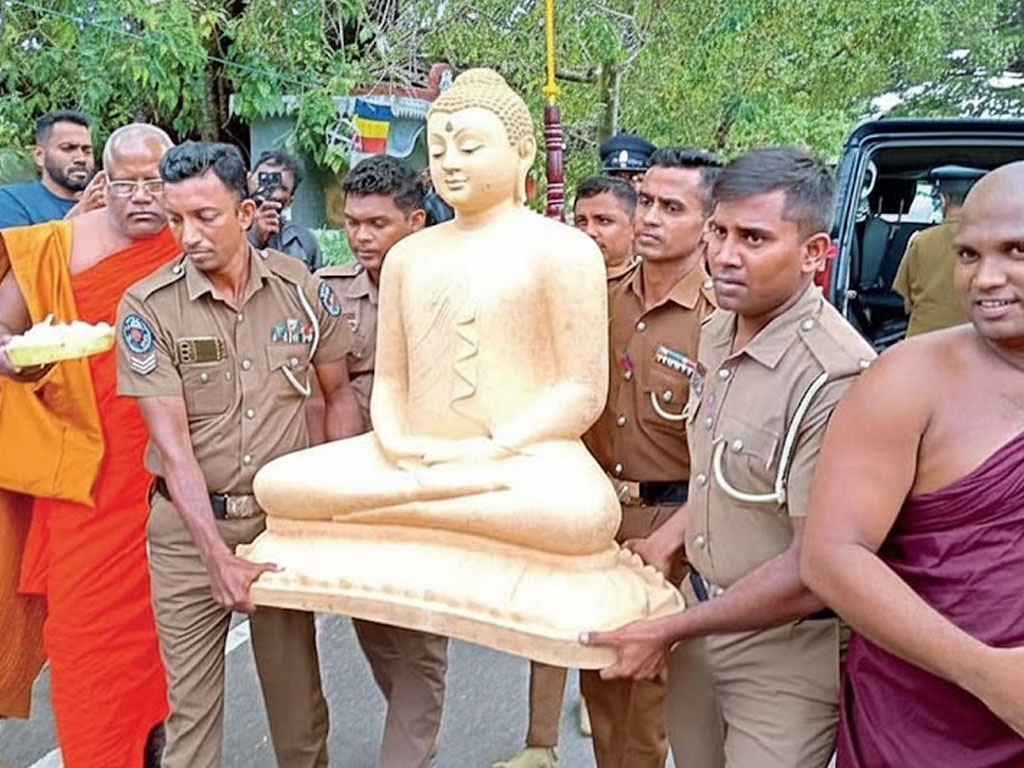
Imagine if the recent Trincomalee confrontation had occurred in reverse, with police storming a kovil, mosque or church in Colombo, Galle or anywhere in the South, dragging clergy aside and removing a statue of Jesus or Lord Vishnu. Social media activists, NGOs and Western embassies would erupt in coordinated outrage. Yet this week, when police entered a Buddhist temple premises, clashed with monks and removed a Buddha statue during a foundation stone ceremony for a Sunday school, the same loud moral guardians were largely silent. Ironically, public outrage was louder years ago when Mervyn Silva burst into a kovil to release animals meant for sacrifice.

The government said naval police intervened after the Coastal Conservation Department alleged that an unauthorised Buddhist temple was being constructed on its land. Monks rejected this claim, arguing the temple began in 1951 and received a Sacred Land deed in 2014. The Sunday School began around 1960 and was formally registered in 1996, but was destroyed by the Tsunami and never rebuilt until the current effort. It was also alleged that the sacred land deed was revoked after the current government came to power.
After widespread criticism, police returned the Buddha statue the next day, and the public security minister told Parliament it was removed for protection. That explanation suggested the multi ethnic town was at fault and did little to hide the failure to manage a sensitive issue responsibly.
In reality, the entire episode appears to be a simple legal dispute that should have been settled in court. However, reports that police acted after a ministerial phone call created the perception of political interference and triggered fears of racial tension in a region long burdened by delicate demographics.
The Buddhist clergy is not blameless. A few monks have been overly eager to build structures on contested land. While they are expected to follow legal procedure, some try to establish makeshift shrines overnight and resist court orders, as seen in the Kurunthurmalai dispute in Mullaitivu. These actions help neither Buddhism nor ethnic harmony, even though such incidents are relatively rare and often amplified to generate renewed post war Tamil grievances.
Predictably, the Trincomalee incident spilled into Parliament, where opposition MPs attempted to exploit the moment without openly provoking ethnic hostility. There is a difference between promoting racism and acknowledging Sri Lanka’s Buddhist heritage and Sinhala Buddhist majority identity, just as India recognises its Hindu majority or the United States its majority white Christian heritage. Occasionally, politicians deny this demographic reality to win applause, while others dangerously exaggerate it to agitate communities.
Still, Sri Lanka’s Buddhist historical and demographic identity cannot be erased without dismantling the State itself. Many Western nations now realise that diluting demographic heritage without balance leads to institutional and social collapse. A government must protect cultural heritage, but not at the cost of minority rights. Likewise, political factions preparing rallies have a responsibility not to turn the crisis into a race-baiting contest.
Amid the uproar, the Tamil National Alliance reaction revealed deeper issues in Tamil politics. M. A. Sumanthiran tweeted that the government returning the Buddha statue proved the NPP regime was a Sinhala Buddhist nationalist force, and demanded that all Tamil NPP members resign. This statement highlights the political pattern that shaped Tamil nationalism, militancy and ultimately suicidal terrorism.
Early Tamil nationalist politics relied on branding any Northern Tamil leader aligned with the government as a traitor. Elites competed to appear more hardline than their rivals. By the 1970s, pro government Tamil leaders became targets, beginning with the assassination of Alfred Duraiappah. The Federal Party then passed the Vadukkodai Resolution, won Northern and Eastern seats and cultivated Tamil militancy. This path birthed the LTTE, whose ambush of 13 soldiers sparked Black July. Later, TULF MPs abandoned Parliament after the Sixth Amendment, accelerating Tamil political radicalisation.
Today, TNA influence in Tamil areas is weakening as the NPP gains ground. Sumanthiran appears to be reviving the old tactic of delegitimising Tamils who work with the government. Such strategies once bred a generation of suicide bombers and risk repeating the cycle. What begins as rhetoric can consume a community and then a nation.
Sri Lanka cannot afford another descent driven by ethnic fear and political opportunism. The Trincomalee incident should be a reminder of how fragile the country’s demographic and political landscape remains.