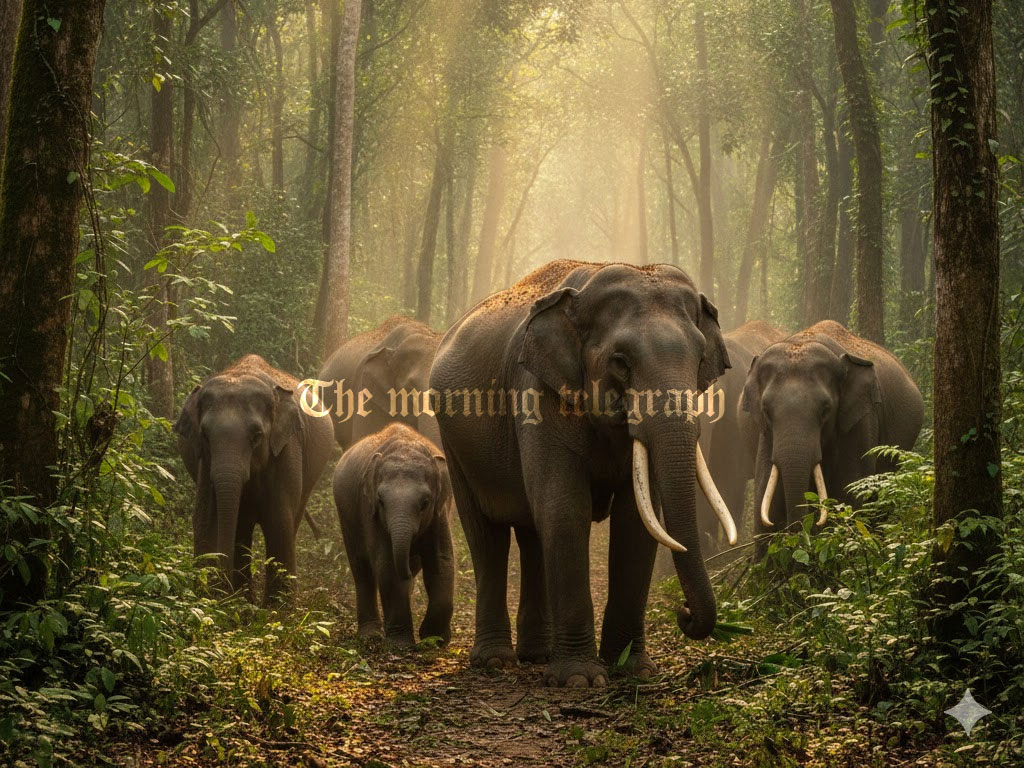
Sri Lanka’s latest elephant survey reveals a striking shift in the country’s wildlife landscape, with 7,451 elephants recorded and male and female populations now almost equal, raising new concerns about rising human elephant conflict.
According to Ranjan Marasinghe, Director General of the Department of Wildlife Conservation, the latest national elephant survey has estimated a minimum of 7,451 elephants in Sri Lanka. He announced this figure during a media briefing at the Government Information Department. He added that this number reflects only the minimum population and that the actual number of elephants roaming the country could be higher.
Survey comparisons show a steady growth in the minimum elephant population over the decades. In 1993 the estimated minimum was 1,967. By 2011 it had increased to 5,879 and by 2024 the figure rose to 7,451. Despite this growth, the structure of the population has changed in notable ways. The percentage of baby elephants below one year old, standing under three feet in height, was 23 percent in 1993. This decreased to 18.8 percent in 2011 and further declined to 16 percent in 2024, suggesting a reduction in the youngest age group.

In contrast, the adult elephant population has shown a continuous rise. Elephants over 15 years old and over six feet tall made up 52.8 percent of the population in 1993. This increased to 55.9 percent in 2011 and reached 61 percent in 2024, indicating a stronger adult presence in the national herd. Tuskers also recorded an increase. Their percentage was 11 percent in 1993, dropped to 8.4 percent in 2011, and then climbed significantly to 17.6 percent in 2024.
The gender ratio has undergone major transformation. Female elephants, which stood at 1.8 times the number of males in 1993, changed to 1.09 in 2011 and now rests at 1.04 in 2024. This shows that male and female numbers are almost equal. Wildlife authorities pointed out that while female herds cause less damage, male elephants are responsible for more property destruction and fatalities. The near equal gender ratio is therefore believed to be a factor contributing to the recent rise in human elephant conflict.
Officials also noted that the full research paper from the August 2024 elephant survey will be released within the next two weeks. Further findings reveal that elephants currently roam over 60 percent of Sri Lanka’s land area. Only about 30 percent of this land consists of protected zones while the remaining 30 percent overlaps with human settlements. This highlights that large numbers of elephants now share space with the public, intensifying encounters between humans and wildlife across the country.