A shocking investigation into the national budget exposes a brutal austerity plan where funding for schools, hospitals, transport, and public welfare is being slashed to settle a colossal debt burden, forcing ordinary Sri Lankans to shoulder an economic crisis they did not create.
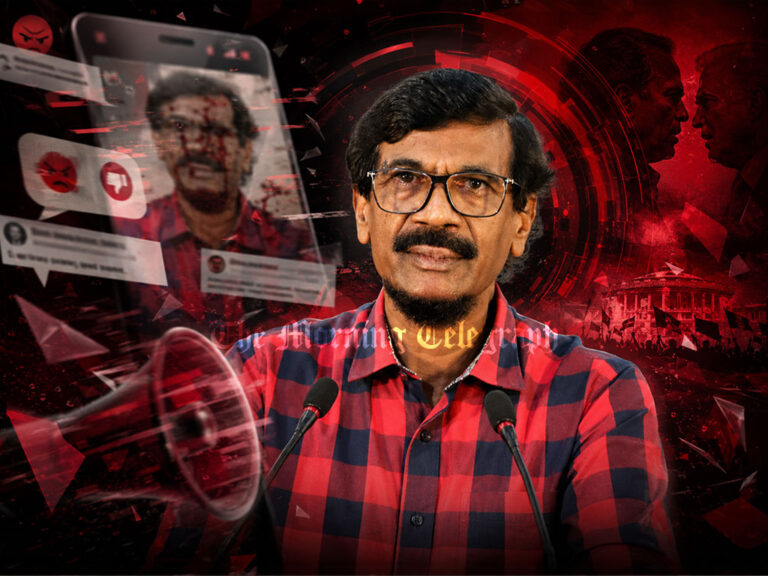
Pubudu Jayagoda, Education Secretary of the Frontline Socialist Party, warned at a media briefing that Sri Lanka now has only 1,014 million dollars in usable reserves, and that in September alone the government purchased 177 million dollars from the market. He argued that this government’s economic direction is designed so that the full weight of the crisis eventually falls on the common people.

According to him, the government proudly markets the 2026 Budget as inclusive, claiming it has considered “everyone from the street dog to the estate worker and the university student.” Yet, the parliamentary opposition, he said, agrees with the policy framework despite pointing out minor flaws. “The problem with Ravi Karunanayake is not that this government is also following Ranil’s policies, but that he is blaming Ranil instead of praising him while following those policies,” he said. He added that Harsha de Silva’s comment that “it does not matter if the people go hungry as long as the treasury is overflowing” exposes the true nature of the parliamentary opposition’s economic stance. “These guys cannot raise a single issue on the part of the common people in the budget.”
Jayagoda stressed that this year’s budget proves the government is fully committed to the IMF austerity program and that no alternative strategy for recovery exists. The government previously promised to strengthen a productive economy, expand education and healthcare, invest in public transport, reduce the tax burden, and offer relief. Instead, he said, the opposite is happening.
The President claims the tax ratio has shifted from 80:20 to 75:25, and then to 60:40. Jayagoda argues that simply using words like “direct” and “indirect” hides the real issue. The important question is how much is taxed from large capitalists versus how much is extracted from ordinary people. Of the 4,910 billion rupees projected tax revenue, 3,056 billion rupees come from goods and services regressive taxes that hit the poor hardest. A large part of the 544 billion rupees raised from import-related taxes ultimately falls back on the people through higher prices. Of the 1,120 billion rupees labeled as direct taxes, 215 billion come from workers’ income taxes and another 185 billion from withholding taxes on ordinary people’s bank deposits. Meanwhile, huge concessions continue to flow to capital owners. During the first six months of 2025, BOI companies alone received 120.6 billion rupees in tax concessions.
As taxes on the poor rise, Jayagoda warned that the government is aggressively cutting expenditures essential to the people. Capital expenditures crucial for long-term development have been deliberately slashed. Around 30% of the 2025 capital allocation was withheld merely to accumulate funds for the treasury, starving crucial sectors. The Ministry of Health diverted 60% of its funds despite a collapsing hospital system plagued with medicine shortages, outdated equipment, and understaffing. The 2026 Budget further reduces capital expenditure across multiple ministries, worsening the crisis.
Capital spending on school education is reduced from 99.3 billion rupees in 2025 to 98.9 billion in 2026. The textbook printing budget drops by 500 million rupees. Scholarships for Grade 5 scholarship winners in low-income schools fall by 45 million rupees. Students in sports schools lose 80 million rupees in nutritional meal allocations. University education also faces cuts, from 134.5 billion to 131.3 billion, with only 7.5 billion allotted to Kotelawala Defence University while public universities face systematic defunding.
Infrastructure budgets are also slashed. The Ministry of Transport, Highways and Civil Aviation sees its allocation drop from 435 billion rupees to 390 billion. The Ministry of Agriculture, Livestock, Lands and Irrigation loses 3 billion in capital funds. Even the Ministry of Industries and Entrepreneurship Development central to building a productive economy sees its capital budget reduced by one-third. Key ministries serving the public, such as Women and Child Affairs, Urban Development and Housing, Labour, and Plantations, face further cuts. Jayagoda argued that this is how “the treasury is being filled on the backs of the people.”
He warned citizens not to fall into what he called “Ranil Wickremesinghe’s debt restructuring trap.” He said that when examining the budget, it becomes clear why Wickremesinghe had previously requested the creation of an alternative debt-restructuring strategy. Of the total government expenditure of 8,980 billion rupees, including debt service 4,495 billion rupees, more than half, go exclusively toward interest payments. The government then collects tax revenue to buy dollars and repay foreign loans, placing enormous pressure on the local currency.
Sri Lanka’s foreign reserves, he said, remain in a dangerously weak state. On December 31, 2024, reserves stood at 6,091 million dollars. By September 30, 2025, reserves were 6,243 million an increase of only 152 million dollars in nine months. To reach the IMF target of 7,174 million dollars by December 31, 2025, Sri Lanka must find 931 million dollars around one billion in the remaining three months, which he said is impossible under current conditions.
He warned that what is occurring is a vicious cycle: the government borrows to settle existing debts, drains rupees from the people to buy dollars, then forces the public to endure austerity.
Of the 6,243 million dollars in reserves:
• 1,359 million dollars are Chinese debt
• 900 million dollars are Indian debt
• 580 million dollars are IMF debt
• About 2,400 million dollars are commercial bank debts that must be repaid soon
This leaves only 1,014 million dollars as usable reserves. Jayagoda highlighted that even these funds are largely dollars that the government purchased directly from the domestic market, draining liquidity. “In September alone, 177 million dollars have been purchased,” he said.
Jayagoda warned that the government is pushing the nation down a path that will impose the full burden of the crisis on ordinary people, dragging them into “a frying pan” as austerity deepens. He argued that the current administration and the parliamentary opposition both support the same IMF-driven policy framework, differing only in rhetoric. “The opposition is applauding the public and making excuses as if the pace is not fast enough.” He concluded that the people must build “an opposition outside Parliament,” as the formal opposition cannot and will not challenge the economic policies harming the public.